
This Policy Brief is based on a speech by Ignazio Angeloni at the Digital Assets Summit 2026, Cyprus, 7 July 2026. The views expressed are those of the author and not necessarily those of the institutions the author are affiliated with.
Abstract
Stablecoins are the most prominent “new entry” in the payment universe. Unknows a decade ago, they are now central to all discussions on the future of payment systems. I argue that stablecoins as presently designed are not adequate to perform the function of general payment means. Key prerequisites that such instruments must possess are general acceptance, singleness and stability. All payment instruments in use today (private, like bank deposits, or public, like banknotes or bank reserves) enjoy those properties either because they coincide with central bank money, or because are freely convertible into it at no cost. Stablecoins have none of those properties. However, tokenization and programmability, which stablecoins possess because of the distributed ledgers on which they are recorded and exchanged, are valuable and likely to become standard options in certain categories of payments. The most promising avenue therefore consists of combining those new features with mainstream instruments protected by legacy safety nets. There are signs that market participants may already be moving in this direction.
The payment industry has changed dramatically in recent years, for the better, saving time and increasing security for all: retailers, companies, banks. Yet, as I read the literature on payment issues circulating everyday online, especially from market sources, I see two misconceptions.
First, the current system is described as hopelessly inefficient, slow and cumbersome. In need of radical change. I interrogated AI on the state of the payment system. The answer was: “The payment revolution is just beginning”. My artificial interlocutor did not even spend a word on the improvements already occurred. Maybe this proves that even AI can be wrong.
The second misconception is that innovation in payments is always for the better. Let me be clear: innovation is essential for progress. Because it requires experimentation, even failed innovation is useful, indirectly. But not all innovation deserves to survive, and in fact not all innovation does survive. From Schumpeter to his modern followers, three of which have received the Nobel prize this year, we know that creative innovation requires abandoning inferior techniques. This is true for payments like for any economic sector.
My point here is that stablecoins, in their present form, are not a very promising form of financial innovation.
Stablecoins are the most prominent “new entry” in the payment universe. Almost nonexistent before the pandemic, they are now central to all discussions about payments. Views are divided. According to some, they are the frontrunners of the monetary system of the future. For others, they are another example of financial madness. Where is the truth? Is it at one of these extremes, or somewhere in between?
We need to consider two separate questions:
Theory and experience demonstrate that a good monetary instrument must possess certain characteristics.
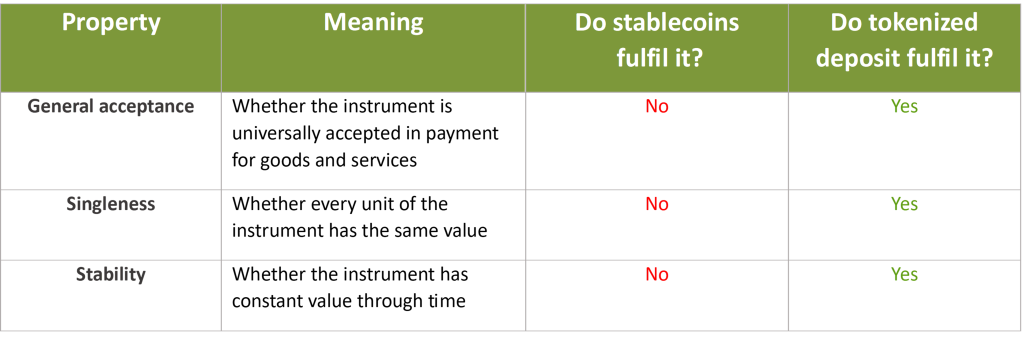
The most important one is general acceptance: in order to agree to receive an instrument in payment, people must be confident they will be able to give it out in the future. This is a self-fulfilling process. The more people use a given form of money, the more others will accept it because they know they can give it away later. This “network externality”, favors incumbents. Initially new forms of money struggle to be accepted, but then a virtuous circle may set in whereby they become increasingly popular. All digital instruments popular today – cards, smartphone applications, PayPal, etc. – went through this cycle, initially challenging incumbents and then becoming incumbents themselves.
General acceptance requires two characteristics.
One is “singleness”. Every unit must be equivalent to any other, otherwise it cannot provide a good measure of value. Payment instruments have this property if they are convertible without limit in central bank money at a fixed rate. Central bank money (banknotes, bank reserves) is the trusted standard of value. Bank deposits are guaranteed a constant value by contractual arrangements that guarantee convertibility with no limit. The deposit contract is also backed by a deposit guarantee backed by the government.
The other condition is stability. Money’s value must be certain and reliable. Nobody wants to hold a “money” whose value changes at any point in time, because this makes holding risky and use for future transactions doubtful. Money is a bridge in time: I accept money today counting on the fact that I can use it in the future. Stability in value is an essential condition for that bridge to be solid.
General acceptance; singleness; stability: in the simplest possible terms, these are the benchmarks we must use to judge if a monetary instrument is, or is not, adequate for payments.
Stablecoins barely existed before 2020. Stablecoins rose initially as an ancillary instrument of other crypto assets, largely bitcoin. Traded on the same crypto platforms, stablecoins are the “money” that crypto holders conveniently use when transacting in and out of other crypto instruments. This is the main function they still have today.
One interesting measure of popularity is the frequency of quotes in the internet, which we can obtain from Google Trends. The frequency of quotes of stablecoins in the web is highly correlated with political events: Russia’s invasion of the Ukraine, Trump’s second term in the White House. As well known, the Trump administration made stablecoins a center piece of the administration’s financial policies. It is never a good sign when a financial instrument is propped up for political reasons. The GENIUS Act regulating stablecoins in the US was passed by Congress in July last year; this coincided with a peak in the popularity of the instrument. In spite of that, stablecoin capitalization remains relatively small: barely above 300 billion UD dollars. Far from increasing, it has flattened out lately.
Stablecoins are private, tokenized assets exchanged in blockchains on distributed ledgers. “Private” means that they are issued by private intermediaries, banks or other. “Tokenized” means that their property and other characteristics are bundled in a digital token. “Distributed” are ledgers in which all participants have access and over which have some control. Finally, “blockchain” denotes the way transactions take place, not one transaction at a time in batches (“blocks”), requiring an algorithmic procedure to be validated.
Financially speaking, stablecoins are assets whose value is backed by portfolios of liquid collateral, mainly bank deposits and treasury bills. The collateral supports the peg to an official currency: one stablecoin is supposed to always equal one dollar, or one euro. Collateral pools are regulated by law; respectively, MiCA in the EU, which is already in force, and GENIUS Act in the US, which will enter into force next year.
It is important to understand that these characteristics (private issuance; tokenization; distributed ledgers, blockchain) are not inextricably linked. They can be separated. It is possible to have private money which is neither tokenized or exchanged on distributed ledgers; for example, bank deposits. It is also possible to have public money traded on a distributed ledger, though this is less common. The project Pontes launched by the ECB, whose pilot is to go live later this year, consists of tokenized central bank money exchanged on a permissioned distributed ledger.
I am getting closer to my central point. Let’s consider again the three aforementioned criteria – general acceptance, singleness, stability.
As of today, stablecoins are not generally accepted. Not yet, perhaps? Could they be in the process of becoming incumbents, like others have done? I doubt it. For one, exchange on distributed ledgers is cumbersome, slow and costly, not suitable for daily transactions. Stablecoins remain largely confined to crypto circles. They are also popular for criminal activities, not a good premise for general acceptance.
Stablecoins fail to fulfil the other two conditions as well.
Being private assets backed by collateral, their value depends on the creditworthiness of the issuer. Like banknotes in the “free banking” era of the 19th century were subject to a risk discount, so stablecoins prices oscillate and differ from one another depending on the trust enjoyed by the issuer. The “singleness of money” is jeopardized.
In spite of their name, stablecoins are not guaranteed to remain stable in time either. Unlike for bank deposits, whose contractual value is stable and protected by a deposit guarantee, no similar protection exists for stablecoins not is it foreseen to be put in place by regulators, either in Europe or elsewhere.
For the reasons I have briefly outlined, stablecoins as presently designed are unlikely to exit their narrow boundary and acquire general use. This is particularly true for retail, because retail traders value stability and certainty more than anything else. But the same problems also make their use for wholesale transactions problematic.
That said, certain features are promising and likely to find broader applications. Tokenization allows for efficient asset exchange by bundling and trading together contractual characteristics and facilitating programmability. Bundling and programmability are not necessary everywhere, but can be useful in certain contexts. They reduce costs and speed up transactions in situations where multiple contractual characteristics are conveniently traded together. At the same time, structured trades are also more rigid. My impression is that tokenization may become important in some areas, but will never be pervasive in the broader financial system.
The advantages of tokenization can be exploited in combination with features of the mainstream monetary sector and the associated prudential framework. The market is moving spontaneously in this direction. Recently, it was announced that a group including the largest US banks has created a consortium to launch tokenized deposits, which combine the traditional safety net surrounding bank deposits, including federally backed insurance, with exchange on a permissioned blockchain. The project, with a network among the participating banks acting as clearing house, is designed to serve the wholesale payment needs of large corporations. In Europe, the ECB project Pontes will add a distributed ledger onto Target, its payment infrastructure among central bank counterparties. This will make tokenization and programmability of central bank money possible.
These steps are in the right direction.
Crypto markets have appeared puzzling on occasions in recent years, even contradicting economic logic. But eventually market innovation – especially if well regulated, which also means not excessively regulated – can be counted on to move in the right direction. I think stablecoins will eventually prove useful, even if elements of them are discarded.
Table 1. Properties of a good monetary instrument