

This policy brief is based on Banca d’Italia Occasional Paper No 996. The opinions expressed are those of the authors and do not necessarily reflect the views of the Bank of Italy, the European Central Bank or the Eurosystem. All remaining errors are our own.
Abstract
This paper provides new evidence on how firms invest and reallocate capital, using a novel dataset covering the universe of firms’ vehicle transactions in Italy (2015-2023). We show that leasing accounts for about half of vehicle acquisitions and is particularly important for financially constrained firms. Younger firms rely heavily on used capital. We observe significant segmentation in the market for used vehicles: direct transactions between firms occur predominantly within the same industry and geographic region, as well as within similar productivity deciles. Dealers’ involvement in a transaction lead to more extensive reallocation of vehicles across industries, geographic regions, and productivity levels, suggesting that dealers facilitate capital reallocation.
Business investment is central to economic activity and long-term growth, yet understanding firm-level investment decisions is constrained by several limitations of the available data. Aggregate expenditure figures in financial statements only partially reflect firms’ investment behavior, as they do not specify the types of assets acquired or distinguish between investments in higher-quality assets, new capital goods, or used equipment from the secondary market.
A further limitation is that financial statements typically record only net asset purchases, omitting assets acquired through leasing. Leased assets, however, also contribute to firms’ production capacity. This raises a key question: to what extent do firms use outright purchases as opposed to leasing or rental arrangements?
Addressing these issues is crucial for understanding how firms develop productive capacity and for assessing implications for productivity. In a recent study (Crispino, Loberto, Pavanello, and Sette, 2026), we provide new evidence by exploiting comprehensive microdata on motor vehicle transactions in Italy, including leasing activity. According to National Accounts data, motor vehicles represent about one-fifth of total investment in equipment, and for some industries, in particular logistics and transportation, this figure exceeds 70%. In addition, they are used across a wide range of sectors and vary from standard passenger cars, a non-specific, easy-to-redeploy type of capital, to highly specialized vehicles such as garbage trucks.
By leveraging detailed administrative records that track the entire lifecycle of each registered vehicle – from acquisition (purchase or lease) to final disposition – we document firm-level investment behavior with unprecedented granularity. This allows us to shed new light on the composition of business investment and the role of leasing in firms’ capital accumulation.
This study draws, for the first time, on the Italian national vehicle registry. The registry records all purchases and leases of new vehicles, transfers of ownership and imports of second-hand vehicles, long-term rentals, and vehicle cancellations in Italy.
Based on this source, we build a novel dataset that tracks each vehicle over its lifecycle through its unique identification number. The analysis is based on transactions made from 2015 to 2023 by non-financial firms that use vehicles in production. We exclude dealers, leasing companies, and vehicle manufacturers. The dataset includes about 5 million transactions involving roughly 1 million firms and 4 million vehicles (of which about 40 percent are commercial vehicles and trucks).
A first key finding is the widespread use of leasing (see figure). In 2023, purchases of new vehicles accounted for about 13 percent of acquisitions. Including used vehicles raises the share of purchases to less than 50 percent, implying that most vehicles are acquired through leasing. Leasing is especially common for passenger cars, but it is also substantial for commercial vehicles (around 36 percent).
This finding is important because traditional investment measures typically focus on outright purchases, potentially understating the amount of capital actually used by firms. Leasing is especially relevant for smaller or financially constrained firms. Excluding leased assets results in an incomplete understanding of capital deployment across the economy.
Leasing is not a special feature of motor vehicles, as it is also relevant for other types of capital goods. For example, leasing accounts for about 10 percent of investment in machinery and equipment,1 and survey evidence2 suggests that a significant share of firms (approximately 32 percent) uses leasing for non-vehicle capital as well.
Figure 1. Vehicles’ acquisition arrangement
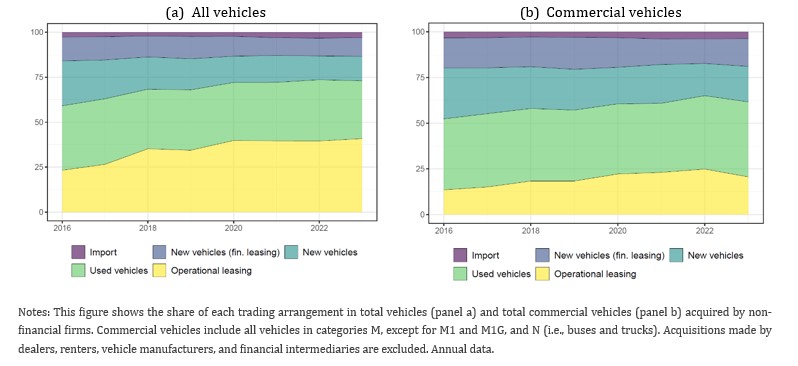
Firms’ vehicle acquisition modes are closely associated with their financial conditions and risk profiles. Financially constrained or riskier firms tend to favor leasing over purchasing. When they do purchase, they are more likely to acquire used than new vehicles.
Younger firms rely heavily on the second-hand market. At the same time, some large firms also acquire most of their vehicles through rental agreements.
These patterns suggest that investment statistics based solely on purchases may misrepresent the capital actually used by different types of firms. Firms with diverse characteristics acquire assets of varying quality and rely differently on leasing. As a result, relying exclusively on monetary measures of investment from balance sheets or surveys to estimate the elasticity of investment expenditure can produce biased results, as such measures do not account for the interplay between firm characteristics, acquisition mode (purchase versus leasing or rental), and capital quality.
Many firms, particularly younger ones, rely on the market for used capital goods, making it essential to understand how this market reallocates assets among firms.
The data reveal significant market segmentation. Direct transactions between firms occur predominantly within the same industry and geographic region. This is surprising as motor vehicles are easy to move and, in most cases, a non-specific type of capital, which can be relatively easily employed across different industries. This points to the presence of significant frictions, also related to the quality of the used capital goods, which hinder reallocation.
In contrast, transactions involving intermediaries facilitate broader reallocation of capital goods across industries and regions. Intermediaries also enable larger asset flows from large to small firms and between firms with differing productivity levels. Specifically, they support the transfer of assets from high-productivity sellers to lower-productivity buyers, thereby enhancing capital reallocation within the economy.
The data also provide insights into the adoption of new technologies, specifically electric vehicles. The share of electric vehicles has increased substantially in recent years, although adoption remains uneven.
Leasing is more frequently used for electric vehicles, while purchases of second-hand electric vehicles are still limited, possibly also reflecting their relatively recent introduction. Younger and more profitable firms are at the forefront of this transition, suggesting that leasing may reduce barriers to experimentation with and adoption of new technologies.
Traditional investment measures based on financial statements do not capture the full extent of capital used by firms and may underestimate the role of leasing. This study highlights the importance of considering both acquisition modes and asset characteristics to better understand investment behavior. While not accounting for leasing may have limited effects for estimates of aggregate investment in the overall economy, it makes a substantial difference when it comes to studying investment by industry and by firm type. Analyses of the distribution of investment across firms and industries may be substantially biased if they do not take into account leasing, as an acquisition mode of capital by firms.
Moreover, we document that capital reallocation is shaped by frictions and market structure, and that intermediaries play a key role in facilitating the reallocation of assets across firms.
Improving the measurement of investment and better understanding the mechanisms of capital reallocation are essential for designing policies that support productivity growth, efficient resource allocation, and technological adoption.
Marta Crispino, Michele Loberto, Carlo Pavanello, and Enrico Sette, 2026, New evidence on business investment and capital reallocation, Questioni di Economia e Finanza (Occasional Papers), Bank of Italy, Economic Research and International Relations Area, number 996.
Report by the Italian National Association of Leasing Companies (ASSILEA).
Bank of Italy’s annual Survey of Industrial and Services Firms, 2023.