

This policy brief is based on Fuster, Gianinazzi, Hackethal, Schnorpfeil and Weber (2026), “The Response of Debtors to Rate Changes.”. The views expressed are those of the authors and not necessarily those of the institutions the authors are affiliated with.
Abstract
How do the higher interest rates since 2022 transmit to households whose mortgage needs to be rolled over? Combining data from a large German bank with a borrower survey and a letter randomized control trial (RCT), we show that mortgagors’ actions substantially reduce the impact of higher rates on monthly payments when their rate fixation ends. Survey responses indicate high informedness and a strong propensity to prepare, while the latter increases awareness of available options and raises refinancing activity among borrowers close to expiration. Overall, financial strains on mortgagors appear limited despite much higher rates, and mortgagors’ anticipatory actions affect the transmission of monetary policy.
The sharp rise in inflation after the pandemic led central banks to tighten monetary policy rapidly. Mortgages are one of the main ways these rate changes reach households and the wider economy. In many countries, mortgage rates are fixed for several years. This slows the pass-through of policy tightening to existing borrowers but does not eliminate it: when the fixed-rate period ends, many households must refinance at prevailing market rates.
In such an environment, the key question is not only how much interest rates rise, but also how borrowers respond before the reset occurs. If households prepare in advance, they may dampen transmission. If they do not prepare, the rate reset can generate financial strain and, possibly, risks for financial stability.
In recent work (Fuster et al. 2026), we study how mortgage borrowers prepare for and respond to changes in borrowing costs. We focus on Germany and combine three sources of evidence: loan-level administrative data from a large bank, an online survey of the bank’s mortgagors, and a randomized field experiment in which the bank sent an informational letter to a subset of mortgage customers. Together, these data provide a detailed picture of what borrowers know, what they do before refinancing, and how much those actions change the realized pass-through of higher rates.
German mortgages offer a useful setting for studying these questions. Mortgage maturity and the interest-rate fixation period are distinct. A loan may typically amortize over 25 to 35 years, but the interest rate is often fixed for only 5 to 15 years. When that fixation ends, borrowers usually refinance the remaining balance.
This structure matters because the refinancing event is foreseeable. Borrowers can often take out a forward mortgage and lock in a future rate up to four years before the reset date. At refinancing, they may also reduce the outstanding balance or adjust the speed of amortization by choosing a different loan term. In other words, the future payment reset is not just predictable; it is also, to an important extent, manageable.
That creates room for anticipation. A borrower who expects much higher rates can react by locking in a rate early, paying down part of the balance, or slowing down debt repayment. These margins of adjustment imply that the eventual effect of tighter monetary policy on household cash flow is not purely mechanical.
Our bank data follow mortgagors through May 2025 and include information on loan terms, balances, payments, and refinancing choices. When a borrower refinances internally, we can link the old and new contract and observe how the new monthly payment compares with the old one.
To assess the role of borrower action, we compare realized payment changes with a passive counterfactual. In that counterfactual, the borrower simply rolls over the remaining balance at expiration and does not make extra repayments or alter contract terms. The difference between the realized outcome and this passive benchmark captures how much borrowers alter the effect of higher rates through their own decisions.
The result in Figure 1 is clear. For loans expiring from the second half of 2022 onward, when the rate environment had shifted sharply upward, passive refinancing would have raised monthly payments by EUR 87 per month on average, or EUR 1,044 per year. The realized increase is much smaller: EUR 23 per month, or EUR 276 per year.
Figure 1. Changes in monthly payments following internal refinancing
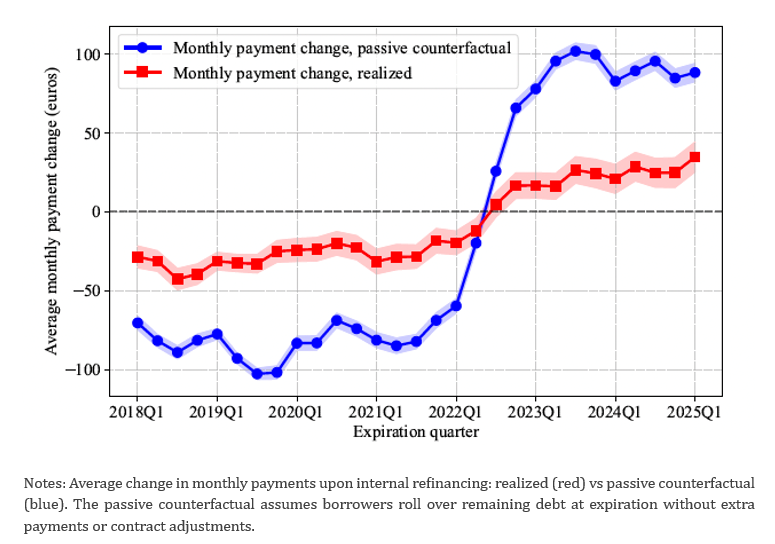
This gap shows that the pass-through from market rates to household payments is heavily shaped by borrower behavior. Borrowers do not simply accept the new rate. Many reduce the balance they refinance, choose loan terms that lower the immediate payment burden, or lock in rates before the full increase in market rates materializes.
The low-rate period before 2022 is also informative. During those years, realized payments often exceeded the passive counterfactual. The main reason is that borrowers used lower rates to shorten the maturity of their loan and repay faster. This pattern is consistent with monthly payment targeting (Argyle et al. 2020): when rates fall, some borrowers keep payments roughly stable and use the lower rate to amortize more quickly.
Administrative data reveal what borrowers do, but not always why they do it. To better understand beliefs and preparation, we surveyed a subset of borrowers in late 2024. Three findings stand out.
First, most respondents are aware that mortgage rates rose sharply since 2022. Their perceptions of current mortgage rates are generally accurate, and many expect rates to remain elevated rather than quickly return to the low levels seen earlier.
Second, most borrowers say they prepare for the end of the fixation period. Preparation takes several forms. Some respondents report gathering information about their options, some build up savings, some consider partial repayments, and others look into locking in future borrowing rates. Not all of these actions are visible in the bank data.
Third, a vignette experiment embedded in the survey shows that preparation is forward-looking and state-contingent. When respondents are presented with hypothetical refinancing scenarios, they react more strongly when the increase in rates is larger and when the refinancing date is nearer. This is the pattern one would expect if borrowers pay attention to the size and timing of the upcoming reset and adjust accordingly.
The survey also helps identify who is less prepared. The minority of borrowers who report not preparing are more likely to be less aware of rate increases and to have smaller outstanding balances. This is consistent with a rational-inattention story (Mackowiak et al. 2023): borrowers with more at stake have stronger incentives to pay attention.
To study the role of attention and awareness, we partnered with the bank to run a RCT in November 2024. The bank sent an informational letter to more than 35,000 mortgage customers. The letter explained that mortgage rates had risen, illustrated how higher rates could affect monthly payments after refinancing, and described options borrowers could use to cope, including partial repayments, forward loans, and higher savings.
The survey conducted about a month later shows that the letter had little effect on average beliefs about current mortgage rates or expected payment increases. This is consistent with the survey evidence of high baseline awareness: many borrowers already knew that rates had gone up.
At the same time, the letter did increase familiarity with specific mortgage features. In particular, recipients became more aware of partial prepayments and the option to lock in rates early through forward loans. So the letter did not shift broad beliefs about the rate environment, but it did improve knowledge of concrete tools borrowers can use.
We then turn to realized behavior in the bank data over the six months after the mailing. Average treatment effects are limited in the full sample. But that masks meaningful heterogeneity. Among borrowers whose fixation period is close to ending, the letter significantly increases refinancing activity. For this group, the information arrives at a moment when action is both relevant and feasible.
The experiment also reveals an important limitation of communication policy. Borrowers who report reading the letter are positively selected: they tend to have larger loans, higher income, higher self-reported financial literacy, and more accurate prior beliefs about rates. That is, the borrowers most likely to engage with lender communication are often those who are already relatively well-informed. This makes it harder to reach the less attentive households for whom such information may matter most.
The broader lesson is that the transmission of monetary policy through household debt depends not only on contract structure, but also on borrower preparatory behavior. In settings where mortgage rates reset infrequently, a large share of the adjustment may happen before the reset date. Borrowers can lock in rates early, reduce balances, build precautionary savings, or adjust repayment plans. These actions can materially reduce the eventual hit to monthly payments. This matters for two reasons. First, it implies that the effect of higher policy rates on household cash flow may be weaker than a passive benchmark suggests. Second, it means that financial stability risks linked to refinancing may be more muted, at least in environments where borrowers are informed and have room to act.
That does not mean informational frictions are irrelevant. Our evidence shows that communication can improve knowledge of specific options and can affect behavior for households close to refinancing. But it also shows that the least informed borrowers are often the hardest to reach. For lenders and policymakers, this suggests that general information campaigns may have limited effects unless they are timed well and designed to engage households that are otherwise less attentive.
The recent rise in interest rates creates a natural test of how mortgage borrowers respond when their fixed-rate period ends. Our evidence from Germany shows that borrowers do not passively absorb higher refinancing rates. Instead, many take anticipatory actions that substantially reduce the increase in monthly payments relative to a simple rollover benchmark.
Survey evidence indicates that most borrowers are aware of the changed rate environment and actively prepare for future refinancing. The letter experiment shows that information can matter, especially when refinancing is imminent, but also that communication tends to be read by borrowers who are already relatively informed.
Overall, the financial pressure on mortgagors appears considerably smaller than one might conclude from looking only at market rates. The mortgage channel of monetary policy therefore depends not only on interest rate movements themselves, but also on how borrowers anticipate and respond to them.
Argyle, B. S., T. D. Nadauld, and C. J. Palmer (2020). “Monthly Payment Targeting and the Demand for Maturity.” Review of Financial Studies, 33, 5416–5462. URL: https://academic.oup.com/rfs/article-abstract/33/11/5416/5713526?redirectedFrom=fulltext
Cloyne, J., C. Ferreira, and P. Surico (2020). “Monetary Policy When Households Have Debt: New Evidence on the Transmission Mechanism.” Review of Economic Studies, 87, 102–129. URL: https://academic.oup.com/restud/article-abstract/87/1/102/5272505?redirectedFrom=fulltext
Fuster, A., V. Gianinazzi, A. Hackethal, P. Schnorpfeil, and M. Weber (2026). “The Response of Debtors to Rate Changes.” NBER Working Paper 34752. URL: https://www.nber.org/papers/w34752
Mackowiak, B., F. Matejka, M. Wiederholt (2023). “Rational Inattention: A Review,” Journal of Economic Literature, 61, 226–273. URL: https://www.aeaweb.org/articles?id=10.1257/jel.20211524