

The views expressed are those of the authors and not necessarily those of the institutions the authors are affiliated with. Support by Maurizio Marinaro is gratefully acknowledged.
Abstract
The monetary system is currently undergoing major structural change, in particular due to the rapid advance of digital payment instruments. The purpose of this note is to summarise the main themes of a recent SUERF Baffi Bocconi event and to outline potential future paths. The webinar examined how the rise of stablecoins (SCs) and central bank digital currencies (CBDCs) is reshaping money in its two core roles — store of value and means of payment — and what this implies for banks, central banks, and the wider financial system. We start with a summary of the current situation in digital payment markets. Based on the panel contributions we then take four complementary perspectives on digital money: Resilience and sovereignty, the settlement infrastructure for tokenized finance, remuneration of money, and the political-institutional choices ahead. We close by outlining three scenarios for payment practices in 2035, such as agentic payments.
Digital assets are traded, used and stored digitally. They use a secure technology to make payments and record ownership on a centralised or distributed ledger. Due to their materiality at the time of writing we focus on stablecoins (SCs) and central bank digital currencies (CBDCs) as major money-like digital instruments. In contrast, Bitcoin is a (highly) speculative digital instrument without cashflows. It is only popular among retail investors.1
A CBDC can be defined as a “digital banknote”. It is issued by a central bank for settlement of e.g. retail payments.2 At the moment, around 80 countries globally are exploring the introduction of a CBDC. For retail deployments, early adopters are The Bahamas (“Sand Dollar”) and Jamaica (“JAM-DEX”). The Eurosystem is currently looking into the possible issuance of a digital euro. After a preparation phase from November 2023 to October 2025, technical work is advancing. The Eurosystem has selected a group of providers to help build the digital euro platform. This group will deliver key building blocks of the system and comprises private companies chosen via public tenders together with six national central banks. Should EU lawmakers adopt the regulation in the course of this year, the digital euro could be issued in three years.3 In the US, the Trump administration has suspended work on a Digital Dollar.
A stablecoin (SC) is a crypto asset issued by private non-bank with its value pegged to a fiat currency such as the US$. In contrast to a CBDC, a SC doesn’t make use of the state’s balance sheet (unless SCs would be able to obtain central bank access). Outstanding amounts are shown in Chart 1. To put these magnitudes into perspective, the SC market is a tiny share of US T-Bill issuance, a key “money-like” safe asset, where the total outstanding balance is $6.76 trillion.4 SC is often used as a means of storing value within the crypto market.5 Hence it often serves as a medium of exchange between different digital instruments and trading platforms rather than a broad-based store of value such as Money Market Funds. Tether US$ dominates the global SC market with a share of around 65% (Chart 1). Tether is officially domiciled in El Salvador. A material share of the underlying assets backing the SC lack robust safe-asset properties: According to the latest release 3.4% of the underlying assets are held in Bitcoin (an instrument with a notably very high volatility) and 10% in precious metals (which have also recently shown very high volatility).6 SC regulation in the US is provided by the GENIUS act. The upcoming CLARITY Act is expected to clarify whether USD stablecoins can continue to offer interest-like payments on balances via exchanges, with the latest version proposing a ban. This may determine the ability for stablecoins to compete as an alternative to tokenised bank deposits, and whether the mix of banking system deposits shifts from retail to wholesale. EU regulation is provided by the MiCAR framework but so far there is no material issuance of MiCAR-compliant stablecoins. In contrast to the US framework7, EU rules require at least 30% of a SC’s reserves to be deposited in segregated bank accounts.
Finally, the digital asset market also offers tokenised deposits. These deposits are held at a commercial bank similar to standard bank deposits, but they are recorded on a blockchain. So far no economically relevant magnitudes are observed in this category.8
Chart 1. The global SC market9
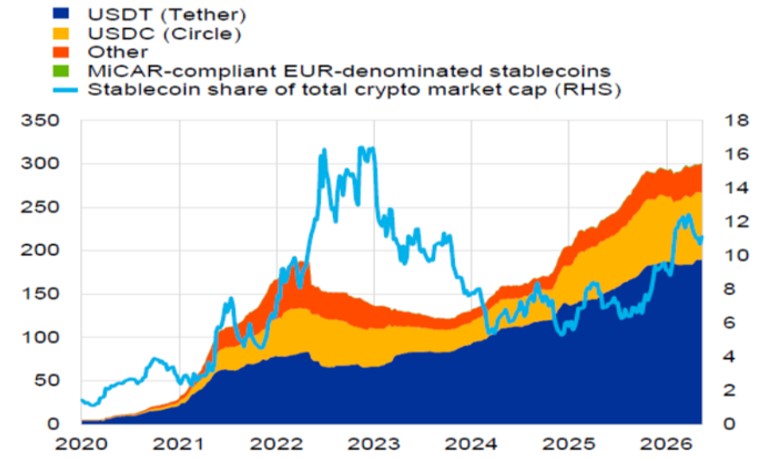
Source: CoinDesk, IntoTheBlock, CoinMarketCap.
Notes: Circulating supply used for stablecoin market capitalisation. Lates observation: May 2026
In this section we summarise the main themes of the panel discussion and we draw out some common themes.
Brunnermeier (Princeton University) considers digital money as a question of resilience and sovereignty. He argued that a lack of resilience erodes three interconnected sovereignties: monetary (a central bank’s grip on the macroeconomy, lost through silent “digital dollarization/euroization” toward a foreign unit of account), digital/cybersecurity (the ability to operate, audit, and if needed switch off the payment rails, lost when the back-rail is foreign and becomes a choke point), and financial (domestic access to credit on domestically governed terms, lost when credit allocation migrates to foreign BigTech platforms).
He distinguished a resilience approach (the flexible “reed” — takes risks, dampens amplification, recovers by bouncing forward) from a robustness approach (the rigid “oak” — resists change, relies on fixed rules). Because resilience is effectively a public good, private platforms underprovide it — especially against tail risk. He proposed a tiered architecture: a maximally resilient public back-rail (Layer 1, e.g. India’s UPI, Brazil’s Pix, a digital-euro settlement layer), diverse private money on top that is allowed to fail onto the public rail (Layer 2, mirroring deposit insurance + lender of last resort), and cash as the deep fallback (Layer 3). UPI was offered as proof of concept: an open, free, interoperable public rail carrying 80%+ of retail digital payments, on which private wallets compete and fail without systemic disruption. He stressed the value of uniformity of currency (“many issuers, but one money”) and closed with the Payment–Credit–Privacy trilemma:11 you cannot simultaneously have perfect payments, perfect credit, and perfect privacy — a “smart CBDC” competes with private credit but sacrifices privacy, while a “privacy CBDC” undermines perfect credit.
In his intervention, Duffie (Stanford University) emphasised that when finance moves on-chain, it needs a safe settlement asset to deliver the technology’s benefits without reintroducing settlement risk. He illustrated this with smart-contract, payment-versus-payment settlement of a tokenized FX trade, where each leg is cryptographically conditioned on the other (citing Project Jura, SNB–Banque de France, and Project Cedar, NY Fed–MAS), and with atomic delivery-versus-payment settlement of a US Treasuries trade executed on Canton in August 2025 using tokenized Treasuries against USDC.
He then catalogued the candidate safe monies for on-chain finance: tokenized central bank deposits (SNB); synchronization of a programmable asset ledger with RTGS settlement in conventional central bank money (under testing at the ECB, Bank of England, and SNB); narrow banks issuing tokenized deposits (e.g. Finality); and stablecoins backed by assets whose market value stays essentially at one unit of account — including daily-auctioned government notes12 and money-market funds invested only in overnight Treasury repos. The unifying point: tokenization and atomic settlement are valuable only if the cash leg is genuinely riskless.
Bindseil (TU Berlin) argued against any rule prohibiting interest on readily available money. He began with definitions, distinguishing “money” (usable any time at par, without liquidity or market risk) from “invested money” (a future cash flow that may carry risk), and noted the ambiguity in how “interest” is defined, including MiCAR’s very broad wording that treats any time-related benefit on a stablecoin as interest.
Tracing the history of thought — usury laws, Gesell’s stamped (negatively-yielding) money that Keynes praised, Friedman’s optimum-quantity argument, and the Black–Fama debate under Regulation Q — he reviewed how the four forms of money are treated today: sight deposits (Reg Q banned interest until its 1982 phase-out), central bank reserves (interest on reserves in the US since 2008/2011; the Eurosystem only generalizing automatic remuneration of excess reserves at the deposit-facility rate from 17 June 2026), CBDCs, and stablecoins. On CBDC remuneration he described an “unholy alliance” of opponents — financial-repression sceptics fearing negative rates, banks fearing competitive positive rates, and central banks willing to compromise to get a CBDC at all. On stablecoins he noted that prohibitions (MiCAR, the Genius Act) are leaky, with roughly $86bn of $290bn already remunerated via lending protocols. His conclusion: in a fully digital, 24/7 world, forcing money’s liquidity premium to swing with short-term rates has no economic rationale and breeds instability; a quantity-constrained CBDC would be a “reversal of values” placing public money under restrictions that private money escapes.
Ingves (Swedish House of Finance) took the long historical and political view: most things have been tried before, technologies change but the basics do not, and money is ultimately a convention — accepted because enough people accept it. He reminded the audience that centralized ledger technology is ancient (Banco di Napoli since 1539) and normally superior to DLT, which can also run 24/7; the real obstacle has been conservative, oligopolistic incumbents who control the system (back-end rails like Target/T2S/TIPS, front-end networks like Visa, Mastercard, PayPal, Apple Pay).
Surveying the DLT design space — permissioned vs. permissionless, the role of legal frameworks (Genius, MiCA) in defining product and provider, smart contracts, AML/CFT, legal-entity type — he laid out the menu of digital-money products (wholesale/retail CBDC, de facto 100%-reserve CBDC, stablecoins of various reserve backing, tokenized deposits). His framing was emphatically political, not just economic: how much oligopoly power should banks have, and should the central bank’s role change merely because technology does? His own view: money is part of how a nation defines itself; the process should speed up; CBDCs will not threaten banks; and without a CBDC we are effectively living with privatized money — “wait until people find out.”
On stablecoins vs. CBDC and “winner takes all,” the panel resisted a single-winner narrative: Brunnermeier’s tiered model and Ingves’s product menu both envision public and private money coexisting, with the public rail as backstop rather than monopolist. On remuneration of stablecoins, Bindseil made the strongest claim — constraints are both leaky and economically unjustified — while noting the competitive distortions they create (e.g. a flight to low-rate CHF stablecoins). On whether all central banks need a CBDC, Ingves leaned yes on sovereignty grounds, Brunnermeier saw CBDC chiefly as a coordination catalyst and out-of-equilibrium threat, and Duffie reframed the need as one for any safe on-chain settlement asset, of which a CBDC is only one option. On impact on banks, the speakers were reassuring rather than alarmist: failure should be permitted at the private layer (Brunnermeier), banks need not be specially protected by remuneration rules (Bindseil), and CBDCs need not be a threat (Ingves). The recurring US vs. EU (vs. China) thread ran through references to FedNow, the digital euro, the Genius/Clarity Acts and MiCAR, UPI and Pix — underscoring that the regulatory framework, more than the technology, will shape where each jurisdiction lands.
The last part of the panel offered a “crystal ball” exercise: Attempting an on outlook for payments in ten years. Three scenarios were developed.
Scenario 1: Evolution but no revolution: SC as a narrow instrument
The first scenario foresees no major revolutionary changes in the payment architecture which is currently in place in the US and Europe. Stablecoins will see some further growth but will not become as widely used as bank-railed deposit payments or paper currency.
Scenario 2: Concentration around US Tech – Losing sovereign control in EU?
A second scenario sees market domination by US providers with serious political ramifications for Europe. Today we have a variety of US-run front end systems such as ApplePay, GooglePay, PayPal or a variety of Point-of-Sale Systems. These major US payment services or payment overlay providers can extend their market share and market power, as public offers suffer from successful industry push back and also potential regulatory capture.
While this process may lead everywhere to higher merchant fees, in Europe it leads in addition to a reduction in sovereign control13. Against this background, in Europe it is also important that the Eurosystem ensures the use of efficient and cheap real-time back-end systems that run 24/7 clearing using central bank money. The euro should be the backbone of the monetary system. In addition, tackling various cross-border payment issues in an efficient way is vital. Since there are large returns to scale in the payments space a special focus should be on the public-good aspects of systems available in order to ensure efficient service to society as a whole. It takes value judgments to set the rules. Hence we are likely to see different solutions in different parts of the world. In this vein, stablecoins do not seem to be the way forward. If that were to be the case it would already have happened as the so-far very limited market size illustrates. For Europe, these concerns therefore also provide further support for a dynamic rollout of CBDCs.
Scenario 3: AI bots paying our bills: Where have all the banks gone?
A third and rather different scenario moves the focus beyond the current payment ecosystem. It assumes widespread use agentic payments, and more broadly, AI bots to take care of everyday financial retail activities. As the AI sector is still evolving (at warp speed), the prediction on which AI providers will dominate is “too early to tell”. For this scenario, China offers some highly relevant perspectives: The large-scale consumer use of “Supper Apps”14 which develop towards material use of AI provides a scenario where traditional payment providers are no longer at the core of the infrastructure.
Kogan et al (2025) study crypto retail trading.
https://www.ecb.europa.eu/euro/digital_euro/html/index.en.html
https://fiscaldata.treasury.gov/datasets/monthly-statement-public-debt/
The Genius Act generally allows deposits as underlying assets.
Discussion of the broader impact of digital money-like instruments on the banking system is beyond the scope of this paper. See e.g. Fed NY (2024) for more details.
Source: https://www.ecb.europa.eu/press/key/date/2026/html/ecb.sp260601~38dffe5ec5.en.html
For comprehensive recent discussions of digital “money”, see Anadu et al (2026), Buckley (2026), Hernandez de Cos (2026), House of Lords (2026) or Schnabel (2026).
Brunnermeier and Payne (2025)
Duffie and Wilson (2026)
Some countries in the “Global South” are more successful in either issuing CBDC or launching successful domestic payment solutions based on fast payments to keep a better balance between international and domestic solutions.
One-stop Apps which provide retail users with a comprehensive set of services for day-to-day activities such as e-commerce, travelling, finance or entertainment.