

This article was written by Luca Nocciola (Directorate General Macroprudential Policy and Financial Stability, European Central Bank), drawing on selected results of Nocciola (2026). The views expressed here are those of the author and do not necessarily represent the views of the European Central Bank or the Eurosystem.
Abstract
We estimate the money demand by European non-financial corporations (NFCs) using a brand-new survey on their cash usage during a stress period. We also assess (i) the relation between cash holdings and firm size; and (ii) point estimates of cash holdings and their aggregations along the sectoral and country dimensions. First, we find that cash holdings are inversely related to firm size, providing further evidence that Small and Medium Enterprises (SMEs) tend to hold more cash relative to their larger peers. Second, we find that cash-intensive sectors and ”cash-friendly” countries exhibit right-shifted distributions of cash holdings, with statistically significant higher average holdings. We argue that in a low interest rate environment, cash holdings serve as a store of value for European firms, particularly for SMEs, which are more likely to be financially constrained, especially in times of crisis.
Several articles and surveys document the store-of-value function of cash for consumers in both crisis and non-crisis periods (Jonker et al. (2022), Stix (2013), Ramirez (2009)), highlighting the insurance role of cash against a credit supply shock and/or risk of bank defaults. Cusbert & Rohling (2013) show that part of the increased cash demand can be attributed to lower interest rates, i.e. the opportunity cost of holding cash, but that the major part may be due to precautionary holdings. Similarly, Rainone (2022) reports that cash demand increased substantially in Italy in 2010-2018 after interest rates approached the effective lower bound. Based on 70 economies over 2001-2014, Jobst & Stix (2017) conjecture that the level shift in cash demand is related to increased uncertainty. Looking at a broader definition of ”cash”, i.e. including not only banknotes but also overnight deposits, other papers document the store-of-value role of ”cash” for firms in crisis times and show that such holdings can give firms a competitive advantage over their peers, even after a crisis is over (Joseph et al. (2020), Duchin et al. (2010)). However, there is a general lack of evidence on currency demand by NFCs for store-of-value purposes.
Here, drawing on Nocciola (2026), we contribute by empirically assessing the store-of-value function of cash, narrowly defined as currency, for European firms during a crisis, such as the COVID-19 pandemic. We exploit a unique and brand-new survey on cash usage by European companies conducted by the European Central Bank (ECB (2022)) in a stress period to: 1) assess the relation between cash holdings and firm size; and 2) estimate point values of average cash holdings and carry out statistical comparisons across sectors and countries. This policy brief contributes to the literature in several ways. First, it provides additional evidence on the inverse relation between cash holdings and firm size, suggesting that SMEs tend to hold more cash relative to their larger peers. Second, it provides an estimate of cash holdings of European firms for store-of-value purposes. Aggregating cash holdings by country and sector, we find that firms in ”cash-friendly” countries (e.g. Austria) or in cash-intensive sectors (e.g. hotels) hold more cash. Third, it offers insights for the design of Central Bank Digital Currency (CBDC), e.g. regarding the calibration of holding limits for businesses.1 Fourth, it adds to the debate on monetary policy transmission and the zero lower bound (see e.g. Assenmacher & Krogstrup (2021)).
We exploit a unique survey on cash usage by European firms conducted by the ECB (ECB (2022)).2 The survey aims to obtain an overview on companies’ strategic view on the current and future use and acceptance of cash. In particular, it seeks to: 1) understand acceptance of and satisfaction with cash (versus other means of payments); 2) understand companies’ views on the future of cash and their willingness to accept it going forward; and 3) estimate cash received through payments and cash held by companies. In this policy brief we focus on 3). Assuming that the portion of cash useful for store-of value purposes is not deposited in the first place, the average amount of cash holdings provides a reliable estimate of cash physically hoarded for store-of-value reasons. The ECB interviewed 10,141 firms in the period October-December 2021, at the beginning of a COVID-19 pandemic wave in Europe. The survey design, size, representativeness, non-response rate and weighting schemes are discussed in Nocciola (2026).
Using this data and a model, we estimate the amount of cash firms hold and study how firms’ cash-holding choices relate to firm size and other firm characteristics. Cash holdings are captured through bracket answers, so their point value is a latent variable. We use interval regression to exploit the bracket data (the observed quantity) to estimate their relationship with firm size and other characteristics. Using the estimated parameters we then infer the point estimates of cash holdings at the firm level. Firm size is measured by the number of employees, while other firm characteristics include the sampling categories (sector of operation, employee size class, country of residence and annual turnover) and further variables, such as the average number of payments received, percentage of payments in cash, the respondent’s role, legal form and expectations about future cash acceptance.
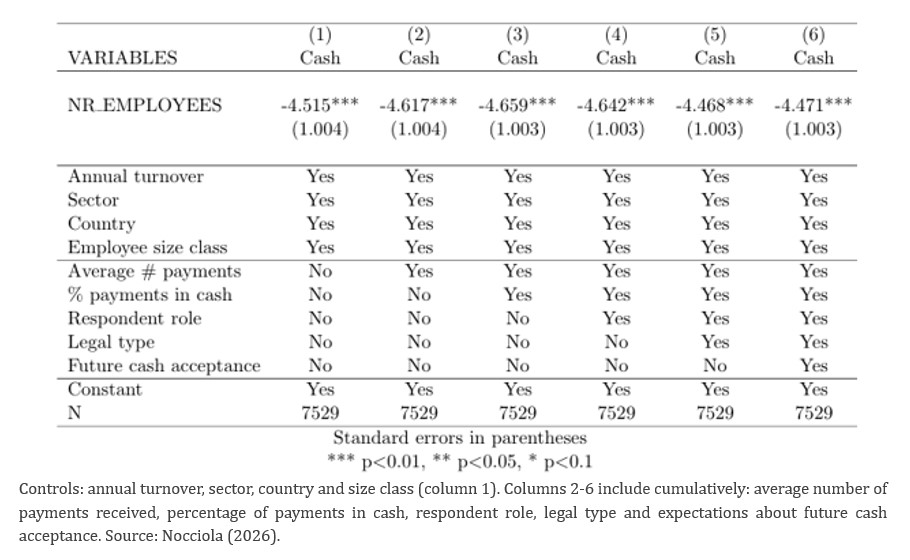
Table 1 shows that cash holdings are inversely related to firm size, as measured by the number of employees. An increase in firm size by one employee is associated with a reduction in average cash holdings of about €4.5. Interpreted at the margin, this effect is small per employee. However, firms may differ in size by thousands of employees. Hence, average cash holdings may vary by a similar order of magnitude when comparing SMEs with large firms. For example, conditional on turnover, a firm that increases its size by 1,000 employees would exhibit an average reduction in cash holdings of about €4,500. This result provides evidence that SMEs tend to hold more cash relative to their larger peers and is consistent with, e.g., Opler et al. (1999), who find that larger firms hold less cash, Bates et al. (2009), who find that smaller and riskier firms hold more cash, Almeida et al. (2004), who find that financially constrained firms hoard cash, Kakhbod et al. (2025), who show that cash levels decline as firms expand, although they document a U-shaped relationship between cash levels and firm size, and Amronin & Chakravorti (2009), who find that the share of SMEs in 13 advanced economies over 1988-2003 is associated with stronger cash demand. This result is robust to the inclusion of various controls, as described in the previous section and reported in columns 2-6.
Table 1. Average cash holdings as a function of number of employees
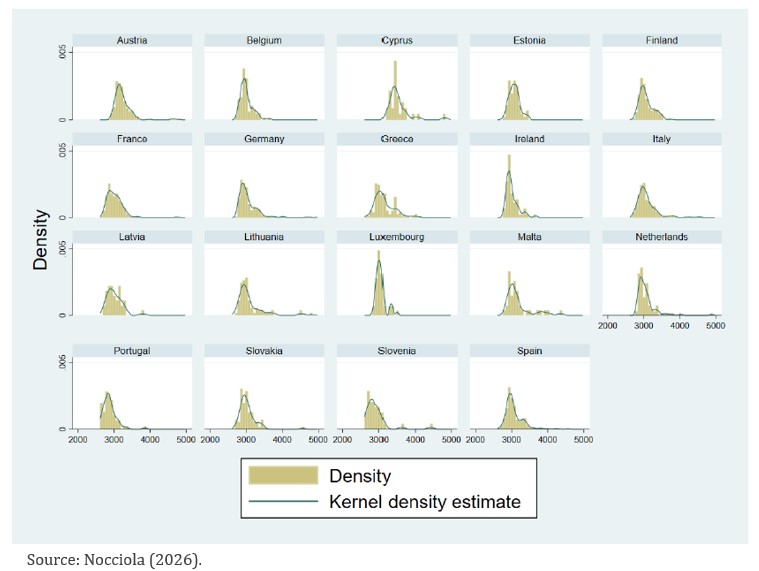
After estimating point values of cash holdings, we report the estimated distribution of average cash held by sector and focus, for illustrative purposes, on bracket €1,000-4,999. Figure 1 shows that the estimated distribution is approximately normal and slightly positively skewed, i.e. with a longer right tail. Comparing presumably cash-poor sectors with cash-intensive sectors, the latter display a right-shifted distribution. For example, this is evident when comparing the manufacturing sector with the hotels sector.3 We also report the estimated distribution of average cash held by country for the same bracket. Figure 2 again shows an approximately normal distribution with a slight positive skew. Comparing presumably less “cash-friendly” countries with “cash-friendly” ones, the latter exhibit a right-shifted distribution. For example, this is visible when comparing France with Austria or Luxembourg with Cyprus. Formal statistical inference confirming these graphical insights can be found in Nocciola (2026).
Figure 1. Estimated distribution of cash held by sector: bracket €1,000-4,999
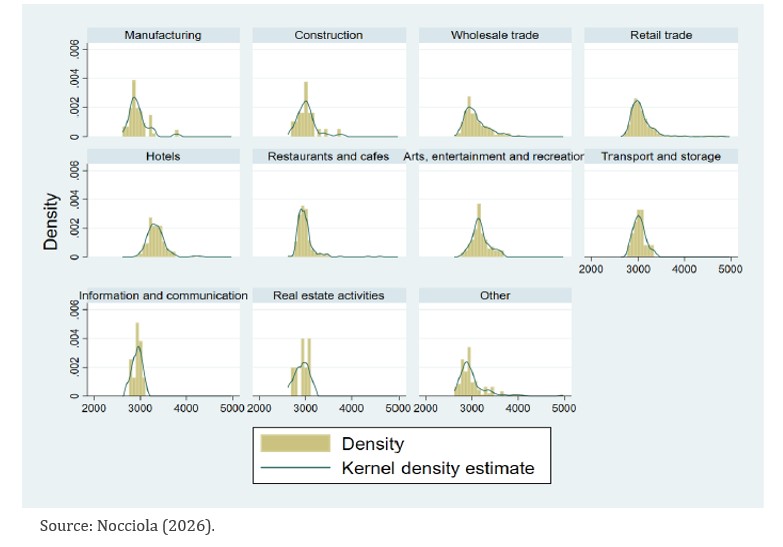
Figure 2. Estimated distribution of cash held by country: bracket €1,000-4,999
Our findings indicate that firms belonging to certain categories (e.g. SMEs), sectors (e.g. hotels) or countries (e.g. Austria) hold more cash. The result for hotels is intuitive given the period in which they were surveyed: despite government support measures, high-contact service sectors, and in particular hotels, suffered from a reduction in clients during the COVID-19 pandemic. A plausible explanation for higher cash holdings in the hotel sector is that hotels tried to protect themselves against income shocks arising from uncertainty over lockdowns by holding more cash to ensure sufficient liquidity for survival over an extended period. This explanation would need to be confirmed by 1) repeated surveys to establish whether the result for hotels is specific to the pandemic; 2) an analysis of the dynamics of hotels’ cash and deposit holdings to rule out a substitution effect in favour of deposits during the pandemic; and 3) a decomposition of hotel cash demand (transactional and precautionary) to identify its precautionary part. In the absence of such a disaggregated evidence, aggregate time-series evidence on cash demand may shed initial light on this explanation, in particular with respect to point 2).
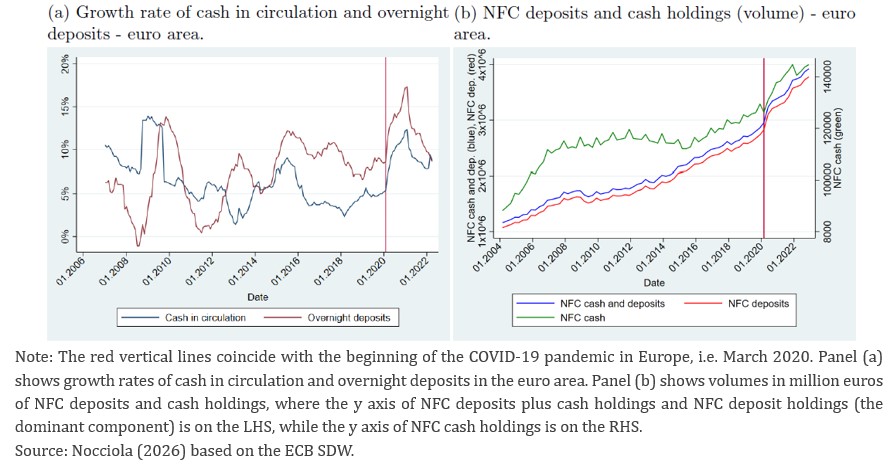
A key question is why firms would hold cash rather than deposit it at banks. Firms may behave in a precautionary manner by maximising their deposits and reducing cash holdings. In other words, we may observe a substitution effect between cash holdings and deposits, in favour of deposits. First, aggregate cash in circulation in the euro area, sourced from the ECB Statistical Data Warehouse (SDW), increased sharply at the beginning of the pandemic (Figure 3, panel (a)). While this already speaks against a reduction in cash holdings at the onset of the pandemic, we provide further evidence on the dynamics of overnight deposits. Figure 3, panel (a), shows that deposits also accelerated at the beginning of the pandemic. The correlation between the acceleration rates of the two forms of money during the COVID-19 period is positive and sizeable, at about 0.7, much stronger than the correlation over the full sample, at about 0.2. Hence, there has been no substitution effect, neither in favour of deposits nor in favour of cash; rather, both forms of money expanded, clarifying point 2).4 Moreover, the Quarterly Sectoral Accounts from the ECB SDW provide further indications on the dynamics of cash and deposit holdings of NFCs. Figure 3, panel (b), shows that both increased sharply in aggregate for NFCs, even when the dynamics of cash and deposits are examined separately. However, this is aggregate evidence and, at present, we are not able to distinguish between cash and deposit holdings of firms along the sectoral dimension.
Figure 3.
This policy brief documents empirically the money demand by European NFCs by exploiting a unique and brand-new survey on their cash usage in a stress period, such as the COVID-19 pandemic, and contributes to the literature in multiple ways. First, it provides additional evidence of an inverse relation between cash holdings and firm size, suggesting that SMEs tend to store more cash relative to their larger peers. Second, it offers an estimate of cash holdings of European firms for store-of-value purposes. Cash holdings can be viewed as a prudential instrument that protects firms against (potential) credit supply shocks. Third, it adds to the discussion on the design of a CBDC. Some features of cash remain unique so far, e.g. anonymity, real-time settlement and also physicality/offline usability (see e.g. Nocciola and Zamora-Pérez (2024)). Firms still hold physical cash for store-of-value purposes, and this may be relevant for CBDC design, in particular for the calibration of holding limits for businesses and merchants. For instance, one reason for firms to store cash is its real-time settlement property: by holding cash, firms rely on its ability to settle future transactions instantly, thus overcoming distrust in counterparties and avoiding any transaction risk except counterfeiting. Finally, the brief contributes to the literature on monetary policy transmission and the effective lower bound (see e.g. Assenmacher & Krogstrup (2021)). While cash constrains monetary policy, it also acts as a store of value.
Our findings indicate that firms belonging to certain categories (e.g. SMEs), sectors (e.g. hotels) or countries (e.g. Austria) hold more cash. Despite government support, high‑contact service sectors, such as hotels, experienced income losses during the COVID‑19 pandemic. We document that both cash in circulation and overnight deposits accelerated at the onset of the pandemic, suggesting that firms increased their holdings of liquid assets in general, rather than substituting between cash and deposits. Sector‑level information on firms’ cash and deposit holdings would be needed to assess more firmly whether this pattern holds for specific sectors, such as the hotel sector. Our working hypothesis is that cash holdings rose particularly strongly in sectors such as hotels, which sought to protect themselves against income shocks amid uncertainty over lockdowns. A related explanation on why SMEs tend to hold more cash is that they face more restricted access to finance, especially in crisis times. The Survey on Access to Finance of Enterprises (SAFE) could be used to test and substantiate this explanation.
Almeida, H., Campello, M., & Weisbach, M. S. 2004. The cash flow sensitivity of cash. Journal of Finance, 59(4), 1777–1804.
Amronin, G., & Chakravorti, S. 2009. Whither loose change? The diminishing demand for small-denomination currency. Journal of Money, Credit and Banking, 315–335.
Ashworth, J., & Goodhart, C. A. 2020. The surprising recovery of currency usage. International Journal of Central Banking.
Assenmacher, K., & Krogstrup, S. 2021. Monetary policy with negative interest rates: de-linking cash from digital money. International Journal of Central Banking.
Bates, T. W., Kahle, K. M., & Stulz, R. M. 2009. Why do U.S. firms hold so much more cash than they used to? Journal of Finance, 64(5), 1985–2021.
Cusbert, T., & Rohling, T. 2013. Currency demand during the global financial crisis: evidence from Australia. RBA Research Discussion Paper.
Duchin, R., Ozbas, O., & Sensoy, B. A. 2010. Costly external finance, corporate investment, and the subprime mortgage credit crisis. Journal of Financial Economics, 418–435.
ECB. 2022. Use of cash by companies in the euro area. Report. ECB.
Jonker, N., van der Cruijsen, C., Bijlsma, M., & Bolt, W. 2022. Pandemic payment patterns. Journal of Banking and Finance.
Joseph, A., Kneer, C., van Horen, N., & Saleheen, J. 2020. All you need is cash: corporate cash holdings and investment after the financial crisis. BoE Working Paper Series.
Kakhbod, A., Reppen, A. M., Umar, T., & Xing, H. 2025. Does the level of cash always increase with firm size? Theory and evidence from small firms. Review of Finance, 29(3), 661–683.
Nocciola, L., (2026). “Money demand by non-financial corporations”, ECB Working Paper Series, No 3182, Frankfurt am Main.
Nocciola, L. and Zamora-Pérez, A. (2024) “Transactional demand for central bank digital currency”, ECB Working Paper Series, No 2926, Frankfurt am Main.
Opler, T., Pinkowitz, L., Stulz, R., & Williamson, R. 1999. The determinants and implications of corporate cash holdings. Journal of Financial Economics, 52(1), 3–46.
Rainone, E. 2022. Currency demand at negative policy rates. Banca d’Italia Temi di Discussione.
Ramirez, C. D. 2009. Bank fragility, ”money under the mattress”, and long-run growth: US evidence from the ”perfect” Panic of 1893. Journal of Banking and Finance, 2185–2198.
Stix, H. 2013. Why do people save in cash? Distrust, memories of banking crises, weak institutions and dollarization. Journal of Banking and Finance, 4087–4106.
A quantitative study on the potential impact of CBDC design on its demand is by Nocciola and Zamora-Pérez (2024),
This survey is conducted by the ECB for purposes that go beyond the scope of this policy brief.
For some sectors, e.g. real estate activities, the distribution is irregular due to the lower number of observations.
This feature of the COVID-19 pandemic period contrasts what happened during the global financial crisis (September 2007- September 2008), when the correlation between cash and deposit acceleration rates was negative, at about -0.25. Within this period, at the onset of Lehman’s bankruptcy, deposits actually diminished (bank runs) while cash continued to grow (see e.g. Ashworth & Goodhart (2020)), i.e. there was a substitution effect.