This policy brief is based on IMF Working Paper No. 2025/207. The views expressed in this brief are those of the authors and do not necessarily represent the views of the IMF, its Executive Board, or IMF management.
Abstract
Housing markets often deviate from fundamentals. This policy brief shows that monetary policy has stronger effects when valuations are stretched. Using data for two hundred U.S. metropolitan areas over the last three decades, we find that interest rate increases are associated with larger and more persistent declines in real house prices in overvalued housing markets. The evidence is consistent with extrapolative expectations as the primary mechanism behind this amplification and suggests that monetary policy can serve a stabilizing role during housing booms.
Debates about whether central banks should “lean against” housing booms hinge on a key question: is monetary policy more effective at moving house prices when markets are overvalued, and if so, why? Despite its centrality to policy design, the evidence on this particular state-dependency of monetary policy transmission remains limited, and the mechanisms behind it even less understood. In a recent paper (Biljanovska, Espuny Diaz, Kermani, and Mano, 2025), we provide new evidence on these questions.
The analysis draws on a rich quarterly dataset covering nearly two hundred U.S. metropolitan areas over the past three decades. This granular structure makes it possible to compare how national-level monetary policy shocks propagate across local housing markets with different valuation levels.
Overvaluation is measured through the price-to-rent ratio (PRR) — a standard indicator of whether house prices are running ahead of the value of housing services. To identify monetary policy shocks and isolate unexpected interest rate changes, we use a narrative-based measure from Romer and Romer (2004) extended by Miguel Acosta. To assess the robustness of all its findings, the paper also employs two additional monetary policy shock measures: a high-frequency measure (Bauer and Swanson, 2023) and a forecast-error measure (De Stefani and Mano, 2025).
The central finding is that monetary policy has stronger effects on real house prices in overvalued local housing markets. A tightening of monetary policy leads to house price declines across all markets, but as shown in Figure 1, the response is significantly larger in areas where valuations are elevated. The results are estimated using a local projection instrumental variable (LP-IV) approach, which traces the dynamic effects of monetary policy while addressing the endogeneity of interest rate changes.1
Figure 1. Differential effect on house prices of monetary policy conditional on degree of house price overvaluation in percentage points
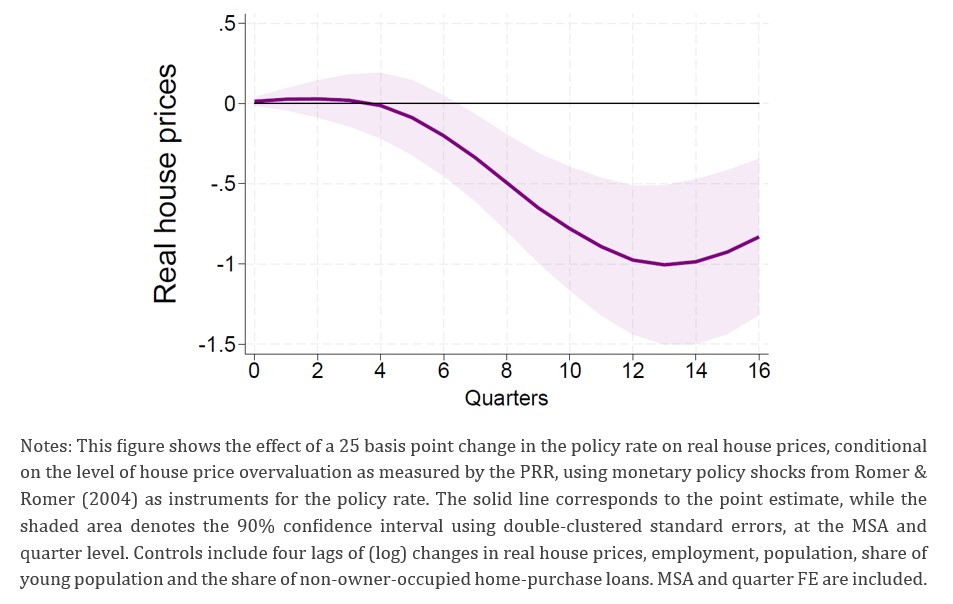
The difference is economically meaningful: a one-standard-deviation higher PRR is associated with an additional decline in real house prices of around 1 percentage point after 12–14 quarters following a 25-basis point rise in the policy rate — roughly 40% of the average effect of monetary policy on house prices across all metropolitan areas.
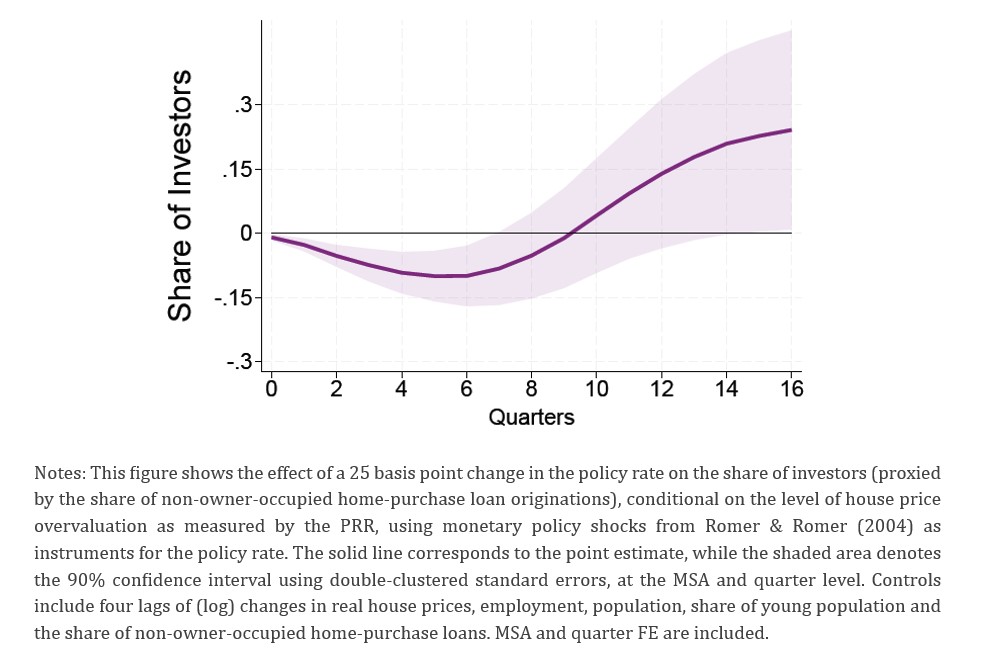
Monetary policy also affects who buys homes. As shown in Figure 2, in overvalued markets, a policy tightening leads to a larger — though temporary — decline in the share of houses bought not for primary residence, a standard proxy for investor demand. The effect builds over time, peaking around quarter 6 at about 0.12 percentage points for each standard deviation of the PRR, before gradually reverting.
This pattern suggests that investors are more reactive initially to monetary policy in overvalued markets, and then largely revert their reaction. In the case of monetary policy tightening, they exit sooner and re-enter once prices have fallen, effectively timing the market at the expense of primary home buyers.
Figure 2. Differential effect on the share of non-owner-occupied loan originations of monetary policy conditional on degree of house price overvaluation in percentage points
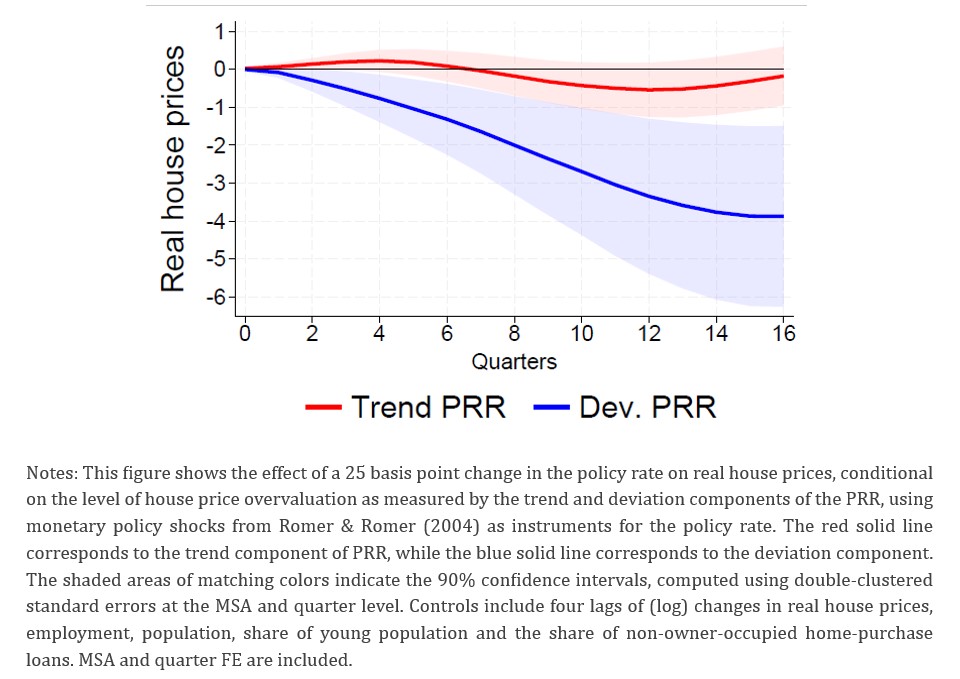
A key question is whether the stronger policy effects documented above are driven by long-run structural trends in overvaluation or more temporary dynamics. To address this, the analysis decomposes the price-to-rent ratio into a long-term trend and short-term deviations from that trend, separating persistent valuation differences from more cyclical movements, likely linked to shifts in expectations.
As shown in Figure 3, the stronger response to monetary policy is almost entirely driven by temporary deviations from the PRR trend. When overvaluation is measured by the trend in PRR, the effect on house prices is small and not statistically significant (red line). By contrast, deviations from trend produce large and persistent effects: in markets where the PRR is one standard deviation above its trend, a 25-basis point increase in the policy rate leads to an additional decline in real house prices of over 3 percentage points after three years (blue line). This is approximately three times larger than the estimate using the PRR, as reported in Figure 1.
Figure 3. Decomposing the amplification of the transmission of monetary policy to house prices in percentage points
What explains this stronger response of house prices to monetary policy in overvalued markets? The results point to the role of extrapolative expectations. In overvalued markets, a monetary tightening first prompts more sophisticated buyers, such as investors and speculators, to exit the market quickly, as higher interest rates erode expected returns. This initial pullback causes prices to soften. Owner-occupiers and less sophisticated buyers, whose expectations tend to be extrapolative — that is, shaped by recent price trends — then observe the cooling and begin to revise their beliefs downward. This revision further dampens demand, amplifying the initial price decline. The mechanism is thus self-reinforcing: monetary policy disrupts the expectation that prices will continue to rise, and once that belief unravels, the adjustment in the housing market can be sharp and persistent.
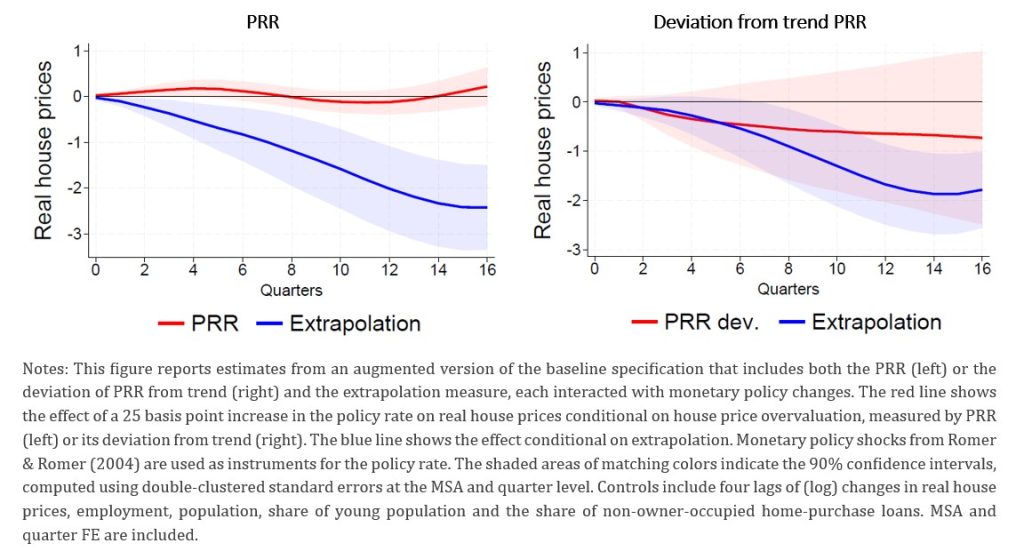
To assess this mechanism more directly, the analysis introduces a measure of extrapolative behavior based on the joint dynamics of house prices and transaction activity, following Barberis et al. (2018). Markets characterized by extrapolative expectations tend to exhibit a high correlation between price growth and transaction volumes, as optimistic beliefs simultaneously attract more buyers and push prices higher. As shown in Figure 4, when this measure is included alongside the PRR, the latter loses its explanatory power, while the extrapolation proxy remains strongly associated with the sensitivity of house prices to monetary policy (left). This pattern also holds when focusing on deviations of the PRR from its trend (right): the effect attributed to overvaluation completely disappears once extrapolative behavior is accounted for.
Figure 4. Differential effect on house prices of monetary policy: horse race between PRR and extrapolation
Could other mechanisms explain the results? Two natural candidates are investor composition — since investor demand may be more sensitive to financing conditions — and affordability constraints, which become more binding as house prices rise. However, controlling for both leaves the main results unchanged. Differences in local housing supply conditions likewise do not alter the findings.
Taken together, these results reinforce the interpretation that belief-driven dynamics, rather than structural features of housing markets, are central to understanding why monetary policy is more powerful in overvalued environments.
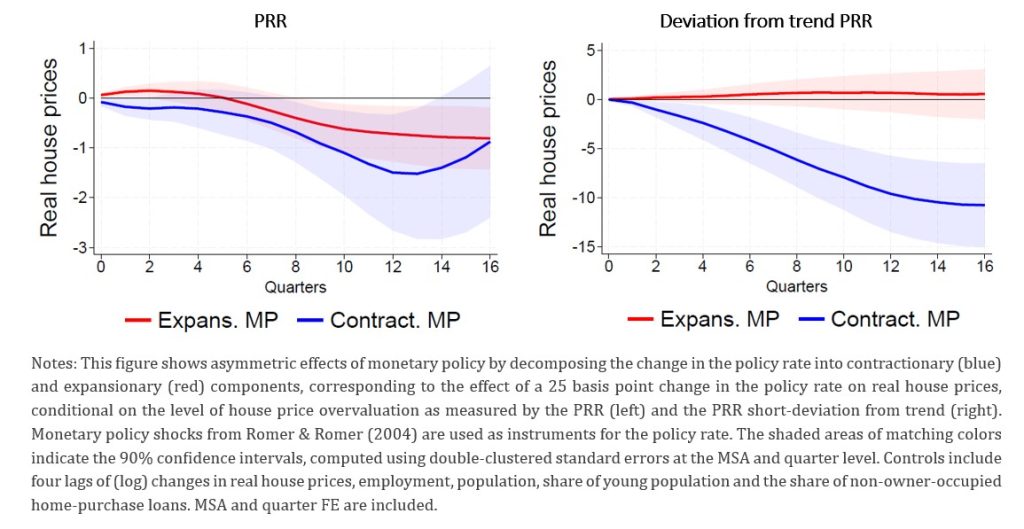
A further question is whether the stronger effects of monetary policy in overvalued markets are symmetric — that is, whether both tightening and easing have similar amplification effects. If easing is equally powerful, monetary policy could amplify housing cycles in both directions. If tightening dominates, it would suggest that monetary policy can play a stabilizing role during housing booms.
The evidence points to the existence of asymmetries. As shown in Figure 5, the response of house prices is stronger following interest rate increases than after rate cuts in overvalued markets. When overvaluation is measured by the overall PRR, the response to tightening is roughly twice as large as that to easing (left). The asymmetry becomes even more pronounced when focusing on short-term deviations from trend PRR (right): tightening leads to a significant and persistent decline in house prices, whereas easing has effects that are small and not statistically significant.
These findings reinforce the view that monetary policy can be particularly effective in leaning against housing booms, especially when overvaluation reflects temporary and expectation-driven dynamics.
Figure 5. Differential effect on house prices of monetary policy: testing for asymmetries
This brief shows that monetary policy has stronger effects on house prices in overvalued housing markets, particularly when overvaluation reflects short-term deviations from PRR trends. Investor demand also responds more sharply in these markets. The evidence points to extrapolative expectations as the central mechanism, while investor activity plays a catalytic role. Moreover, these effects are asymmetric: tightening is more powerful than easing in overvalued markets. Taken together, these findings suggest that the effectiveness of monetary policy depends on the state of the housing market, and that it can play a stabilizing role when housing booms are driven by sentiment rather than fundamentals.
Barberis, Nicholas, Robin Greenwood, Lawrence Jin, and Andrei Shleifer (2018) “Extrapolation and bubbles”, Journal of Financial Economics, 129 (2), pp. 203–227.
Bauer, Michael D. and Eric T. Swanson (2023) “An Alternative Explanation for the “Fed Information Effect””, American Economic Review, 113 (3), pp. 664–700.
Biljanovska, Nina, Eduardo Espuny Diaz, Amir Kermani, and Rui Mano (2025) “Monetary Policy and Housing Overvaluation”, IMF Working Papers, Number: 2025/207 Publisher: International Monetary Fund.
De Stefani, Alessia and Rui Mano (2025) “Long-Term Debt and Short-Term Rates: Fixed-Rate Mortgages and Monetary Transmission”, IMF Working Papers, Number: 2025/024 Publisher: International Monetary Fund.
Jordà, Òscar, Moritz Schularick, and Alan M. Taylor (2015) “Betting the house”, Journal of International Economics, 96, pp. S2–S18.
Romer, Christina D. and David H. Romer (2004) “A New Measure of Monetary Shocks: Derivation and Implications”, American Economic Review, 94 (4), pp. 1055–1084.
See Jordà et al. (2015) for methodological details.