

The views expressed here are those of the authors and do not necessarily reflect those of the Bank of Italy. This policy brief is based on “Macroeconomic surprises and financial market reactions: insights into euro-area interest rates”, Occasional Paper No. 959, Bank of Italy.
Abstract
We examine how euro-area (EA) interest rates react to EA and US macroeconomic surprises. Our findings suggest that the sensitivity of interest rates to surprises varies across tenors and over time. During the forward guidance period (2013-22), interest rate reactions were rather muted, especially at the short end of the yield curve. However, since the European Central Bank (ECB) adopted a data-dependent and meeting-by-meeting approach, interest rate sensitivity has sharply increased, returning to the levels observed during the Great Financial Crisis. In particular, EA OIS rates have become highly sensitive to US surprises, pointing to significant spillovers from US economic developments to EA financial conditions. Moreover, monetary policy uncertainty amplifies the sensitivity of interest rates to macroeconomic surprises – especially those related to the US – and this amplification is most pronounced for the EA expected short-term rate component.
The ECB’s transition to a data-dependent and meeting-by-meeting approach, better suited to calibrate monetary policy in a highly uncertain environment, has coincided with a remarkable increase in the sensitivity of euro-area (EA) interest rates to macroeconomic news. This development has complicated monetary policy decision-making and the determination of the appropriate stance. We investigate the dynamics of EA interest rate responsiveness and answer the following questions:
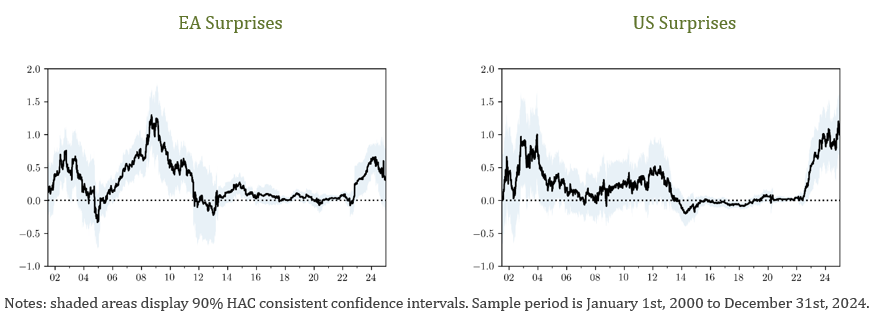
Following the approach of Gürkaynak et al. (2005) and Altavilla et al. (2017), we quantify the interest rate sensitivity to EA and US surprises first for the full sample from 2000 to 2024 and second in a time-varying setting. The analysis shows that EA interest rates responsiveness to EA and US macroeconomic surprises varied substantially over time, reflecting shifts in financial markets’ perception of the importance of macroeconomic data for the central bank’s reaction function. During forward guidance (between July 2013 and July 2022) sensitivity was muted due to compressed expected short-term rates and term premia. As the ECB adopted a data-dependent and meeting-by-meeting approach in July 2022, sensitivity to domestic news reverted to levels last seen in 2010, and sensitivity to US news hit record highs (Figure 1).
Figure 1. 2-year OIS rate sensitivity to macro surprises
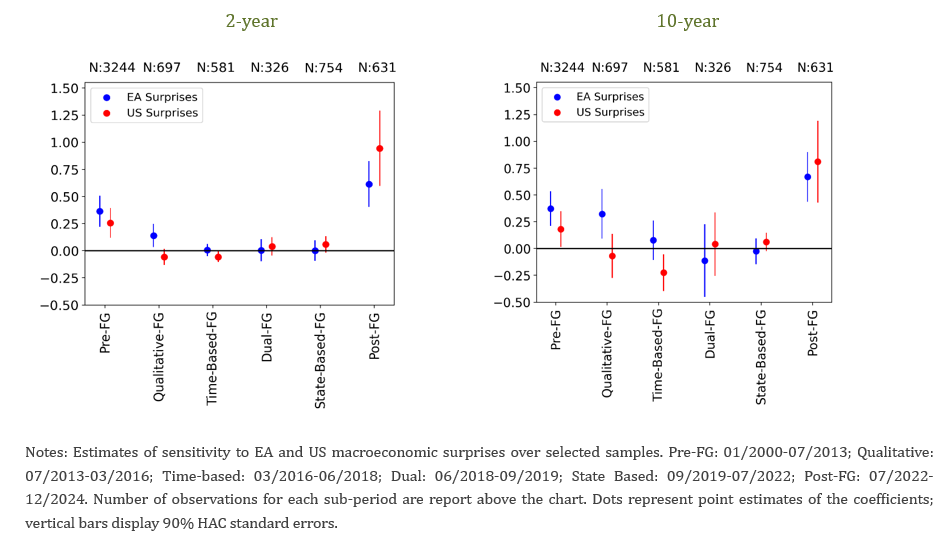
In our sample, the ECB resorted to several different communication approaches and policy tools. We evaluate how interest rate sensitivity evolved across different monetary policy regimes and find that sensitivity was muted during forward guidance, especially quantitative guidance based on calendar deadlines and economic conditions. Before FG, EA interest rates were sensitive to both US and EA macroeconomic news. The adoption of qualitative FG by the ECB in July 2013 had no noticeable effect on the responsiveness of interest rates to EA news, but it successfully shielded EA interest rates from US macroeconomic news. When more explicit forms of FG were adopted by the ECB (time-based, dual, state-based) interest rates became largely insensitive to both domestic and US macroeconomic surprises. In the recent data-dependence and meeting-by-meeting period, the reactiveness of the EA interest rates to EA surprises increased to pre-FG levels, while spillovers from US surprises reached unprecedented levels (Figure 2).
Figure 2. OIS rate sensitivity across ECB communication strategies
The data-dependent and meeting-by-meeting phase together with the uncertain macroeconomic outlook have led financial markets to rely more heavily on incoming data releases in the formation of policy rate expectations, thereby fuelling uncertainty about the future path of policy rates. Motivated by this, we investigate the role of monetary policy uncertainty in shaping interest rate sensitivity to macroeconomic surprises. Previous literature found monetary policy uncertainty to exert upward pressure on sensitivity (see Kurov and Stan (2018), Swanson and Williams (2014)). We evaluate the existence of these effects on the EA’s risk-free yield curve, but, unlike the existing literature, we consider the effects of monetary policy uncertainty separately for EA and US macroeconomic surprises.
We estimate the market-implied probability distribution for the 3-month Euribor rate at a one-year horizon as implied by Euribor futures options prices and measure monetary policy uncertainty as the difference between the 90th and the 10th percentile of the distribution. To investigate the impact of monetary policy uncertainty on interest rate sensitivity, we run a non-linear regression based on the specification of Swanson and Williams (2014).
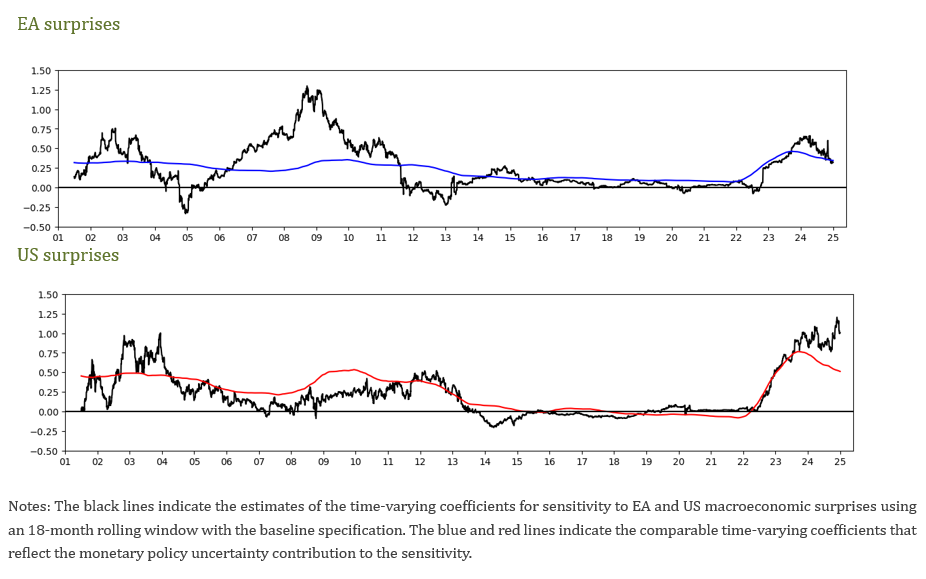
We find that monetary policy uncertainty amplifies interest rate sensitivity, especially to US surprises, and has driven its sharp rise since 2022. Under high uncertainty, US surprises impact EA rates more than EA surprises do. In figure 3 we compare the evolution of interest rate sensitivity between (I) the baseline model, in which we remain agnostic about the cause of sensitivity, and (II) a model in which we account explicitly for monetary policy uncertainty. The two specifications have increasingly co-moved since 2022, suggesting that monetary policy uncertainty has become a key driver of sensitivity during the data-dependent regime. While it is intuitive that uncertainty about EA monetary policy affect sensitivity to EA surprises, the close relationship between EA monetary policy uncertainty and US surprises further emphasises the leading role of US developments in shaping interest rates during periods of uncertainty.
Figure 3. Time-varying sensitivities of 2-year rate: baseline and uncertainty-augmented model
To further investigate the nature of the sensitivity, we decompose the overall response into two components using the Adrian et al. (2013) model: (I) expected short-term rates component and (II) term premium (that is the extra yield required for bearing additional risks, mainly interest rate risk, over the life of the bond).
Understanding how monetary policy uncertainty amplifies the transmission of surprises to both expected short term rates and term premia is relevant for assessing monetary policy implications. As noted by Diercks and Asnani (2024) in the case of an increase in interest rates, upward shifts in expected short term rates may signal that investors expect monetary policy to be tighter in the future. Thus, if monetary policy does not evolve accordingly, deviations in short term rates could trigger expansionary impulse on the economy. In contrast, increases in term premium would tighten financial conditions independently of shifts in short rate expectations. Consequently, tighter financial conditions driven by term premia could reduce economic activity and inflation, calling for an easing of the monetary policy to preserve price stability.
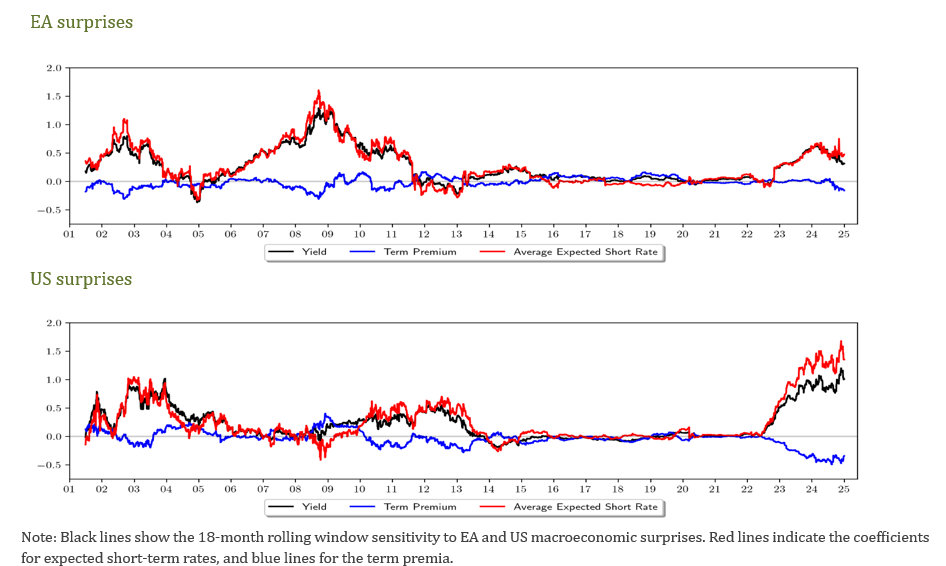
Our results indicate that monetary policy uncertainty amplifies the responsiveness of the expected short term rates component to macroeconomic surprises from both the EA and the US, and across tenors, with a stronger impact for US surprises. This finding suggests that under elevated uncertainty, US developments exert a particularly strong influence on market expectations regarding future EA interest rates. For the term premium component, the effects differ by tenor. At the 2-year horizon, EA surprises have only a marginally significant impact, whereas US surprises compress term premia, indicating a resolution of uncertainty about the future evolution of EA yields, with the resolution effect intensifying as monetary policy uncertainty increases (Figure 4). At the 5- and 10-year horizons, EA macro surprises have a positive and significant effect on term premia, which intensifies with rising monetary policy uncertainty, while US surprises have no particular impact.
Figure 4. Decomposition of 2-year rate responses into expected short-term rates and term premium
Since the ECB shifted to a data-dependent and meeting-by-meeting policy, sensitivity of EA interest rates to macroeconomic surprises has risen, particularly to US surprises for which estimates has been hovering around historical highs since 2022. Uncertainty regarding future monetary policy amplifies the impact of surprises, with a more pronounced effect on the expected short term rates component. Heightened sensitivity of interest rates to macroeconomic surprises may hamper the ECB’s ability to steer financial conditions and, by extension, shape its policy stance, especially when this is combined with increased magnitude of surprises. Our findings suggest that providing some information regarding the future path of policy rates – aimed at reducing market uncertainty about future rates – could help to reduce market sensitivity and, where macroeconomic conditions warrant, decouple EA financial conditions from those of the US. However, such communication should strike a balance between the ECB’s desire to steer financial conditions and the need to avoid binding commitments that might endanger its credibility.
Adrian, T., Crump, R. K., & Moench, E. (2013). Pricing the term structure with linear regressions. Journal of Financial Economics, 110(1), 110-138.
Altavilla, C., Giannone, D., & Modugno, M. (2017). Low frequency effects of macroeconomic news on government bond yields. Journal of Monetary Economics, 92, 31-46.
Diercks, A. M., & Asnani, D. (2024). The Treasury Tantrum of 2023. Feds Notes.
Gürkaynak, R. S., Sack, B., & Swanson, E. (2005). The sensitivity of long-term interest rates to economic news: Evidence and implications for macroeconomic models. American economic review, 95(1), 425-436.
Kurov, A., & Stan, R. (2018). Monetary policy uncertainty and the market reaction to macroeconomic news. Journal of Banking & Finance, 86, 127-142.
Swanson, E. T., & Williams, J. C. (2014). Measuring the effect of the zero lower bound on medium-and longer-term interest rates. American economic review, 104(10), 3154-3185.