

The views expressed represent the authors’ personal opinions and do not necessarily reflect the views of the Deutsche Bundesbank or the Eurosystem.
Abstract
Refinancing operations will play a central role in the Eurosystem as reserves continue to decline. This marks a shift from the past decade of asset purchases, but not from historical practice: prior to the global financial crisis (GFC), collateralized lending operations, in particular refinancing operations, already played a key role. This Policy Brief revisits the pre-GFC experience of German banks to assess two questions that are central today: will banks be operationally ready to use lending operations, and could their use raise communication challenges? The evidence suggests that banks were operationally ready to access reserves when needed. Lending volumes were typically concentrated among a limited number of institutions. Neither concentration nor occasional recourse, in itself, raised concerns about banks’ potential dependence on Eurosystem refinancing operations.
As the Eurosystem normalizes its balance sheet, collateralized lending operations are set to become an important source for providing reserves.1 This marks a clear shift from the past decade, when large-scale asset purchases dominated monetary policy implementation. At the same time, it is not without precedent. Prior to the GFC, refinancing operations were the primary way the Eurosystem provided reserves to the banking system. Revisiting banks’ behavior in the pre-GFC period can therefore give useful insights into how lending operations may function when the Eurosystem balance sheet has shrunk.
Collateralized lending operations for implementing monetary policy include refinancing operations, which are initiated by the Eurosystem, and the marginal lending facility (MLF), which the bank initiates on demand. Lending operations have changed their importance since the start of the Eurosystem. Prior to the GFC standard refinancing operations, – 1-week main refinancing operations and the 3-month longer-term refinancing operations – were substantial accounting for around 40% of Eurosystem assets.2 They served de facto a dual role: steering short-term interest rates and covering a structural liquidity deficit of banks vis-à-vis the central bank, largely driven by banknote demand.3 The latter role was the main reason why refinancing operations were increasingly sizeable in the euro area. This has changed fundamentally due to the large-scale asset purchases. As of May 2026, monetary policy portfolios account for around 57% of Eurosystem assets and have generated a structural liquidity surplus, while standard refinancing operations represent well below 1%.
As the Eurosystem balance sheet continues to decline, redistributing reserves between banks will no longer be sufficient at some point such that lending operations are expected to increase. This raises important policy implications. First, operational readiness becomes critical: banks need to be able to source central bank reserves swiftly and in a scalable manner.4 Second, lending operations should again be used as a routine liquidity management tool rather than being perceived merely as a backstop. This means that borrowing from the Eurosystem can become substantial and potentially concentrated.
The pre-GFC experience of German banks provides an interesting case study to assess these issues. At the end of 2006, Germany had the largest banking system in the euro area with total assets of around 7 trillion Euro (and a market share of close to 30%) according to data from the ECB data portal. Moreover, the German banking system is notable for its large number of banks, across a diverse array of categories: for example, large and internationally active commercial banks coexist alongside more specialized regional banks and branches of foreign banks as well as smaller savings banks and credit cooperations. Our dataset is based on balance sheet items of German banks (BISTA) available monthly from the banking statistics. It contains more than 2,000 banks over the period 2000-2006 and allows for a detailed analysis across bank categories
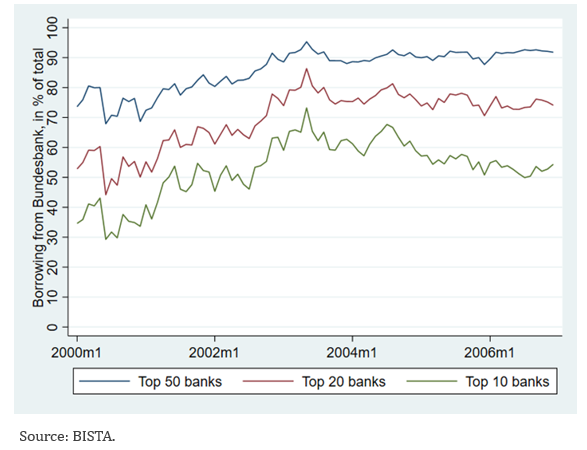
The take-up of German banks accounted for more than half of total Eurosystem lending (around €250 billion at the end of 2006), which the Bundesbank provided as a national central bank and which is reported in BISTA as a separate liability item. Borrowing from the Bundesbank became increasingly concentrated up until May 2003. By that time, the top 10 banks accounted for around 73% of total take-up, and the top 50 for 95% (Figure 1). For the sake of reference, these top 10 (top 50) banks had a share of 26% (48%) of total assets in the German banking system at the time. Hence, take-up was relatively concentrated.
Figure 1. Share of top 50/20/10 German banks in terms of borrowing from Bundesbank
A closer look at the different German banking categories reveals interesting observations: First, banking categories differed strongly with respect to their borrowing from the Bundesbank in relation to their total liabilities (Figure 2, top). Branches of foreign banks borrowed almost 14% of their liabilities from the Bundesbank at the end of 2006. Arguably, some of them have special business models such as serving as a hub for Euro liquidity for the parent institution. “Regional and other commercial banks”, “big banks” and “Landesbanken and regional institutions of credit cooperations” borrowed about 8%, 5%, and 4% of their total liabilities at the end of 2006, respectively. In contrast, borrowing from the Bundesbank was less important for savings banks and credit cooperations.
Figure 2. Banks’ borrowing from the Bundesbank by banking category
In % of total liabilities (top). Share of participating banks (bottom).
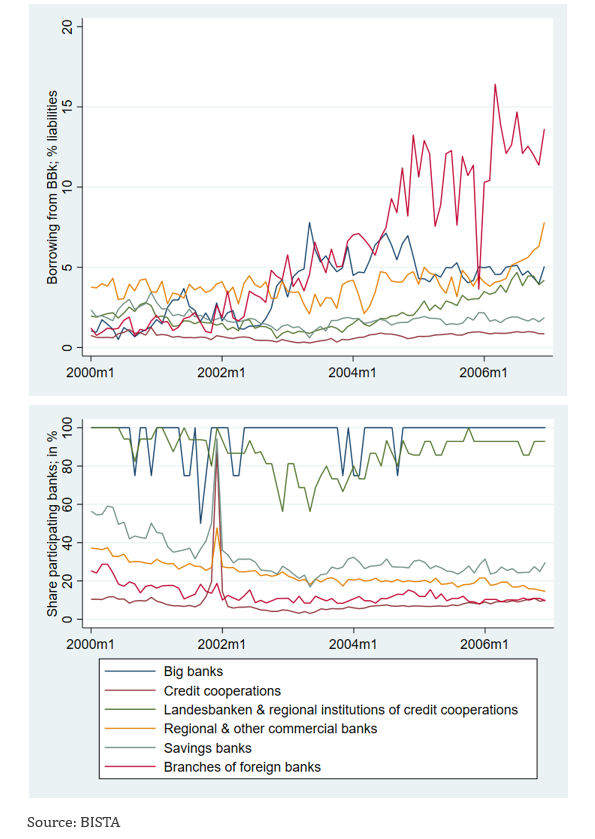
Second, the number of banks within each category that borrowed from the Bundesbank also differed strongly (Figure 2, bottom). While almost all “big banks” and most “Landesbanken and regional institutions of credit cooperations” regularly borrowed from the Bundesbank, less than half of savings banks and only 10% of credit cooperations participated on average. There is, however, one noteworthy exception shortly before the cash-changeover from D-Mark to Euro in December 2001, when 89% of savings banks and credit cooperations borrowed from the Bundesbank. Many of them only borrowed small amounts, which were below the minimum for participating in standard refinancing operations. Apparently, banks accessed the MLF in anticipation of an unusually high demand for euro cash, as customers wished to use it for the first time on 1 January 2002. The MLF is suitable for managing unexpected or extraordinary demand for reserves as banks can use it daily on their own initiative for receiving overnight credit. Banks can either pre-deposit collateral with the Eurosystem or deliver the assets with the request for access. Pre-depositing collateral is required for automatic recourse to the MLF, which takes place when a bank’s current account shows a negative balance after the payment system has closed. The general principle to have the same set of broad collateral for all Eurosystem lending operations facilitates the automatic request, as intraday credit can be seamlessly transferred into the MLF.
The German pre-GFC experience offers three main lessons for the Eurosystem lending operations in an environment with fewer reserves. First, broad access does not guarantee broad participation. Even with a wide set of eligible counterparties in the banking system, actual use of lending operations may remain concentrated among a relatively small group of banks. Such concentration does not necessarily indicate that individual banks overly rely on Eurosystem liquidity provision, but needs to be taken into account to avoid potential misinterpretation. Second, lending operations can function as a routine liquidity management tool. The evidence suggests that banks were both willing and able to borrow from the Bundesbank when needed, including in periods of system-wide demand. This points to limited stigma, in contrast to some evidence for the US discount window.5 In fact, neither occasional recourse nor regular borrowing should, in itself, raise concerns. Lastly, operational readiness is critical for the transition to a demand-driven framework. Banks need to be able to mobilize and pledge collateral in order to source central bank reserves quickly and in a scalable manner. Ever since their inception, the design features of Eurosystem lending operations have successfully served this purpose.
Armantier, O., Cipriani, M. and Sarkar, A. (2024), Discount Window Stigma After the Global Financial Crisis, Federal Reserve Bank of New York Staff Report No. 1137, November.
Buch, C. and Schnabel, I. (2025) Managing liquidity in a changing environment, The ECB Blog
Deutsche Bundesbank (2015) Structural liquidity position of the banking system, box, monthly report, June
ECB press release (2024), Changes to the operational framework for implementing monetary policy, Statement by the Governing Council, 13 March
Iskaki, V., Linzert, T., Schneider, Y., Skrzypinska, M. and Vergote, O. (2026), How banks are adjusting to declining reserves, The ECB Blog
Schnabel, I. (2025) Towards a new Eurosystem balance sheet, Speech at the ECB Conference on Money Markets 2025
Lee, H. and Sarkar, A. (2018), Is Stigma Attached to the European Central Bank’s Marginal Lending Facility? Liberty Street Economics, April.
See ECB press release 13 March 2024; Schnabel, I. (2025); Iskaki, V. et al. (2026)
The Eurosystem mainly conducted variable rate tenders and announced a benchmark allotment. During the early phase it conducted fixed rate tenders, which stopped in June 2000 as a response to severe overbidding, and main refinancing operations had a maturity of two weeks. Prior to the GFC banks did not have an incentive to hold high excess reserves, because they faced opportunity costs for not lending them in the market. Short-term money market rates were close to the rate on the main refinancing operation, which was 100 bps above the rate on the deposit facility.
Banknotes accounted for 55% of liabilities at the Eurosystem and over 90% at the Fed at the end of 2006. The central bank needs to cover a structural liquidity gap in the banking system. Otherwise, banks would face difficulties, for example, when servicing cash needs of their customers. For an explanation on structural liquidity positions, see Deutsche Bundesbank (2015), p. 36, 37.
See Buch, C. and Schnabel, I. (2025)
See Lee, H. and Sarkar, A. (2018), Armantier, O., Cipriani, M. and Sarkar, A. (2024)