

Additional fundamental data, interactive charts and publications on this topic and on “(de)globalization can be found here. The views expressed are those of the authors and not necessarily those of the institutions the authors are affiliated with.
Abstract
The geography of the EU’s external trade is gradually changing. While the United States and the United Kingdom remain central trading partners, their relative importance has been declining, whereas Asia’s role in EU trade has increased steadily. In net terms, the EU continues to run substantial trade surpluses with the US and the UK, but these are increasingly offset by a rapidly widening trade deficit with China. At the same time, Asia is gaining relevance not only as a source of imports, but also as an export destination – an aspect that is particularly important from a growth and macroeconomic policy perspective.
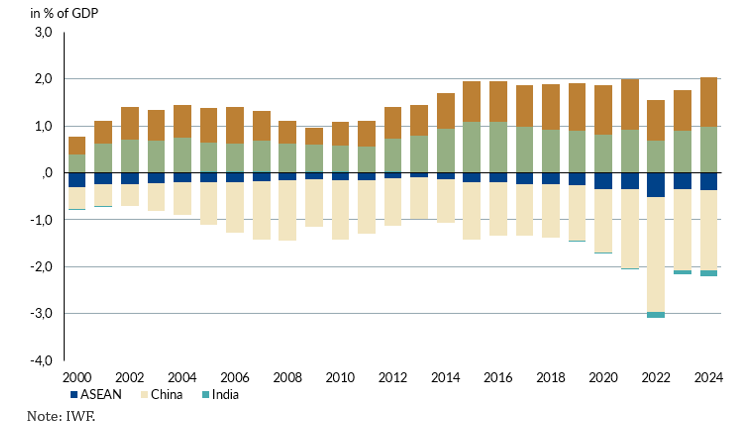
A first look at trade balances suggests a clear pattern in Europe’s external trade relations (Chart 1). Over the period from 2000 to 2024, the EU’s goods trade surplus with the US and the UK has contributed the largest positive share to the overall EU goods trade balance when measured as a percentage of EU GDP, even though this contribution has shown a stagnant trend since 2015.
In contrast, the EU’s trade balance with China has deteriorated sharply, with the deficit expanding significantly since around 2015. Trade balances with ASEAN countries and India are also negative but have remained comparatively stable over time. Taken together, these figures reinforce the view of Europe as a net exporter to the transatlantic economy and a net importer from Asia.
Chart 1. EU: Trade balance in goods with selected partner countries (net exports)
Trade balances alone, however, provide only a partial picture. A more in-depth look reveals that this simple perspective is only superficially accurate. While net exports indicate with which partners the EU records surpluses or deficits – i.e. where it “wins” or “loses” in trade – the separate examination of exports and imports brings the actual degree of economic interdependence into view. Chart 2 illustrates this shift clearly. When EU external trade is decomposed into its gross components the US and the UK still account for the largest shares – particularly on the export side. Yet their relative weight has been declining over time. At the same time, Asia’s importance has increased markedly. This is most visible in imports, where China’s rising share stands out clearly. But it is also increasingly evident on the export side: EU exports to Asian economies have grown in relative importance.
Chart 2. EU: Trade in goods with selected partner countries (exports and imports)
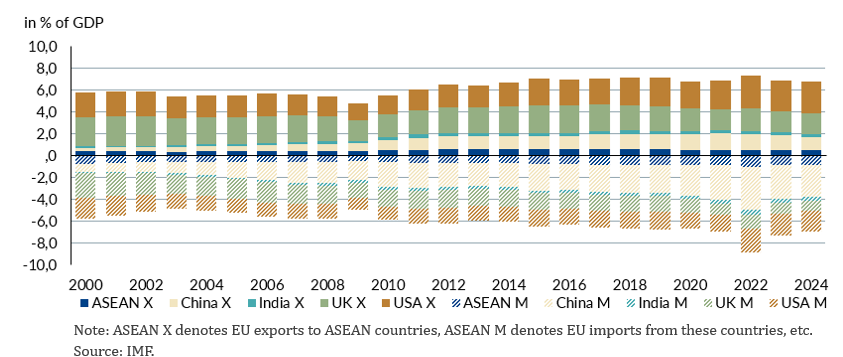
Two structural developments have reinforced this trend. Brexit mechanically reduced the weight of the UK in EU trade statistics, while a more protectionist stance in US trade policy has encouraged a gradual rebalancing of Europe’s external economic relations.
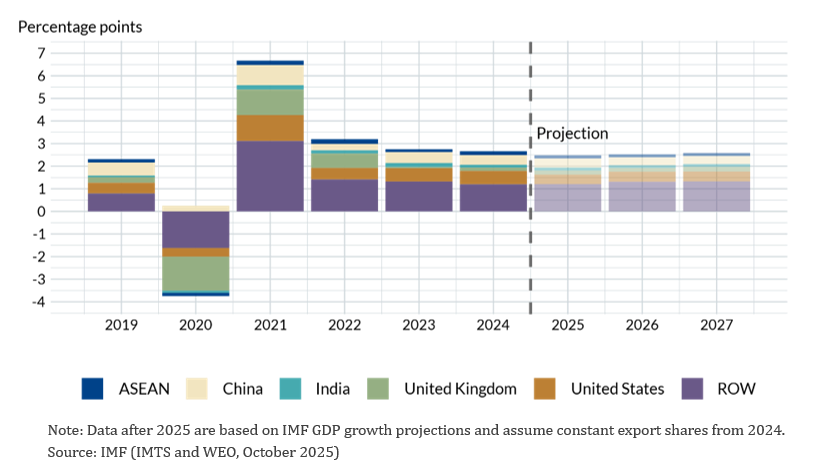
A forward-looking perspective further underlines the macroeconomic relevance of this shift, as Chart 3 suggests. Using IMF growth projections from 2025 onward and weighting partner-country growth rates by their 2024 shares in EU exports, the transatlantic economy remains an important driver of external demand for Europe. However, Asia’s relative contribution increases over time.
Excluding the exceptional pandemic years from 2020 to 2022, export-weighted growth for Asia—defined here as China, India, and ASEAN – is never lower than that of the US and the UK combined. This does not imply an abrupt redirection of Europe’s trade, but it does point to a gradual change in the external environment. Asia’s higher trend growth means that it will increasingly shape Europe’s export dynamics, with implications for business cycles, supply-chain-driven inflation pressures, and the transmission of global shocks to the euro area.
This evolving trade geography is already reflected in EU trade policy. In recent years, the EU has concluded trade agreements with Vietnam and Singapore and has intensified its engagement with the region more broadly. Negotiations with partners such as India, Malaysia, and the Philippines are ongoing. Over time, this is likely to make the EU’s external demand base more diversified and less exclusively transatlantic.
From a strategic perspective, India deserves particular attention. As a potential geopolitical counterweight to China, it may gain importance both as a sales market and as a production location. The euro area already plays a major role as a direct investor in India and is also among the most important sources of foreign direct investment in ASEAN economies.
Chart 3. EU-export weighted GDP growth of important trade partners
From a policy perspective, maintaining stable and resilient trade relations with the United States and the United Kingdom remains essential, as these partners continue to play a central role for EU exports and corporate profitability. At the same time, the growing importance of Asia calls for a more deliberate strategy of diversification, aimed at improving market access, strengthening trade facilitation, and managing risks along increasingly complex supply chains.
Trade policy should therefore be treated as a macroeconomically relevant policy field. Shifting trade weights will influence external demand, import prices, and the transmission of global shocks – factors that are directly relevant for monetary policy assessments of growth, inflation dynamics, and economic resilience in the euro area.
The global economic landscape is changing, and Europe is firmly embedded in this transformation. The challenge for policymakers is to combine continuity in established transatlantic partnerships with a strategic opening toward Asia’s dynamic growth regions. Europe’s future will be neither purely transatlantic nor purely Asia-oriented, but more diversified. The key question is whether Europe actively shapes this transition — or merely adapts to it after the fact.