This policy brief is based on Banca d’Italia, Temi di discussione, No 1507. The views expressed are those of the authors and not necessarily those of the institutions the authors are affiliated with.
Abstract
We investigate how inflation expectations affect pricing decisions in the housing market. We leverage a randomized control trial embedded within an Italian survey of real estate agents and combine (for each agent) survey data with high-frequency listing prices observed on a large digital platform. Exploiting an exogenous shift in inflation expectations generated by an information treatment, we find that higher inflation expectations cause a one-to-one increase in housing listing prices, on average. The pass-through is weaker in low-demand markets, as well as for agents who are more pessimistic about housing and credit developments.
Well-anchored inflation expectations play a pivotal role in monetary policy decisions – in particular during high-inflation periods – because expectations of future inflation significantly influence current price dynamics. Yet, the link between the subjective inflation expectations of price-setters and their pricing strategies remains unclear. Little is known, for example, about how changes in inflation expectations affect pricing decisions in the housing market or in markets for used goods. Existing literature has primarily focused on firms’ pricing behavior, while the role of intermediaries and brokers in shaping price-setting decisions in response to inflation expectations has received virtually no attention.
In a recent working paper, we investigate how subjective inflation expectations affect price-setting behavior in the housing market (Guglielminetti and Loberto, 2025). We provide novel evidence using a randomized control trial (RCT) among Italian real estate agents during the high-inflation period from the fourth quarter of 2022 to the second quarter of 2023.
Real estate agents intermediate a large share of housing transactions and play a central role in the formation of housing prices. They possess superior local market knowledge and determine directly initial listing prices, which are typically characterized by strong upward rigidity. Once a property is listed, prices are rarely revised upward, which makes the initial pricing decision crucial. Agents are typically compensated through a commission based on a fixed percentage of the final sale price. In a high-inflation period agents face a trade-off: raising nominal listing prices helps preserve the real value of their commissions, but higher prices can reduce the probability of sale (or increase the time required to sell the property). These features make the housing market an ideal setting to examine how subjective inflation expectations influence pricing decisions.
Like for households and firms, real estate agents’ expectations can be elicited from surveys. Moreover, both expectations and current decisions are jointly influenced by unobserved factors, making the identification of a causal impact of expectations on agents’ choices challenging. We exploit a randomized information treatment embedded in the Italian Housing Market Survey (IHMS). In this experiment, half of the real estate agents surveyed received recent information on consumer price inflation. This intervention led to a significant increase in their one-year-ahead inflation expectations (figure).
We match the agents interviewed in the IHMS with the housing ads they post on the largest online platform that offers real estate services in Italy, Immobiliare.it. This allows us to combine the agents’ survey responses with detailed information about the properties they sell, their current and past activity, and the microstructure of the local markets in which they operate.
This dataset allows us to estimate how an exogenous upward shift in inflation expectations translates into actual listing prices, rather than merely into planned price adjustments. This approach overcomes a common limitation in empirical studies of firms’ price-setting decisions, where only self-reported pricing intentions are available. Most notably, respondents usually report an average planned price change, regardless of the number of products or services they offer and the diversity of markets in which they operate.
Figure 1. Inflation Expectations in IHMS
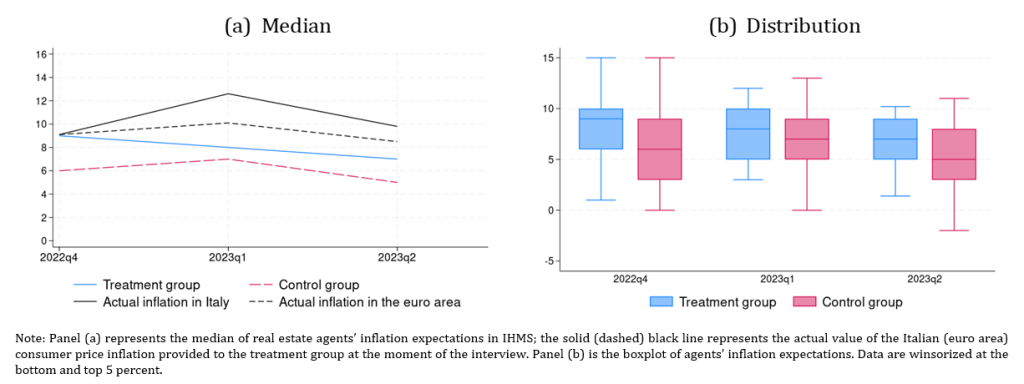
We employ an instrumental variable (IV) methodology, using the randomized treatment as an instrument for inflation expectations. Results indicate that a one percentage point increase in inflation expectations leads to a 0.8-1.1 percent increase in current listing prices. The effect is even more pronounced for new listings. These estimates are considerably higher than typical firm-level pass-throughs (0 to 0.3; Coibion et al., 2020; Baumann et al., 2024; Rosolia, 2024) and align with theoretical models predicting that markets with long price spells and high nominal rigidity experience amplified responses during periods of rising inflation (Werning, 2022).
We identify two mechanisms through which inflation expectations affect housing prices. The first goes through the prices of newly listed properties: expecting higher inflation, treated agents list new properties at higher prices compared with untreated agents. The second is an indirect effect that goes through existing listings: higher expectations reduce the likelihood that agents will engage in downward price revisions. As a result, properties remain listed at higher relative prices and stay on the market longer. Difference-in-difference analysis confirms that treated agents maintain higher prices even for properties already on the market, an outcome consistent with the rarity of upward revisions and the reluctance to cut prices when future inflation is expected.
Heterogeneity analysis reveals that the inflation expectations pass-through (IEPT) depends on market structure and as well as on agent characteristics. The pass-through is significantly weaker in more concentrated markets, where dominant agents may have greater pricing power and could sustain prices above their reservation values, allowing them to absorb the expected real losses associated with higher inflation. Conversely, the IEPT is stronger in high-demand markets, where we expect the trade-off between setting a higher listing price and experiencing a longer time-to-sale to be less pronounced.
At the agent level, those operating in multiple markets – an indicator of greater sophistication – display a larger pass-through. Conversely, agents reporting pessimistic expectations about future housing prices or noting that buyers face credit constraints show reduced responsiveness to expected inflation.
The study offers important policy insights. It demonstrates that inflation expectations influence not only firm-level pricing but also propagate through intermediated markets such as housing, which has significant macroeconomic implications given its role in household wealth, consumption, and the transmission of monetary policy. While the study focuses on a short, high-inflation period in Italy, which limits its generalizability to low-inflation contexts, these are precisely the conditions under which understanding the influence of expectations on pricing is most critical. By documenting a robust and heterogeneous pass-through of inflation expectations in the housing market, this research expands the literature on how monetary policy, by managing inflation expectations, can affect real economic activity through the behavior of market intermediaries.
Baumann, Ursel, Annalisa Ferrando, Dimitris Georgarakos, Yuriy Gorodnichenko, and Timo Reinelt. SAFE to Update Inflation Expectations? New Survey Evidence on Euro Area Firms (No. w32504). National Bureau of Economic Research, 2024.
Coibion, Olivier, Yuriy Gorodnichenko, and Tiziano Ropele. “Inflation expectations and firm decisions: New causal evidence.” The Quarterly Journal of Economics 135.1 (2020): 165-219.
Guglielminetti, Elisa, and Michele Loberto. Inflation expectations and price-setting decisions: insights from the housing market. No. 1507. Bank of Italy, Economic Research and International Relations Area, 2025.
Rosolia, Alfonso. “Do firms act on their inflation expectations? another look at italian firms.” Journal of Political Economy Macroeconomics 2.4 (2024): 651-686.
Werning, Iván. Expectations and the Rate of Inflation. No. w30260. National Bureau of Economic Research, 2022.