

This Policy Brief is based on Grigoli, Sandri, Gorodnichenko, and Coibion (2026), Monetary Policy According to Households: Perceptions, Reactions, and Channels, NBER Working Paper 35127. The views expressed in this Policy Brief are those of the authors and do not necessarily reflect those of the Bank for International Settlements or any other institution with which the authors are affiliated.
Abstract
The post-pandemic tightening cycle has revived debate about how monetary policy reaches households. Standard frameworks list a clear set of channels — the real interest rate, income, asset prices, and a credit channel — but their relative weight has long been pinned down by theory and calibration rather than by direct measurement of households’ beliefs. We provide an empirical channel-by-channel decomposition based on a survey of more than 25,000 US households combined with randomized information experiments. One channel does most of the work: households’ inflation expectations. Households expect that an increase in policy rates will increase inflation; in turn, they respond to higher expected inflation by moderating consumption. This finding differs sharply from the predictions of conventional theory, in which the real interest rate and the income channel do the heavy lifting. In our measurement, both are essentially absent. The same channel reappears in households’ portfolio decisions. The household-level transmission we measure is concentrated in respondents who are financially literate and aware of the central bank’s role.
The post-pandemic inflation surge and the aggressive tightening cycle that followed have revived long-standing debates about how monetary policy reaches the spending and saving decisions of households. The textbook account, formalized in Bernanke and Gertler (1995) and Christiano, Eichenbaum and Evans (2005), distinguishes a real-interest-rate (intertemporal-substitution) channel, an income channel, an asset-price channel, and a credit channel. The relative weight of each channel in shaping household behavior, however, has largely been pinned down by theory and calibration rather. The post-pandemic experience, in which consumption proved more resilient to tightening than many models had predicted, has sharpened the question of how well those calibrations capture the actual household-level transmission of policy.
Complementary literature uses surveys and information experiments to look directly at how households perceive monetary policy and how those perceptions translate into decisions. Coibion, Gorodnichenko and Weber (2022) and Coibion et al. (2023) show that simple central-bank communications move household inflation expectations substantially. Andre et al. (2022) document that households and experts hold strikingly different subjective models of the macroeconomy. Roth, Wiederholt and Wohlfart (2023) feed survey-measured expectation differences across policy counterfactuals into a heterogeneous-agent model and recover quantitatively plausible aggregate consumption responses. What has been missing is a comprehensive, channel-by-channel decomposition that connects the two halves of the transmission story at the household level: how a perceived change in the policy rate revises the full set of households’ macroeconomic expectations, and how each of those revised expectations independently affects spending and portfolio decisions.
In Grigoli, Sandri, Gorodnichenko and Coibion (2026), we build such a decomposition from a large-scale survey of more than 25,000 US households conducted in late 2024, with a follow-up wave three months later. This Brief summarizes the design, the main results, and what they imply for the conduct and communication of monetary policy. As we will show, our findings differ in important ways from the predictions of conventional theory.
The survey has two complementary pieces. The first is a hypothetical exercise in which respondents are asked to imagine that the Federal Reserve unexpectedly changes the federal funds rate by one, two, or five percentage points, in either direction, and to report how they think key macroeconomic variables — interest rates on saving and borrowing, inflation, wages, unemployment, house prices, and stock prices — would respond over the following year. This piece tells us how households reshape their macroeconomic expectations after a perceived policy change. The second piece is a randomized information experiment. Different subsets of respondents receive short factual statements about recent values for wages, prices, interest rates, asset returns, or unemployment, after which they report posterior beliefs and intended spending and portfolio choices. Because the treatments are random and shift different beliefs in different ways, we can use them as instruments to estimate how a revision in each type of belief independently affects behavior, holding the others fixed. Combining the two pieces yields the channel-by-channel decomposition.
Most patterns from the hypothetical exercise look conventional. Households expect higher policy rates to raise borrowing and saving rates, push unemployment up, and depress stock prices, with essentially no perceived pass-through to wages. The exception, and the most consequential one for the decomposition, is consumer prices. More than 60 percent of US households say that an increase in the federal funds rate would lead to higher inflation, not lower — a direct departure from the disinflationary intent of monetary tightening that standard theory ascribes to a rate hike. When asked why, the most common explanations are that firms raise prices to cover higher borrowing costs and that credit itself becomes more expensive — the cost-channel logic of Ravenna and Walsh (2006). Whatever its theoretical basis, this view aligns with the well-known price puzzle in the empirical monetary literature, especially over the first year following a rate hike (Christiano, Eichenbaum and Evans, 1999).
The information experiments let us estimate the household consumption function directly. Higher expected wages raise consumption strongly, consistent with standard models. Higher expected inflation reduces it, consistent with Coibion, Gorodnichenko and Weber (2022) and Georgarakos et al. (2024); the most plausible interpretation is precautionary, as households build a buffer against higher living costs and the greater uncertainty that high inflation tends to bring. This response runs counter to the textbook intertemporal-substitution prediction, under which higher expected prices should encourage households to bring spending forward. Higher borrowing rates discourage durable purchases, as expected; higher saving rates raise them, plausibly through a wealth effect. Stock and house price expectations have small and statistically imprecise effects on consumption.
Combining the two pieces of the design yields a channel-by-channel decomposition of the perceived consumption response to a one-percentage-point hike in the federal funds rate. Each block in Figure 1 is the product of how households revise their beliefs about a given macroeconomic variable in response to the rate change, multiplied by the strength with which that revised belief affects spending. The black dot is the net total.
Figure 1. Channel decomposition of monetary policy transmission to household consumption
(Percent change for a one percentage-point increase in the FFR)
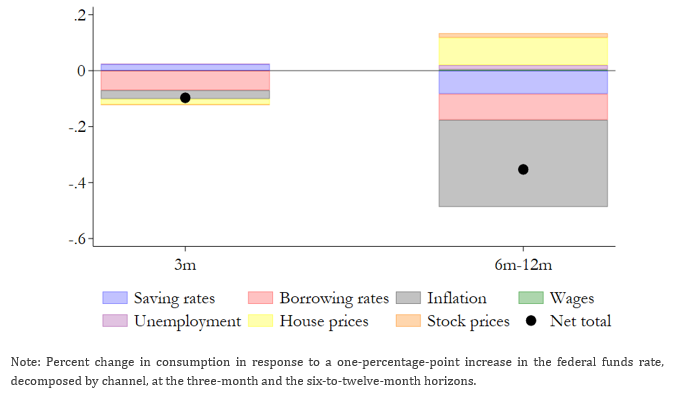
At the three-month horizon, all channels are quantitatively small and the perceived net effect on consumption is close to zero. At the six-to-twelve-month horizon, one channel does most of the work: inflation expectations. It accounts for most of the projected decline in consumption — larger than the borrowing-rate channel, larger than the saving-rate channel, and many times larger than the wage and unemployment channels combined. House prices push gently in the opposite direction. The picture differs sharply from the conventional account of monetary transmission. The income channel is muted because households see no meaningful link between the federal funds rate and their own wages. What remains is a transmission mechanism in which households’ inflation expectations — moving in the cost-channel direction rather than the disinflationary one — do the heavy lifting.
Households make many decisions beyond consumption. Because the survey also asks respondents how they would allocate a hypothetical USD 10,000 windfall across cash, bank deposits, stocks, bonds, gold, and cryptocurrencies, we can perform the same decomposition for portfolio choice. Figure 2 plots the result for each asset class.
Figure 2. Monetary policy impact and transmission channels to household portfolios
(Percent change for a one percentage-point increase in the FFR)
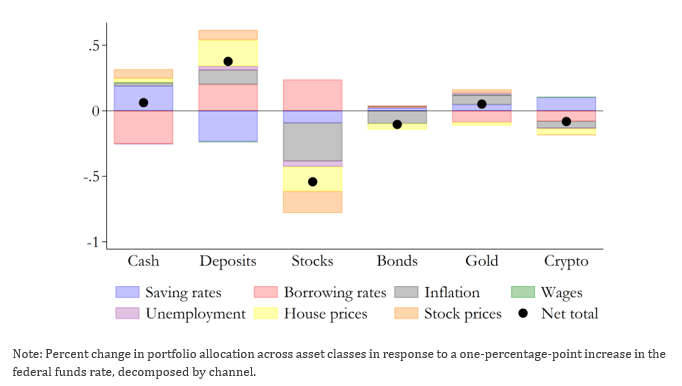
The dominant perceived response to a rate hike is a reallocation away from stocks and into bank deposits. The largest driver of the reallocation is again the inflation-expectations channel: higher expected inflation reduces stock and bond holdings and shifts holdings modestly into gold and cryptocurrencies, which households appear to treat as inflation hedges (Weber et al., 2023). Higher expected house prices push respondents to build cash reserves, plausibly to accumulate down payments or to hedge rising rental costs (Chopra, Roth and Wohlfart, 2025). The finding that one belief — inflation expectations — drives the bulk of the household-level response is therefore not specific to consumption; it reappears across spending and portfolio decisions alike.
The decomposition above is an average. There is substantial heterogeneity in how households perceive monetary policy, and most of the quantitative variation across households is explained by financial literacy combined with basic awareness of what the central bank does. Among respondents who can correctly identify the Federal Reserve as the institution that sets monetary policy and who answer basic questions on how interest rates and inflation interact with the purchasing power of their savings, the implied pass-through from a one-percentage-point rate hike into spending is much larger in absolute value than among other respondents. Among respondents who lack both pieces of basic knowledge, we cannot reject the null of no perceived effect on spending. The household-level transmission of monetary policy in our data is, in effect, concentrated in the subset of households who pay attention.
A second pattern worth flagging is the asymmetric response to interest rate hikes versus cuts. Households perceive a meaningful effect of rate hikes on their spending, but report essentially no spending response to comparable rate cuts. The mirror image appears in debt-related decisions — mortgage refinancing, paying down credit-card balances, taking on new debt — which respond mostly to rate cuts and barely at all to rate hikes. Labor-market intentions, by contrast, respond symmetrically to a change in the policy rate in either direction, consistent with a precautionary motive triggered by perceived increases in aggregate uncertainty.
The findings of our paper have implications both for how monetary transmission is modelled and for how it might be communicated. On the modelling side, the results call for a reconsideration of how households perceive the effects of monetary policy, as well as how they react to changes in expected inflation. In particular, the analysis underscores the presence of a strong cost-channel mechanism driving households’ perceptions and reactions to monetary tightening, which sits awkwardly with the disinflationary intent of policy rate hikes. On the communication side, the analysis underscores the need to better inform the broader public about the disinflationary effects of monetary tightening. At the same time, if households were persuaded that policy rate hikes lower inflation, this would dampen the contractionary impact on consumption.
Andre, P., Pizzinelli, C., Roth, C., and Wohlfart, J. (2022). “Subjective Models of the Macroeconomy: Evidence from Experts and Representative Samples”, Review of Economic Studies 89(6), 2958–2991.
Bernanke, B., and Gertler, M. (1995). “Inside the Black Box: The Credit Channel of Monetary Policy Transmission”, Journal of Economic Perspectives 9(4), 27–48.
Chopra, F., Roth, C., and Wohlfart, J. (2025). “Home Price Expectations and Spending: Evidence from a Field Experiment”, American Economic Review 115(7), 2267–2305.
Christiano, L., Eichenbaum, M., and Evans, C. (1999). “Monetary Policy Shocks: What Have We Learned and to What End?”, in Handbook of Macroeconomics, Vol. 1A, edited by J.B. Taylor and M. Woodford, Elsevier, pp. 65–148.
Christiano, L., Eichenbaum, M., and Evans, C. (2005). “Nominal Rigidities and the Dynamic Effects of a Shock to Monetary Policy”, Journal of Political Economy 113(1), 1–45.
Coibion, O., Georgarakos, D., Gorodnichenko, Y., and Weber, M. (2023). “Forward Guidance and Household Expectations”, Journal of the European Economic Association 21(5), 2131–2171.
Coibion, O., Gorodnichenko, Y., and Weber, M. (2022). “Monetary Policy Communications and Their Effects on Household Inflation Expectations”, Journal of Political Economy 130(6), 1537–1584.
Georgarakos, D., Coibion, O., Gorodnichenko, Y., and Kenny, G. (2024). “The Causal Effects of Inflation Uncertainty on Households’ Beliefs and Actions”, NBER Working Paper 33014.
Grigoli, F., Sandri, D., Gorodnichenko, Y., and Coibion, O. (2026). “Monetary Policy According to Households: Perceptions, Reactions, and Channels”, CEPR Discussion Paper 21408.
Ravenna, F., and Walsh, C. E. (2006). “Optimal Monetary Policy with the Cost Channel”, Journal of Monetary Economics 53(2), 199–216.
Roth, C., Wiederholt, M., and Wohlfart, J. (2023). “The Effects of Monetary Policy: Theory with Measured Expectations”, manuscript.
Weber, M., Coibion, O., Gorodnichenko, Y., and Candia, B. (2023). “Do You Even Crypto, Bro? Cryptocurrencies in Household Finance”, NBER Working Paper 31284.