

This policy brief is based on ECB Working Paper 3207, “A Quantile Probability Model for Sectoral Corporate Defaults in Europe”. The views expressed are those of the authors and not necessarily those of their institutions.
Abstract
Standard approaches to corporate stress testing focus primarily on average default risk. Yet stress episodes are often characterised by non-linear responses concentrated in the upper tail of the default distribution and varying across sectors. Using sector-level European corporate default data for roughly five million non-financial firms across nine euro area countries, and a quantile probability of default (QPD) framework estimated via unconditional quantile regressions, this brief shows that macro-financial variables affect corporate default risk non-linearly across quantiles and that this non-linearity differs markedly across sectors. The tail of the default distribution is three to five times more sensitive to macro-financial shocks than the median. Under an adverse trade shock scenario reflecting rising geopolitical and trade tensions, default risk increases sharply, especially in the first year, with construction, wholesale and retail trade, accommodation and food services, real estate, and arts and entertainment emerging as the most vulnerable sectors. The findings underline the importance of incorporating tail risk and sectoral heterogeneity into macroprudential surveillance and stress-testing frameworks.
Recent years have been marked by a sequence of unusually large shocks affecting European firms: the pandemic, geopolitical fragmentation, war, and two subsequent energy crises. While aggregate corporate default rates have remained relatively contained in many economies, stress has increasingly become concentrated among firms and sectors that are especially vulnerable to specific shocks.
This concentration matters for financial stability. Banks and policymakers are generally less concerned about modest changes in average default probabilities than about sharp deteriorations in the upper tail of the distribution, where corporate distress can become systemic. Yet, stress-testing frameworks often rely mainly on average relationships between macroeconomic conditions and default risk. Firms with specific vulnerabilities, such as exposure to trade disruptions or energy price increases, may show much stronger sensitivity to combinations of macroeconomic variables in a stress scenario. Conventional stress tests can therefore underestimate risk when they focus on aggregate default rates and do not account for sector-specific differences.
This note argues that such approaches may overlook vulnerabilities precisely when stress becomes most relevant. Using a quantile-based framework, we show that default risk in the upper part of the distribution reacts much more strongly to macroeconomic conditions than median risk does. Using granular corporate data, we also derive sectoral default probabilities, which reveal substantial differences in tail sensitivity across sectors.
Figure 1. Estimated sensitivities of default risk to macroeconomic variables at different quantiles

The central finding is that the sensitivity of corporate default risk to macroeconomic conditions is highly non-linear across quantiles. At the core, a standard stress-testing model is estimated, relating corporate flow default rates on the left-hand side to a set of macroeconomic variables on the right-hand side: sectoral components of GDP growth, the unemployment rate in first differences, the long-term interest rate in first differences, the spread between long-term and short-term interest rates in first differences, the European stock price index, and a country-level property price index. This equation is estimated at different quantiles of the distribution, allowing to obtain different coefficient and even fixed effect sensitivities for countries and corporate sectors at different points in the distribution. Fitted values generate the corresponding model PDs.
Figure 1 shows how coefficient estimates change between the 5th and 95th quantiles. As default rate levels increase, moving from lower to higher quantiles, the sensitivity of default rates to macro-financial conditions changes markedly. Unemployment, stock returns, property prices, and interest rates affect corporate defaults much more strongly in higher quantiles. Gross value added to GDP, by contrast, while showing some volatility at higher quantiles, remains broadly stable across the distribution.
Figure 2. Sectoral corporate default probabilities
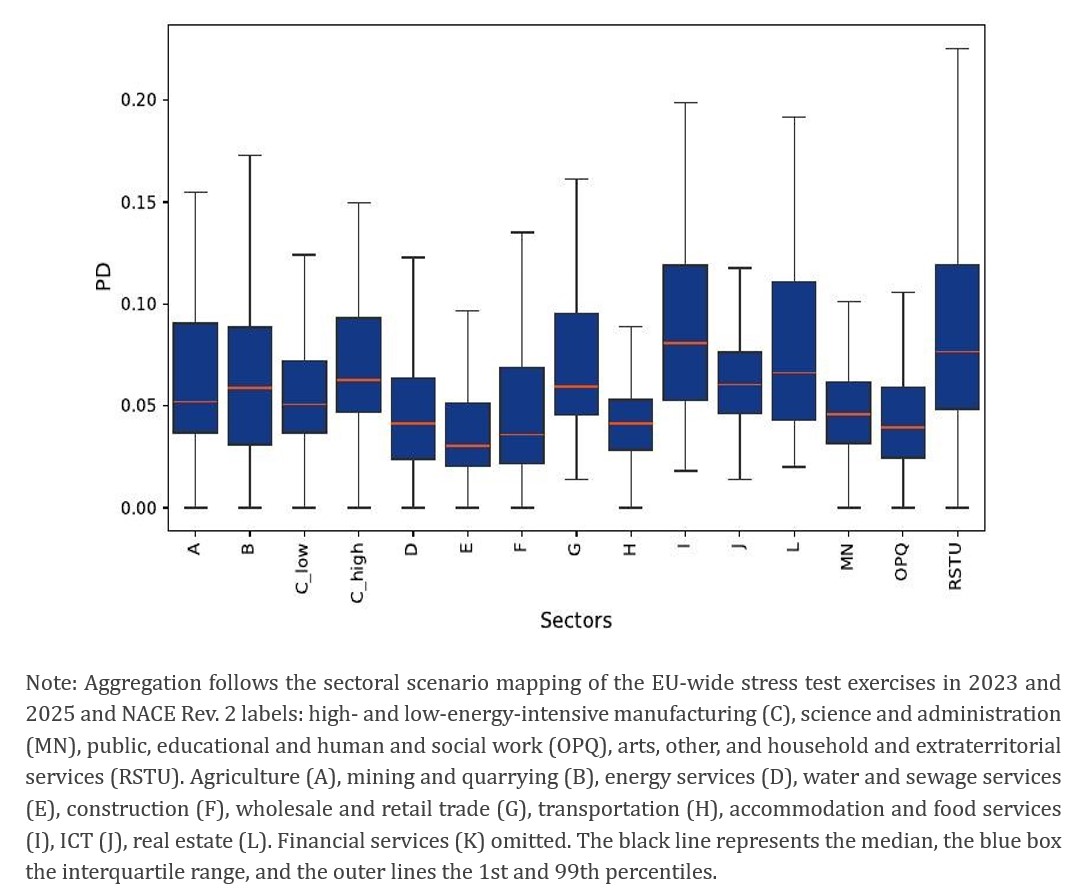
Figure 2 highlights the variation of sectoral corporate default probabilities by NACE-letter aggregation across nine euro area countries. The figure showcases on one side the different levels of PDs, which places the bulk of the observations for certain sectors at different ends of the PD distribution, indicating varying sensitivity to macroeconomic shocks in a quantile framework. It also reveals within-sector dispersion of corporate default rates: some sectors’ default rates most commonly materialise within an interquartile range of 5–7 percentage points, while others show limited variability within 3–4 percentage points.
Independently from PD levels, the transmission of macro-financial stress also varies sharply across sectors. Including sector fixed effects into the quantile regressions enables to measure the sectoral degree of non-linearity of PDs. Figure 3 shows estimated sectoral fixed effects contributing to fitted PDs at different quantiles, underlining pronounced variation not only in the cross-sectoral level, but also pronounced heterogeneity in cross-sectoral non-linearity. The figure showcases which sectors face the steepest amplification of default risk as one moves from the median to the upper tail of the distribution.
Figure 3. Sectoral heterogeneity across quantiles

Recent geopolitical developments have intensified concerns about fragmentation risks in the global economy. Trade restrictions, energy supply disruptions, and strategic decoupling affect firms both directly and indirectly through tighter financing conditions. In the ECB working paper 3207, the QPD framework is applied to an adverse scenario aligned with the European Central Bank’s June 2025 Broad Macroeconomic Projection Exercise (BMPE) and the 2025 EU-wide stress test. The scenario includes a further 10 percentage point bilateral tariff increase on euro area exports to the United States relative to the adverse scenario of the 2025 EU-wide stress test, implying an assumed 20 percentage point bilateral tariff increase relative to the baseline. Symmetric EU retaliation is assumed, alongside persistently elevated US-China tariffs and trade policy uncertainty that weakens financial market confidence, triggers disorderly corrections, and raises bank funding costs.
The scenario’s transmission operates through four main channels, ranked by impact. First, capital goods exports fall sharply as global firms postpone investment amid uncertainty, with peak effects in 2026. Second, competitiveness in the US market erodes directly. Third, domestic investment is suppressed. Fourth, precautionary saving and weaker consumer confidence depress consumption. At the sectoral level, the tariff-induced slowdown affects agriculture, mining, manufacturing, energy, utilities, and construction most severely, amplifying aggregate GDP losses through supply-chain linkages to downstream services and trade-intensive industries.
The scenario analysis highlights two important patterns, which are displayed in Figure 4. First, the relationship between macro-financial stress and default risk is strongly non-linear. PDs rise sharply from the 2024 baseline to the first scenario year, 2025, which delivers the largest macro-financial shock. Crucially, dispersion across quantiles also widens, reflecting the higher tail sensitivity of the QPD model. As the scenario assumes a partial recovery in 2026 and 2027, both PD levels and cross-quantile dispersion decline, although projected PDs remain above the pre-shock baseline throughout. Second, sectoral divergence increases significantly during the stress episode. Construction, wholesale and retail trade, accommodation and food services, real estate, and arts and entertainment record the strongest increases in tail PDs, with some sectors approaching default probabilities of 25 per cent or more at the 90th quantile. By contrast, information and communication technologies, transport, and utilities show comparatively muted responses, consistent with their lower cyclicality and weaker direct trade exposure.
Figure 4. Trade and geopolitical stress scenario

The findings have several concrete implications for policymakers and financial supervisors. First, stress-testing frameworks based mainly on mean default relationships will systematically understate vulnerabilities during adverse periods. Average default dynamics can remain relatively stable even while vulnerable sectors experience severe deterioration in upper-tail risk. Incorporating tail-sensitive approaches, such as the QPD framework, improves the identification of emerging risks and provides a more conservative, supervisory-relevant assessment of credit risk under stress.
Second, sectoral heterogeneity matters substantially. Monitoring frameworks should place greater emphasis on sectors with elevated tail sensitivity, including construction, real estate, accommodation and food services, and energy-intensive manufacturing. These sectors tend to amplify macro-financial shocks and warrant targeted supervisory attention, especially where banks have concentrated exposures. The country- and sector-level granularity of the QPD framework also supports a more targeted calibration of macroprudential instruments by linking sectoral PDs more directly to banks’ credit portfolios.
Third, distributional modelling offers a coherent and model-consistent basis for quantile selection in stress testing. The QPD approach embeds distributional estimation directly into the stress-testing workflow and allows flexible use of macro-financial scenario variables aligned existing Eurosystem frameworks. This makes it readily compatible with established stress-testing exercises as a modular challenger model. The framework has already been used in the Eurosystem stress tests of 2023 and 2025.
Overall, the note demonstrates that periods of macro-financial stress are characterised by increasingly concentrated vulnerabilities. Upper-tail risks rise much more strongly than average default measures would suggest while heterogeneity in levels and non-linearity across sectors highlight the need for scenario specific analysis. A quantile-based stress-testing framework captures these macro non-linearities and sectoral heterogeneities systematically, offering a more accurate and policy-relevant assessment of threats to financial stability under adverse macroeconomic scenarios.
Adrian, T., Boyarchenko, N., and Giannone, D. (2019). Vulnerable growth. American Economic Review, 109(4):1263–1289.
Budnik, K., Marques, A.P., et al. (2024). Advancements in Stress-Testing Methodologies for Financial Stability Applications. ECB Occasional Paper 348.
European Central Bank (2025). 2025 stress test of euro area banks. Stress test report, European Central Bank.
European Central Bank (2025). Eurosystem staff macroeconomic projections for the euro area, June 2025 – Box 2: US tariffs and trade policy uncertainty. Projections report, European Central Bank.
Firpo, S., Fortin, N.M., and Lemieux, T. (2009). Unconditional quantile regressions. Econometrica, 77(3):953–973.
Gourinchas, P.-O., Kalemli-Özcan, Ş., Penciakova, V., and Sander, N. (2020). Covid-19 and SME failures. NBER Working Paper 27877. Kalemli-Özcan, Ş., Sørensen, B.E., Villegas-Sanchez, C., Volosovych, V., and Yeşiltaş, S. (2024). How to construct nationally representative
firm-level data from the ORBIS global database. American Economic Journal: Macroeconomics, 16(2):353–374.
Koenker, R. and Bassett, G.J. (1978). Regression quantiles. Econometrica, 46(1):33–50.
Konietschke, P., Metzler, J., and Ponte Marques, A. (2026). A Quantile Probability Model for Sectoral Corporate Defaults in Europe. ECB Working Paper Series 3207.
Krüger, S. and Rösch, D. (2017). Downturn LGD modeling using quantile regression. Journal of Banking and Finance, 79:42–56.