

This policy brief is based on Banque de France, Working paper, World Cycles Revisited: Diverging Trends in Prices and Quantities. The views expressed are those of the authors and not necessarily those of the institutions the authors are affiliated with.
Abstract
We provide a new quarterly macro‑financial database covering 40+ economies over 1950–2019 and revisit the properties of “global” economic cycles. Global co-movement is much stronger for prices — inflation, equity prices and bond yields — than for quantity variables—GDP and domestic credit. Asset prices have become steadily more synchronized worldwide since the post‑war period, while output and credit co-movements have remained modest despite globalization. Trade openness is associated with higher synchronization of both activity and prices, but financial openness mainly increases synchronization in asset prices, not in output. A simple risk‑sharing mechanism can reconcile these facts: financial integration globalizes asset demand and promote risk-sharing, while encouraging more specialized, riskier production that de‑synchronizes output.
Policy debates about global economic factors — e.g. global financial conditions, inflation synchronization and US monetary policy global spillovers — often rely on evidence drawn from short samples, limited country coverages or annual data.
In a recent paper (Camous, Puy and Monnet, 2025), we address this gap by constructing a harmonized quarterly macro-financial database for the post-war era (1950–2019), covering 40+ advanced and emerging economies. We use this dataset to revisit the evidence on global economic cycles. In what follows, “global synchronization” refers to the increased co-movement in annual growth rates of each variable across countries. Our results highlight a sharp contrast between price and quantity variables and show that globalization has heterogeneous effects on business-cycle convergence.
The macro-financial dataset is constructed from archival volumes of the IMF’s International Financial Statistics (IFS). It provides harmonized quarterly coverage for key variables: real GDP, domestic credit, CPI inflation, stock prices and long‑term bond yields.
Two features matter for economic analysis and policy use. First, quarterly frequency over seven decades helps identify business cycles without conflating them with long‑run trends. Second, data quality follows best practice. For instance, GDP is constructed using indicator‑based temporal disaggregation (rather than mechanical linear interpolation), and credit series are corrected for definitional breaks by exploiting overlapping IFS vintages.
We revisit the conventional view that globalization has strengthened world business and financial cycles. Using our long horizon quarterly frequency dataset, we ask: how much of a typical country’s fluctuations are explained by a common world component, and does this differ across variables and over time? The main finding of our analysis is a sharp difference between prices and quantities synchronization.
Figure 1. Global synchronization is much stronger for prices than for quantities
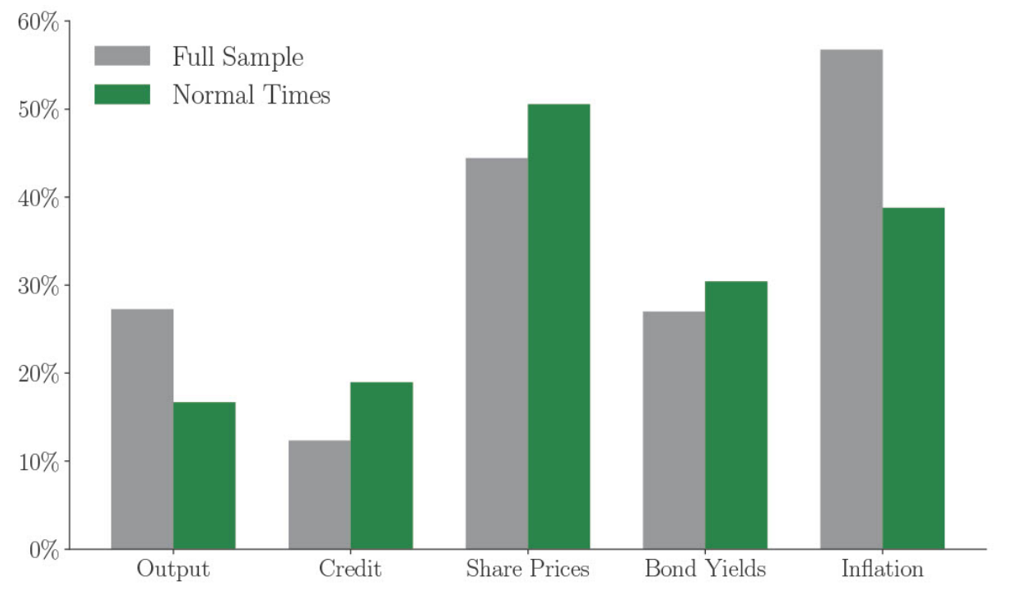
Notes: The figure reports, for the median country for each indicator, the share of variance of annual growth explained by the associated global cycle over 1950–2019. “Normal times” exclude major crisis periods: the first oil shock (1973–1983) and the Global Financial Crisis (2007–2010). Output is real GDP. Credit is domestic credit to resident non-financial corporations.
Sources: Authors’ calculations based on the global macro-financial database compiled from archival IMF sources (see related paper for details).
Indeed, as reported in Figure 1, across the full sample, world cycles explain a much larger share of the variance of inflation and asset prices than of GDP and domestic credit. In other words, global forces are clearly visible in the pricing of financial assets — and increasingly in inflation — while they account for a much smaller fraction of real activity fluctuations.
This gap has widened over time, as illustrated in Figure 2. Asset price synchronization rises steadily from the Bretton Woods era onwards. By contrast, output and credit synchronization remain low and broadly stable; if anything, the co-movement of quantities weakens after the Global Financial Crisis.
Figure 2. The divergence has widened over time
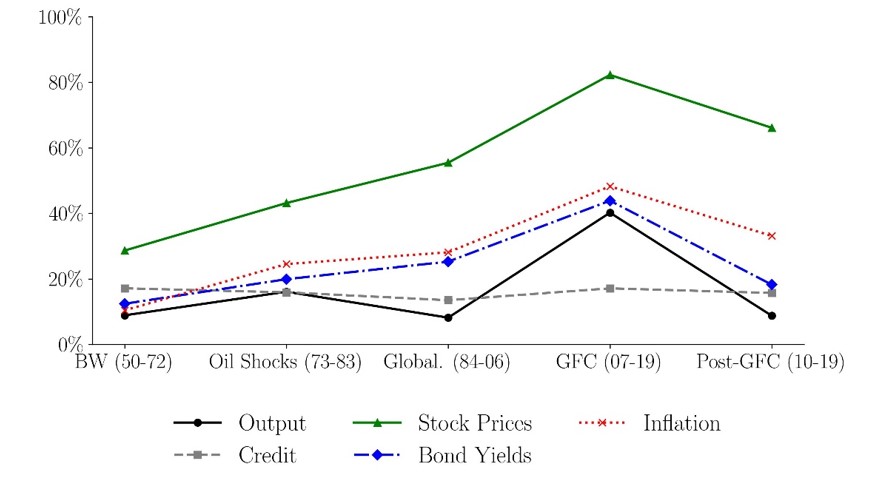
Notes: The figure reports, for the median country for each indicator, the share of variance of annual growth explained by the associated global cycle within each subperiod shown on the x-axis: Bretton Woods (1950–1972), first oil shock decade (1973–1983), globalization period (1984–2006), recent period with Global Financial Crisis (2007–2019), and post-GFC (2010–2019).
Sources: Authors’ calculations based on the global macro-financial database compiled from archival IMF sources (see related paper for details).
Two clarifications matter. First, the fact that asset price synchronization is already high under Bretton Woods indicates that strong co-movement in financial prices does not require fully liberalized capital flows. Second, price synchronization does not mechanically imply synchronized real economies.
We then relate a country’s exposure to world cycles to two dimensions of economic integration: trade openness (measured as the share of international trade to GDP) and financial openness (measured as de jure capital account liberalization).
The patterns are intuitive for trade: more trade openness is associated with higher synchronization of both output and asset prices. Financial openness is different. Countries that are more financially open exhibit stronger synchronization of asset prices with the global financial cycle, but not stronger synchronization of output. This result is surprising because equities are ultimately claims on output. The evidence suggests that finance primarily globalizes pricing and financial conditions, not necessarily real activity.
To make sense of these facts, we develop a simple two‑country general‑equilibrium mechanism with two features: (i) international portfolio choice subject to financial frictions and (ii) endogenous production choices.
Financial integration contributes to two forces. First, it globalizes asset demand — raising cross‑country co-movement in asset prices. Second, it improves international risk sharing, which can encourage countries to tilt production toward higher‑return but riskier and more specialized technologies. This increases idiosyncratic risk and lowers the co-movement of output across countries.
Global cycles are real — but they are variable-specific. Over 1950–2019, prices (especially asset prices) have become increasingly global, while quantities (GDP and credit) have not. This divergence matters for how we interpret globalization and for how we design policy frameworks in an environment where financial prices can move together across countries even when domestic activity does not.
In particular, for monetary policy, the results suggest that inflation and financial prices are increasingly shaped by global forces, whereas real activity remains comparatively country specific. This can complicate the inflation–activity trade-off: stabilizing inflation may require responding to shocks that are largely global in nature and may not coincide with the domestic business cycle.