

This policy brief is based on the recent IFC Bulletin no 67, in particular Araujo et al (2026). The views expressed are those of the authors and do not necessarily reflect the views of the BIS, Bank of Italy, Central Bank of Brazil, the IFC or its members.
Abstract
Central banks are increasingly exploring and deploying generative artificial intelligence (AI) across a wide range of functions, including economic and monetary analysis, statistical production, financial supervision and payment oversight. While continuous and rapid innovations are further expanding the capabilities and quality of generative AI’s outputs, the deployment of this new technology is not without challenges and risks. Hence, one fundamental question is how to make the most of promising yet often embryonic advances in an efficient, effective, ethical and safe way. This policy brief sheds light on four priorities based on central banks’ recent experience: securing adequate governance and resources for implementing generative AI; developing skills, literacy and IT infrastructure; ensuring robust documentation and data quality; and fostering cooperation between central banks and the multiple stakeholders involved in the data ecosystem.
Central banks are increasingly using generative AI1 to support a wide range of activities and functions (IFC (2025a, 2026)). A key reason is the versatility of most generative AI tools, which makes them suitable for many different applications spanning economic and monetary analysis and forecasting, supervision, payment oversight, financial education and consumer protection.
Yet, in practice, the use of AI is not without challenges, especially those related to data quality and IT infrastructure. On the data side, the main concern lies in preserving the high quality, credibility and integrity of central banks’ data, while ensuring their accuracy, explainability and interpretability as well as addressing broader privacy, security and ethical considerations. On the IT side, the required infrastructure typically demands secure, scalable and high-performing solutions, often entailing additional costs and complex trade-offs – for example with regard to the use of cloud-based services, skills, information protection and computing capabilities.
Drawing on a recent IFC Bulletin, this policy brief discusses how central banks are balancing the opportunities and challenges offered by generative AI to support their various functions and tasks. After taking stock of recent use cases (section 1), it suggests four ways forward to unlock the full potential of generative AI (section 2). Detailed references and use cases can be found in the referenced IFC Bulletin.
Most use cases in central banking appear to be related to four main areas.
Economic and monetary analysis appears to be one of the most promising areas in which generative AI can support central banks. First, large language models (LLMs) are opening new avenues for monitoring economic and financial trends. LLMs can help central banks tap into text-based sources to provide timely indicators and insights, inform risk assessments and complement traditional monitoring exercises. Moreover, when combined with machine learning, generative AI can help gain a better grasp of “soft” indicators, such as economic sentiment and expectations (IFC (2022, 2023)). This can be especially relevant when analysing agents’ behaviour, for instance, in assessing policy communication and monitoring feedback dynamics. Generative AI can also be used to extract meaningful information for policy purposes from vast collections of archival records, for example by helping users categorise and summarise documents.
A second area is nowcasting and forecasting. For instance, the transformer architecture that underpins LLMs can be effectively adapted to nowcast and anticipate key macroeconomic indicators such as the gross domestic product (GDP), inflation and unemployment (Koyuncu et al (2026)). LLMs can also improve the accuracy and timeliness of forecasts, including those related to inflation and the financial cycle, by integrating macroeconomic time series with instruction-based information such as text.
Third, central banks are leveraging generative AI to support the production of statistics, a responsibility that has become increasingly important over recent decades (Dilip et al (2026)). Applications range from classification and mapping tasks to data curation and quality assurance, especially for anomaly detection and editing. Another area in which generative AI supports the statistical function is dissemination, especially through the deployment of chatbots and retrieval-augmented generation (RAG) solutions to improve users’ access to internal and external databases (Tebrake et al (2026)). Statistical data retrieval can be further automated through the use of AI agents, for instance by developing a chain of specialised LM-based software systems to address users’ queries from the initial request through to the final response.
A fourth domain is supervisory and oversight activities, which central banks are often mandated to perform depending on institutional settings. These tasks usually require access to vast amounts of specialised knowledge bases and/or restricted documents, where generative AI – including through RAG systems – can provide valuable support (Crisanto et al (2026)). For example, it is being used for the microprudential supervision of banks, since LLMs can be particularly helpful in analysing the activities of and risks posed by financial institutions. It can also be leveraged to support the oversight of payment systems, for instance by helping to ensure regulatory compliance.
In view of central banks’ recent experience with generative AI, making the most of the opportunities offered by this new technology may call for: (i) securing adequate governance and resources; (ii) developing skills and IT infrastructure; (iii) strengthening data quality, including through information standards and (meta)data curation; and (iv) sharing best practices, especially through international collaboration.
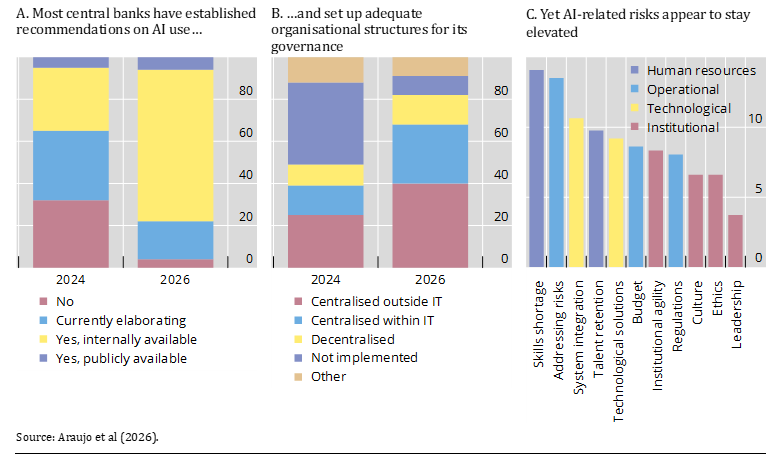
A first priority is to secure adequate governance and resources for implementing generative AI. In practice, most central banks have been allocating additional budget for AI applications. They have also been establishing frameworks to use AI internally in a responsible, safe and efficient way, while also developing adequate organisational structures (Graphs 1.A and 1.B). Yet significant challenges remain, most notably ethical and technological considerations related to security, privacy and dependency on external providers (Graph 1.C). This puts a premium on developing suitable risk management frameworks. These can be beneficial at the level of the organisation – for example by avoiding overreliance on a few companies through the adoption of open-source solutions – and at the level of the financial system – by preventing phenomena such as content homogenisation that could potentially create significant systemic risks (Naudon (2026)).
A second related priority is to develop IT infrastructure and skills in-house, not least to avoid excessive and uncritical reliance on AI “black box” solutions. Looking at IT aspects specifically, implementing generative AI in the organisation requires adequate computing resources. This calls for carefully balancing the respective implications of developing in-house solutions – in terms of costs, flexibility and scalability – versus using (external) cloud solutions – with due consideration of the risks they may pose to data protection and sovereignty. In this regard, the development of small language models (SLMs), which are generally less computationally intensive than LLMs, can be one way forward.
A third priority is to ensure robust documentation and data quality, including in terms of integrity. This is essential for making data AI-ready, including through a number of practical steps. The first is the curation and dissemination of rich and standardised metadata, including through the support of common metadata architectures. A second requirement is the use of interoperable standards (IFC (2025b)), of which the Statistical Data and Metadata eXchange (SDMX) and Data Documentation (DDI) initiatives are prime examples. Third, continuous curation can support traceability and integration with authentic sources, for instance, through the Model Context Protocol (MCP). Other actionable measures include the use of common – and whenever applicable persistent – identifiers such as the Document Object Identifier (DOI), the development of attribution conventions as illustrated by open licenses, disclaimers and citation standards (UNSC (2025)), the use of blockchain to certify the integrity and authenticity of sources, as well as the adoption of generative engine optimisation (GEO) techniques to ensure that official data are accurately referenced.
Last but not least, a fourth priority is to continue fostering adequate data sharing and cooperation – especially at the international level – to secure the provision of trustworthy information as a global public good. Fortunately, sharing data in a secure and responsible way is increasingly supported by ongoing advances in privacy-enhancing technologies, such as homomorphic encryption methods, pseudonymisation and anonymisation (IFC (2025c)). This is particularly important for granular data used to train or fine-tune generative AI solutions. Synthetic data generation also offers a way to preserve confidentiality while retaining statistical properties, though their quality must be rigorously assessed. More broadly, central banks’ experience shows that collaboration between the various stakeholders involved in the national and global data ecosystem can play a decisive role in advancing generative AI applications. Collaboration is particularly instrumental when it comes to sharing source code, pooling expertise and jointly developing technological solutions, such as in the area of financial supervision and official statistics.
Graph 1. Central banks have made notable advancements in AI governance since 2024
(In per cent of respondents)
Artificial intelligence (AI): computer systems capable of performing tasks that normally require human intelligence (FSB (2017)), for instance by inferring how to generate outputs from the inputs they receive (OECD (2024)). It includes applications such as machine learning (ML) and generative AI.
AI agents: systems designed to act autonomously (ie without constant human intervention), making decisions and taking actions based on their programming and objectives.
AI-ready data: data that are suitable for consumption by AI systems and models, such as LLMs. Key dimensions include quality, interoperability, accessibility and compliance (both ethical and legal).
Generative AI: a subset of AI that produces new content, such as text, images, audio or video, based on patterns learned from existing data (or “training data”), usually in response to a user’s prompt.
Knowledge base: a repository of information that provides domain-specific or general data to AI models. Knowledge bases can include various data types, including textual documents, which can be used to provide organisation-specific context through techniques such as RAG.
Large language models (LLMs): AI models trained on vast amounts of text data with the goal of generating human-like language. These models are designed to perform a wide range of natural language processing tasks, including summarising, translating, answering questions and interacting with users.
Model Context Protocol (MCP): an open framework and standard that enables the integration of AI systems with selected external software and data sources.
Privacy-enhancing and -preserving technologies: technologies designed to minimise risks of privacy infringement, such as anonymisation, encryption, differential privacy, homomorphic encryption and secure multiparty computation.
Retrieval-augmented generation (RAG): a technique aimed at improving the quality of generative AI responses by integrating relevant context from pre-defined knowledge sources into each user prompt.
Small language models (SLMs): models similar to LLMs, but with significantly fewer parameters and trained on less data than LLMs.
Araujo, D, G Bruno, A Cap, J Marcucci, R Schimdt, O Sirello and B Tissot (2026): “Generative artificial intelligence in central banking”, IFC Bulletin, no 67, March.
Crisanto, J C, A Currat, J Ehrentraud and W Wu (2026): “In data we trust? Emerging policy and supervisory approaches to AI data use in financial services”, FSI Insights, no 73, March.
Dilip, A, Z Mdingi, O Sirello and B Tissot (2026): “The evolving role of central bank statistics”, IFC Bulletin, no 66, February.
Financial Stability Board (FSB) (2017): Artificial intelligence and machine learning in financial services – market developments and financial stability implications, November.
Irving Fisher Committee on Central Bank Statistics (IFC) (2022): “Machine learning in central banking”, IFC Bulletin, no 57, November.
——— (2023): “Data science in central banking: applications and tools”, IFC Bulletin, no 59, October.
——— (2025a): “Governance and implementation of artificial intelligence in central banks”, IFC Report, no 18, April.
——— (2025b): “SDMX adoption and use of open source tools”, IFC Report, no 17, February.
——— (2025c): “Data science in central banking: enhancing the access to and sharing of data”, IFC Bulletin, no 64, May.
——— (2026): “Data science in central banking: exploring generative AI”, IFC Bulletin, no 67, March.
Koyuncu, B, B Kwon, M J Lombardi, F Perez-Cruz and H Shong Shin (2026): “Introducing BISTRO: a foundational model for unconditional and conditional forecasting of macroeconomic time series”, BIS Working Papers, no 1337, March.
Organisation for Economic Co-operation and Development (OECD) (2024): “Explanatory memorandum on the updated OECD definition of an AI system”, OECD Artificial Intelligence Papers, no 8, March.
Naudon, A, (2026): “Opening remarks”, IFC Bulletin, no 67, March.
Tebrake, J, E B Boukherouaa, J Danforth and M N Harikrishnan (2026): “StatGPT: AI for official statistics”, IMF Departmental Papers, vol 2026, no 004, March.
United Nations Statistical Commission (UNSC) (2025): Fostering AI-readiness and responsible redistribution of official statistics, room document by the World Bank, Fifty-sixth session, New York, 4–7 March.
Expressions formatted in italics are further defined in the Glossary section.