

This Policy Brief is based on Cantore, C., Gatto, M., Gaudio, F. S. and Meichtry, P. (2026), “Fiscal Sustainability when Public Debt is High: The Role of Portfolio Liquidity”, Banque de France Working Paper No. 1055, July. The views expressed are those of the authors and do not necessarily reflect those of the Banque de France or the authors’ other affiliated institutions.
Abstract
The fiscal outlook of many advanced economies, including the U.S., has deteriorated markedly over the past few years. At the same time, higher interest rates have raised debt-servicing costs and renewed concerns about fiscal space. In this Brief, we examine how the prevailing level of public debt shapes the transmission of fiscal and monetary policy shocks. When public debt is already high, additional government bonds provide a smaller marginal insurance benefit, as investors already hold sufficient liquid wealth. Thus, following a fiscal expansion, precautionary bond demand weakens and real interest rates must remain higher for longer to clear the bond market. Debt-servicing costs rise more persistently, amplifying the increase in real government debt and narrowing fiscal space. By contrast, monetary policy shocks have only a limited effect on the insurance value of government bonds, and their transmission is much less sensitive to initial debt levels.
Public debt in many advanced economies has increased substantially following recent crises. At the same time, higher interest rates have raised debt-servicing costs and renewed concerns about fiscal space. When debt is already high, governments have less room to respond to future shocks or finance priority spending. Understanding how public indebtedness shapes the effects of fiscal and monetary policy is therefore important for assessing debt sustainability.
How does the prevailing level of public debt shape the transmission of fiscal and monetary policy shocks? In Cantore et al. (2026), we examine this question with a focus on the liquidity services of government bonds. Government bonds are valued not only for their return, but also because they help households self-insure against future changes in their economic state. A larger stock of outstanding debt changes this insurance value and households’ willingness to accumulate bonds for precautionary purposes, with implications for the transmission of subsequent policy shocks.
Our main finding is that fiscal expansions can pose greater risks to debt sustainability when public debt is initially high. For the same increase in government spending, real government debt rises more and remains elevated for longer when the economy starts from a higher debt-to-GDP ratio. By contrast, the effects of monetary policy shocks are much less sensitive to the initial level of public debt, because these shocks have only a limited effect on the insurance value of government bonds. The liquidity value of government debt is therefore a key determinant of fiscal space.
The analysis is based on a three-agent New Keynesian model similar to Cantore and Leonardi (2025), with three household types: capitalists, savers and hand-to-mouth households. These households differ in their access to financial assets. Capitalists can hold both liquid government bonds and illiquid capital, while savers can hold only bonds. Hand-to-mouth households do not trade assets within the period and finance their consumption with labour income and previously accumulated bonds.
Household types are not fixed. Households may move between types over time, reflecting idiosyncratic economic risk. Only government bonds are portable across states, so they provide self-insurance against future changes in households’ economic state. By contrast, capital pays off only in the capitalist state: it offers a higher expected return, but makes consumption smoothing across future states harder. Capitalists therefore face a portfolio choice between liquid government bonds and illiquid capital.
The liquidity premium is the expected excess real return of capital over government bonds and captures the value of bond liquidity. Capital offers a higher expected return as compensation for its illiquidity. The premium rises when the demand for insurance strengthens and falls when the supply of liquid assets expands. Its movements therefore reflect changes in the relative attractiveness of illiquid capital and liquid government bonds.
We compare steady-state debt-to-GDP ratios between 57% and 100%, approximating the evolution of U.S. debt from 1984–2000 to 2010–2020. The policy regime is held fixed at monetary dominance: the central bank raises the nominal interest rate more than one-for-one with inflation, while the government adjusts primary surpluses to stabilise debt. Because fiscal policy is passive in this sense, debt always returns to its steady state. This allows us to study how the initial stock of public debt shapes the transmission of policy shocks within the same policy regime.
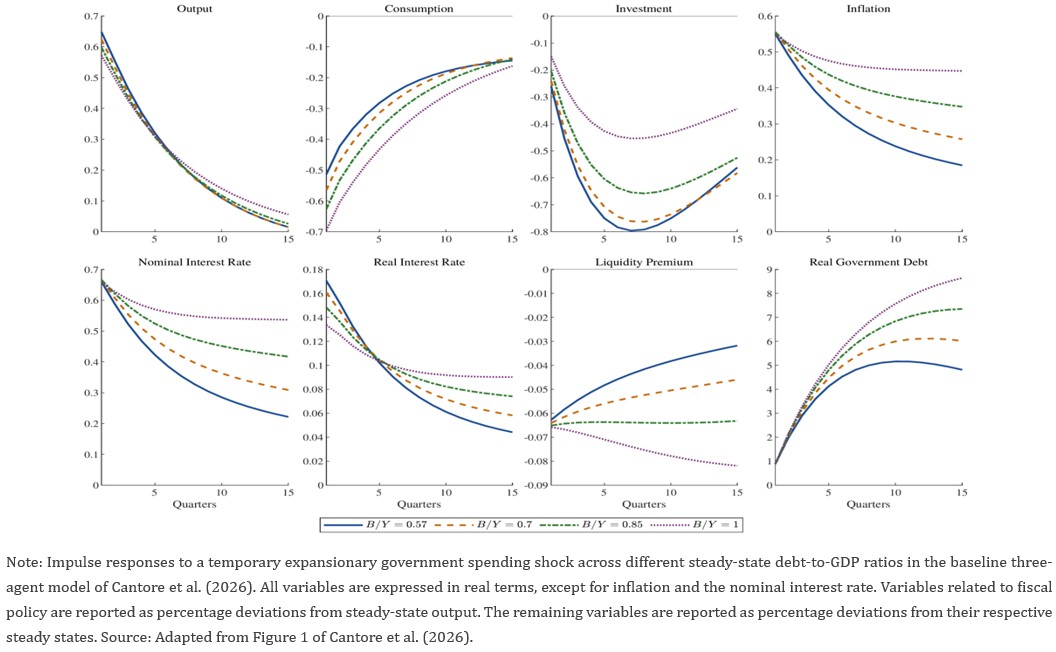
We consider a temporary increase in government spending equal to 1% of steady-state output and compare its effects across steady-state debt-to-GDP ratios of 57%, 70%, 85% and 100%. Figure 1 summarizes the responses of the main macroeconomic variables, including nominal and real interest rates, the liquidity premium, and real government debt.
Consider first the baseline calibration with a debt-to-GDP ratio of 57%. As standard in New Keynesian models, higher government spending raises aggregate demand, output, and inflation. The central bank lifts the nominal interest rate more than one-for-one with inflation, so the real interest rate rises. The fiscal shock also has redistributive effects: hand-to-mouth households use their higher labour income to consume more, whereas capitalists and savers cut spending to absorb the increase in public debt. Capitalists reduce both consumption and capital holdings, depressing aggregate investment. Overall, output expands at the expense of private consumption and investment.
Raising the initial debt-to-GDP ratio produces sizable changes in these dynamics. The response of output remains broadly similar across debt ratios, but the same increase in public expenditure generates much more persistent inflation and longer-lived increases in nominal and real interest rates. Aggregate consumption falls more, driven by lower spending by capitalists and savers, while investment declines significantly less. This is consistent with Bayer et al. (2023): since liquid and illiquid assets are imperfect substitutes, an increase in public debt does not displace physical assets one-for-one as a savings vehicle. The consequences for public debt are substantial: at a debt-to-GDP ratio of 100%, real government debt increases almost twice as much after four years as under the 57% baseline.
These differences are consistent with the interaction between the return on government bonds and their self-insurance value. Higher public expenditure induces the government to issue more debt, while higher real interest rates make bonds more attractive. For capitalists, this return effect by itself tilts portfolios towards bonds and away from capital. At the same time, however, the fiscal expansion raises the consumption of hand-to-mouth households, making that state less painful. Capitalists therefore have less incentive to accumulate liquid bonds for precautionary purposes, and illiquid capital becomes relatively more attractive. Savers do not face this portfolio choice, since they can invest only in bonds.
The liquidity premium falls after the fiscal expansion at every initial debt level, but its decline becomes larger and more persistent as the debt-to-GDP ratio rises. A larger stock of outstanding debt means that capitalists already hold more liquid wealth and are better buffered against idiosyncratic risk. Additional government bonds therefore provide a smaller marginal insurance benefit. As precautionary bond demand weakens, capitalists progressively rebalance their portfolios towards illiquid capital. This is a relative effect: bond holdings still increase and investment still falls, but the latter does so by comparatively less. The smaller decline in investment at high debt levels is thus consistent with a weakening self-insurance motive.
With the liquidity premium remaining persistently lower, clearing the bond market requires real interest rates to remain higher for longer. For a given fiscal expansion, debt-servicing costs therefore rise more persistently when initial public debt is higher, amplifying the increase in real government debt and narrowing fiscal space. The initial stock of debt matters because it changes the insurance value of additional bonds and, through households’ portfolio choices, the interest-rate response needed to absorb them.
The role of portfolio choice is further supported by a two-agent version of the model without savers, similar to Bilbiie et al. (2022). When capitalists must absorb all government debt and the meaningful portfolio margin is absent, differences in the responses across initial debt ratios become much smaller.
Figure 1. Government spending shock
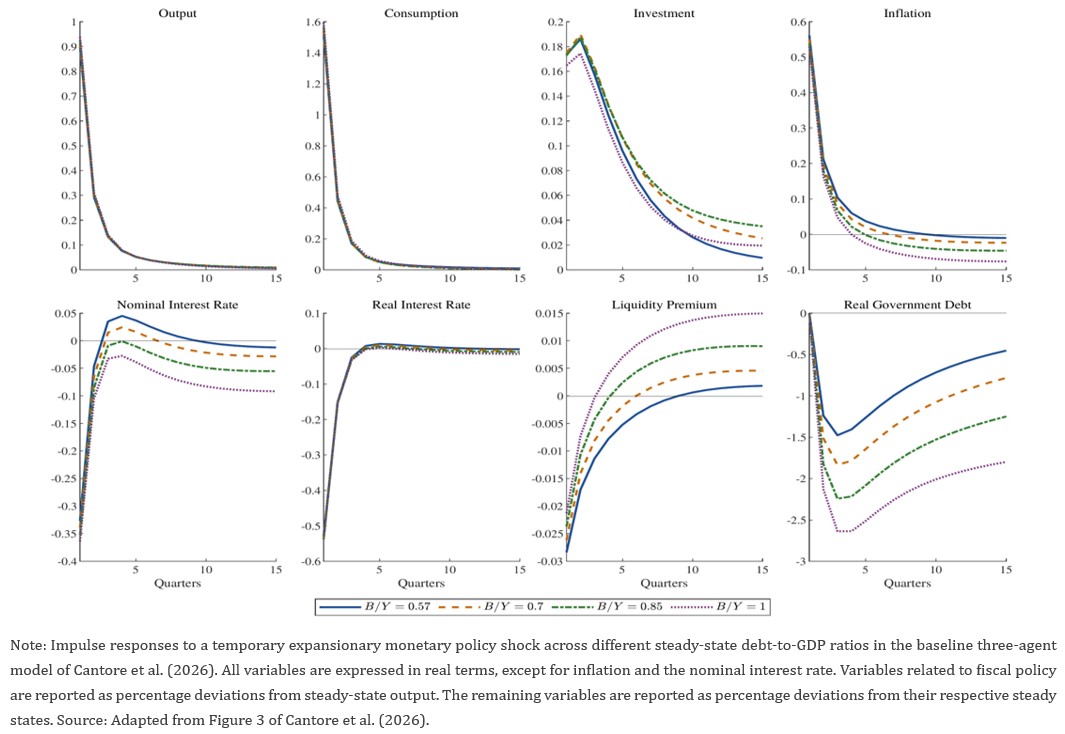
We now turn to an expansionary monetary policy shock. As Figure 2 illustrates, lower nominal and real interest rates boost output, consumption and investment, while stronger aggregate demand puts upward pressure on inflation. The monetary expansion increases the consumption of capitalists, savers and hand-to-mouth households, with the largest relative gains for the latter. The decline in interest expenses reduces real government debt and, given the passive fiscal rule, real tax revenues.
For capitalists, the return on bonds and the self-insurance motive now work in the same direction. Lower real interest rates make bonds less attractive, while the improvement in hand-to-mouth consumption reduces the incentive to hold them for insurance purposes. Capitalists therefore shift savings out of bonds and into illiquid capital, with savers partly offsetting this shift. The liquidity premium, however, decreases only slightly and temporarily. These small movements indicate that the self-insurance mechanism is negligible under monetary shocks: the supply-side effect, operating through the lower stock of government bonds and real interest rates, dominates.
Consequently, varying the initial debt-to-GDP ratio has only minor effects on aggregate dynamics and the real interest rate path. The responses across debt levels largely overlap, in contrast to the more persistent inflation, real-interest-rate pressures and debt accumulation following a fiscal expansion at high initial debt. Higher public indebtedness therefore does not mechanically alter the transmission of every policy shock. Its effects depend on how the disturbance changes the insurance value of government bonds and households’ precautionary demand for them.
Figure 2. Monetary policy shock
Fiscal sustainability depends not only on debt levels and primary balances, but also on the liquidity value of government bonds and households’ use of these bonds for self-insurance. When households value public bonds for their liquidity services, higher steady-state debt amplifies the fiscal costs of government spending shocks. A larger supply of liquid assets weakens precautionary bond demand, requiring persistently higher real interest rates and thereby raising debt-servicing costs. Fiscal expansions undertaken when public debt is already high can therefore raise debt-servicing costs, speed up debt accumulation and narrow fiscal space.
The contrast with monetary policy is important. The transmission of monetary expansions to aggregate economic activity and real interest rates is largely invariant to initial debt levels because these shocks have little effect on the insurance value of government bonds. The implications of high public debt thus depend on the nature of the policy shock and its effects on households’ portfolio choices. Overall, the liquidity value of government bonds and the self-insurance channel of bond demand emerge as key determinants of fiscal space.
Bayer, C., Born, B. and Lütticke, R. (2023), “The liquidity channel of fiscal policy”, Journal of Monetary Economics, 134, 86–117.
Bilbiie, F. O., Känzig, D. R. and Surico, P. (2022), “Capital and income inequality: An aggregate-demand complementarity”, Journal of Monetary Economics, 126, 154–169.
Cantore, C. and Leonardi, E. (2025), “Monetary–fiscal interaction and the liquidity of government debt”, European Economic Review, 173, 104979.
Cantore, C., Gatto, M., Gaudio, F. S. and Meichtry, P. (2026), “Fiscal sustainability when public debt is high: The role of portfolio liquidity”, Banque de France Working Paper No. 1055, July.