

This policy brief is based on Jácome, Luis I., Nicolás E. Magud, Samuel Pienknagura, and Martín Uribe. 2026. “Fiscal Populism and Monetary Policy Rules,” NBER Working Paper No. 35758 (September). The views expressed in this presentation are those of the authors and do not necessarily represent those of the IMF, its Executive Board, or IMF management.
Abstract
Using data for a large set of advanced economies and emerging markets since 1960, this column explores the historical links between populist regimes, fiscal monetization, and inflation, and how these links affect monetary policy in the 21st century. Results suggest that, historically, left-leaning populist regimes are linked to increases in central bank lending to the central government, a gauge of deficit monetization. In turn, central bank lending is associated with marked increases in inflation. Moreover, past exposure to populism that relied on deficit monetization affects the conduct of monetary policy today. Countries with a history of deficit monetization and left-wing populist regimes systematically respond, currently, more strongly to deviations of inflation expectations from target, even after controlling for the direct effect of past inflation on monetary policy rules. In short, central banks operating under the shadow of past populist regimes that relied on inflation-prone deficit monetization continue today to need to send stronger signals of their independence and commitment to price stability to effectively anchor inflation expectations.
The global economy has recently witnessed three intertwined economic trends emerge — rising fiscal deficits, growing public debt levels, and a spike in inflation globally, and at the same time a rise in populist regimes. Fiscal concerns, which were already brewing prior to 2019, were exacerbated by the spending needs and recovery efforts during and after the COVID-19 pandemic. They are now being further impacted with growing military spending. Public debt levels have risen and risks to the debt outlook are heavily tilted to the upside (IMF, 2024). In turn, inflation rose in many countries since 2021, as supply bottlenecks and the fiscal response during the COVID-19 pandemic interacted with other global shocks that caused energy prices to increase, such as Russia’s invasion of Ukraine, and more recently the war in the Middle East. At the same time, further social discontent in the aftermath of the global financial crisis (GFC) sparked a wave of populism in both advanced and emerging markets and developing economies, to levels not previously observed (Funke et al, 2023).
A key question going forward is how these forces may interact and reinforce each other. And what can be the medium- to long-term legacy of the current juncture.1
Against this backdrop, in a recent paper we focus on two interrelated questions: (1) How do populist regimes relate to fiscal outcomes, especially central bank financing of the central government, and, through this link, inflation? (2) How does past exposure to populist regimes associated with monetized fiscal imbalances influence future policy decisions? To answer them, we combine a novel database of populist regimes from Funke et al. (2023) with annual data on central bank lending to the central government from the IMF’s central bank (non-standardized) survey, and data on inflation for the 1960–2008 period. In a separate exercise, we also include quarterly data on policy rates, inflation expectations, inflation targets, economic activity, and exchange rates for 32 inflation-targeting countries for the period since each country’s adoption of an inflation-targeting regime until 2023. Importantly, the identification of populists is based on their discourse rather than their outcomes. This distinction is relevant because discourse does not necessarily translate into policy implementation and outcomes.
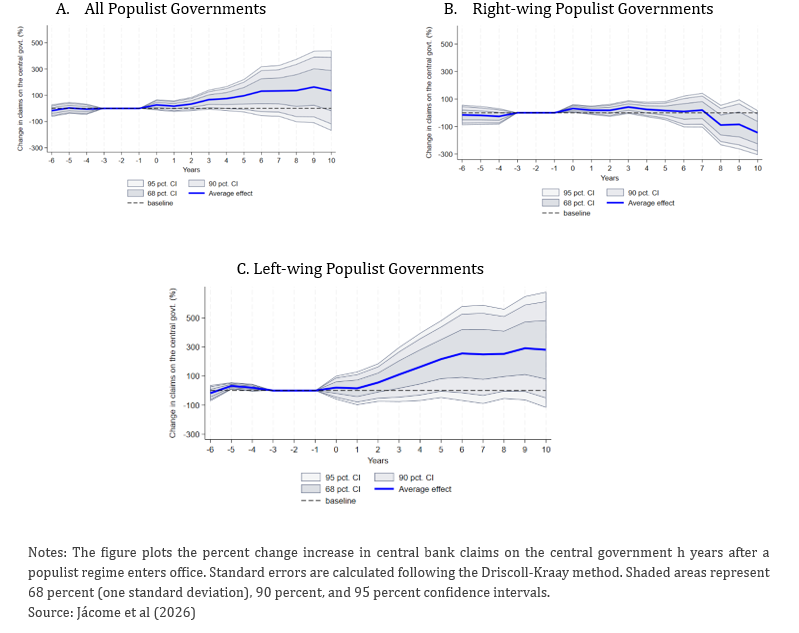
We find that, historically, populist governments — especially those classified as left-leaning — are associated with a significant increase in central bank lending to the central government. Specifically, we show that, compared with a non-populist government, the emergence of a new populist government results in a 150 percent cumulative increase in central bank credit 10 years after the populist government takes office, although these effects are not statistically significant (Figure 1). However, when we zoom in on different types of populist regimes, we find different patterns. While the emergence of right-wing populist governments is linked to moderate and insignificant growth in central bank credit, central bank credit grows substantially, and in a statistically significant way, in the aftermath of left-wing populist governments taking office — 300 percent cumulative growth in central bank credit, on average, 10 years after the populist government takes office. Results are consistent with past evidence that left-wing populist regimes tend to pursue expansionary policies, especially when one of their goals is to focus on domestic demand and redistributive objectives, the latter typically attributed to left-leaning governments.
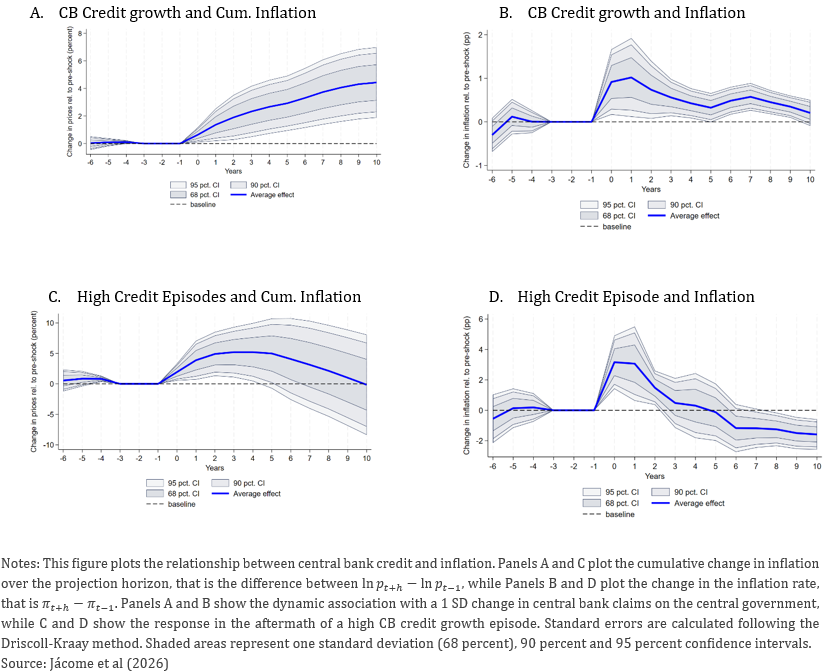
We also find that, compared with non-populist governments, increases in central bank credit to the central government are associated with an increase in inflation (Sargent and Wallace, 1981). A one-standard-deviation increase in central bank credit yields an increase in inflation that peaks at 1 percentage point, on average, two years after the increase in central bank credit. In turn, the increase is linked to a 4 percent cumulative increase in prices after 10 years, relative to a country that did not experience an increase in central bank credit (Figure 2). Taken together, our results illustrate the link between populism, fiscal deficit monetization and fiscal dominance, and inflation.
Figure 1. Populism and Central Bank Credit
We next turn to the longer-run legacy of populism for the conduct of monetary policy. In the context of the literature on experienced learning, we estimate how exposure to past populist regimes with high central bank lending shapes current monetary policy reaction functions among inflation-targeting countries. Note that we do not study how leaders can shape the conduct of monetary policy when they are in power; rather, we zoom in on the shadow that populist governments, long before the adoption of inflation-targeting regimes, can cast on the conduct of monetary policy in the present. Specifically, beyond short-term effects, exposure to populism and deficit monetization can affect monetary policy over the medium to long term, as posed in our second question. Building on Jácome et al. (2025), we estimate the link between past exposure to populism and high levels of central bank credit to the central government, on the one hand, and the conduct of monetary policy, on the other hand, in a sample of countries with central banks currently following an inflation-targeting regime. The results point to a relevant link between past experiences and current policy actions.
Figure 2. Central Bank Credit and Inflation
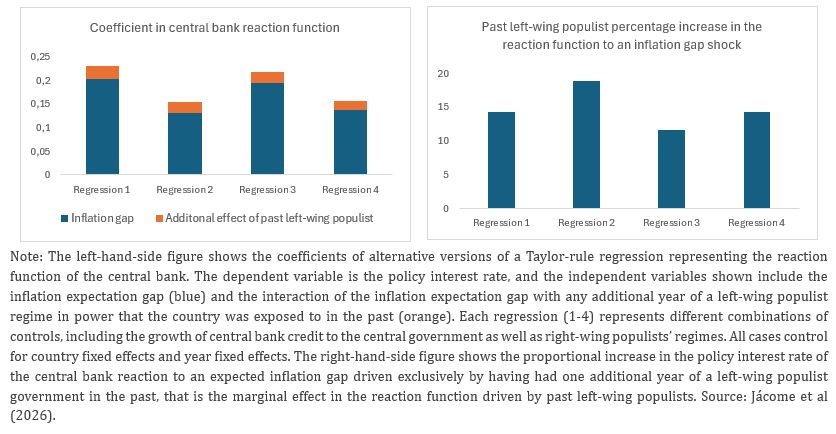
We find that central banks in countries with a past experience of left-wing populism and high levels of central bank credit (deficit monetization) currently respond more forcefully to deviations of inflation expectations from the target (Figure 3). We interpret this as central banks in countries with past exposure to populism and deficit monetization having to assert their independence by responding more forcefully to signs of inflation de-anchoring. That is, in the context of the literature on experienced learning, we stress the persistent effect of past populist policies: central banks operating under the shadow of past populist regimes that relied on deficit monetization continue, even today, to need to send stronger signals of their independence and commitment to price stability to effectively anchor inflation expectations and contain inflationary pressures. Additionally, when we split populist governments between right-wing and left-wing ones, we find an economically meaningful effect of past exposure to left-wing populist governments, but not to right-wing ones. Consistent with the interpretation that central banks with a populist past need to respond more forcefully when inflation expectations appear less firmly anchored, in a restricted sample for which measures of inflation forecast dispersion are available, we find that the differential response of central banks with a populist past is larger when disagreement about future inflation is high.
Figure 3. Taylor-rule responses to inflation gap shocks
Possible interpretations of why the response to the expected inflation gap is larger in economies that experienced past left-wing populist regimes include: (1) a fragile expectations process; (2) a credibility/signaling mechanism; (3) institutional reform; and (4) a forward-looking regime-switching probability effect. One could hypothesize that the longer a central bank works under an inflation targeting framework and presumably improves its operation (potentially associated with improving its credibility over time), it would need a smaller change in interest rates for the same expected inflation gap shock. However, in exploring these explanations, the data shows that central banks continue needing to be extra hawkish regardless of time. Hence, we interpret this as reflecting the existence of experienced learning, as it translates into a latent positive probability that fiscal dominance could return.
Hence, to preserve their credibility, central banks in economies with a history of left-wing populism continue to be more hawkish in order to keep inflation expectations well anchored.
Funke, Manuel, Moritz Schularick, and Christoph Trebesch (2023), “Populist Leaders and the Economy,” The American Economic Review, 113 (12), 3249–88.
IMF (2024), “Fiscal Monitor: Putting a Lid on Public Debt,” IMF, 2024.
Jácome, Luis I., Nicolás E. Magud, Samuel Pienknagura, and Martín Uribe (2026), “Fiscal Populism and Monetary Policy Rules,” NBER Working Paper No. 35758 (September).
Jácome, Luis I., Nicolás E. Magud, Samuel Pienknagura, and Martín Uribe (2025), “The Legacy of High Inflation on Monetary Policy Rules,” NBER Working Paper, No. 34107 (August).
Magud, Nicolas E. and Antonio Spilimbergo, “Economic and Institutional Consequences of Populism,” 2021. CEPR Discussion Paper DP15824.
Sargent, Thomas J. and Neil Wallace (1981), “Some Unpleasant Monetarist Arithmetic,” Quarterly Review, Federal Reserve Bank of Minneapolis, 5.
To be sure, the link between fiscal imbalances and inflation is well understood (see Sargent and Wallace, 1981). Similarly, recent literature has documented the macroeconomic consequences of populism (Funke et at, 2023, and Magud and Spilimbergo, 2021). However, less is known about the ways in which these forces interact and what its potential legacy could be.