

This policy brief is based on the research presented in the Banking Supervision Policy Working Paper Series RSC 2025/45. The views expressed are those of the authors and not necessarily those of the institutions the authors are affiliated with.
Abstract
We examine the impact of FinTech on bank credit risk across 63 countries from 2013 to 2021. We employ a novel measure based on FinTech investment activities to directly capture FinTech development. The analysis distinguishes between bank-based and market-based financial systems to assess whether FinTech’s influence on bank credit risk varies in different financial structures. We account for spatial dependence in bank risk across countries by utilizing various spatial models. Our findings first reveal the existence of positive spatial dependence on bank credit risk across countries. It implies that risk in the banking sector has a positive spillover effect on neighboring countries, thereby validating the necessity of spatial analysis. Second, utilizing the Spatial Durbin Model, which best describes our data, we find that FinTech reduces bank credit risk both domestically and across borders. Third, this risk-reducing effect of FinTech is predominantly driven by economies with bank-based financial systems, whereas it is absent in those with market-based financial structures. Finally, within bank-based countries, the credit risk-mitigating impact of FinTech is more pronounced in financially underdeveloped economies compared to those with well-developed financial markets
The rapid expansion of FinTech over the past decade has transformed financial intermediation, competition, and risk allocation. While FinTech promises efficiency gains and improved access to finance, its implications for financial stability — and in particular for bank credit risk — remain contested.
There are several competing theories regarding whether the overall impact of FinTech development on the banking sector is positive or negative. The “competition-fragility” hypothesis posits that greater competition in the financial system encourages increased risk-taking by individual financial institutions, thereby leading to an overall negative impact on the soundness of banks. Conversely, the “technology spillover theory”, or the “Schumpeter’s innovation theory”, suggests that FinTech innovations are likely to diffuse beyond their original creators, potentially leading to industry-wide improvements in efficiency and service quality. In addition, competition from FinTech may itself contribute to lower bank credit risk. As FinTech platforms often operate with less stringent screening and lower borrowing costs, it is expected that banks would encounter less risky borrowers in their lending operations due to the greater appeal of FinTech lending platforms to adverse borrowers (so called “bottom fishing”).
Existing empirical evidence is fragmented. Most studies focus on individual banks or single countries and typically ignore cross-border spillovers. Moreover, little attention has been paid to the role of financial structure, despite well‑documented differences between bank-based and market-based systems in regulation, information disclosure, and the allocation of credit risk.
We address these gaps by examining whether, and under what conditions, FinTech affects bank credit risk at the banking-system level, taking into account international spillovers and differences in financial structure. As an indicator of the bank credit risk, we use the non-performing loan (NPL) ratio for 63 countries over the period 2013-2021. We focus on the following research questions:
To answer these questions, we employ a novel measure of FinTech development to capture the size/scale of FinTech sector, namely the FinTech Investment Activities data from the Pitchbook which directly reflects the actual volume of investment that flows into the FinTech industry and is comparable across countries.
To reflect the growing interconnectedness of financial systems, we employ spatial econometric models, which allow bank credit risk in one country to depend on developments in others. While for the analysis we use a battery of explanatory variables, our main focus is on the impact of the measure of the FinTech activities1 on the development of the NPL ratio in the countries in our sample. We distinguish between direct and indirect effects of FinTech on bank credit risk. The direct effects refer to the impact of changes in the explanatory variable in one country on the development of the NPL ratio in the same country. Indirect effects, on the other hand, capture the effects of changes in an explanatory variable in one country on the NPL ratio of the rest of the countries in the sample. We are interested in the results for the full sample but also for different country classification.
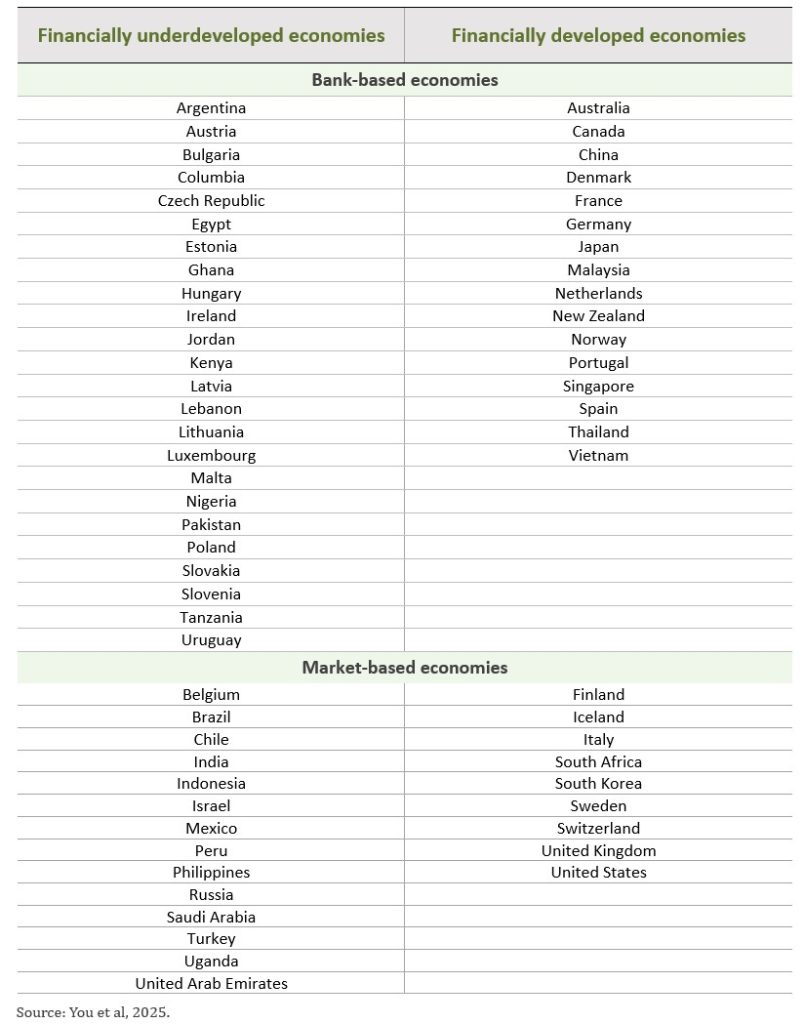
Countries are categorized according to bank-based and market-based financial structures as well as their financial development as financially developed or underdeveloped, following Demirguc-Kunt and Levine (1999). We classify a country as financially developed if both the level of development of its bank (private credit by deposit money banks to GDP ratio) and capital market (stock market total value traded to GDP ratio) are above the average of all the countries in our sample. The rest of the countries are regarded as financially underdeveloped. Next, we construct the conglomerate index by calculating the financial structure score for each country using the indicator of relative size, activities and efficiency 2, based on which countries are classified to be bank-based or market-based. We then take the average of the outcome within the group of financially underdeveloped and developed countries respectively. These two averages are employed as a benchmark. Countries with a cross-time mean higher than the benchmark indicate stronger stock market development relative to the banking sector and are regarded as having a market-based financial system; if lower, a bank-based financial system is presumed. The list of countries, together with their classification, is provided in the table below:
FinTech mitigates bank credit risk both directly and indirectly
For the full sample, FinTech investment is associated with lower bank credit risk both domestically and abroad. The negative direct effects lend support to the argument that, under competitive pressure from FinTech firms, banks may also be motivated to focus more on institutional and wealthy clients in pursuit of stronger performance. Furthermore, as banks increasingly adopt FinTech tools and technologies, the observed effects are also in line with prior research suggesting that such technologies can help minimize human error, enhance data processing and screening, and improve the efficiency of banks’ risk management practices. It is also consistent with the view that the bottom fishing strategy of FinTech lending may attract sub-prime customers away from the formal banking sector.
The negative indirect effect of FinTech on bank risk implies that FinTech development also reduces bank credit risks in neighboring countries. This finding is consistent with the observation that, although many FinTech firms initially operate within a single economy, their successful business models are often imitated in other markets or gradually expanded across borders. Such cross-border expansion may generate knowledge spillovers and intensify competition in financial services. In this context, local banks’ integration with foreign FinTech firms could enhance efficiency through cost reductions, improved service delivery, and more effective risk management. In addition, competition induced by foreign FinTech firms may incentivize local banks to improve service quality, refine product offerings, and manage costs more effectively to remain competitive. Furthermore, the size of the indirect effects is noticeably bigger than that of direct effects, suggesting that FinTech development has far reaching impact on neighboring jurisdictions in reducing their bank risks.
Such risk mitigation is present mainly in bank-based financial systems
Separating the full sample into bank-based and market-based economies allows us to study more precisely the impact of FinTech development on credit risk. Estimations for the bank-based economies yields similar and even stronger impact of FinTech activities on credit risk as the full sample estimations. On the contrary, estimations for the market-based economies do not show any significant, either direct or indirect, impact.
A number of factors could have contributed to such an intriguing finding. First, in both bank-based and market-based financial systems, banks play a crucial role in raising and distributing financial resources to viable sectors of the economy. However, the dominance of banks in the process of capital mobilization and allocation is far more pronounced in the former compared to the latter. The emergence and operation of FinTech in bank-based systems have a significantly more competitive impact on banks than in market-based systems due to the larger substitution gap that FinTech fills in the former.
Second, the systemic importance of banks in bank-based economies might lead to stringent banking supervision and regulation in such economies to safeguard financial stability. Even if the banking regulation is comparable in bank-based and market-based economies, the regulatory perimeter is significantly lower in the latter. This can create significant regulatory arbitrage, allowing FinTech operations in bank-based systems to function with greater flexibility, compared to their counterparts in marked-based systems. As such, FinTech firms can assume greater risk, while banks reduce their risk exposure, thereby lowering overall bank credit risk.
Third, the level of information disclosure varies between bank-based and market-based systems, being much higher in case of the latter due to investor demand. Given the powerful data acquisition and processing capabilities of FinTech, it provides more readily accessible and comprehensive data to stakeholders, including financial institutions, analysts, investors, regulators. The rapid advancement of FinTech has notably alleviated the information asymmetry challenges of the financial market. Hence, the adoption and operation of FinTech tools in bank-based systems are expected to have a greater impact on reducing credit risk levels.
Stronger effects in financially underdeveloped bank-based economies
Within bank-based systems, the stabilizing effect of FinTech is more pronounced in financially underdeveloped economies. Financial regulation may be weaker in financially underdeveloped countries compared to developed nations, due to factors such as limited regulatory capacity, lower adherence to international standards, and weaker institutional frameworks, Furthermore, information asymmetry in financial markets tends to be more severe in these economies, characterized by less transparent financial reporting, the absence of robust bankruptcy procedures and contract enforcement mechanisms, and weaker regulatory oversight. In these environments, FinTech appears to play a larger role in mitigating information asymmetries and reallocating risk away from banks.
The above-described results are robust to different alternative specifications, like using lagged independent variables, alternative credit risk measures in form of capital adequacy ratio instead of the NPL ratio or treating Austria and Luxembourg as financially developed countries.
Several policy-relevant conclusions emerge.
First, financial structure matters. The impact of FinTech on banking-sector risk is not universal, implying that uniform regulatory approaches to FinTech may be ineffective or even counterproductive.
Second, in bank-based systems, especially in financially underdeveloped economies, FinTech can support financial stability by reducing bank credit risk. Policies that facilitate responsible FinTech development and bank–FinTech collaboration may therefore yield stability benefits.
Third, while bank risk declines, there is a possibility that risk is shifted outside the regulated banking sector. Supervisors should ensure that risk migration to FinTech lenders does not create blind spots in the financial system. Finally, the presence of strong cross-border spillovers highlights the need for international coordination in both FinTech oversight and macroprudential policy.
Demirguc-Kunt, A. and Levine, R. 1999. Bank-based and market-based financial systems – cross-country comparisons. Policy Research Working Paper Series 2143, The World Bank
You, K., Koranteng, B. and Klacso, J. 2025. Fintech and bank credit risk: does financial structure matter? Evidence from spatial analysis. Banking Supervision Policy Working Paper Series RSC 2025/45
For the analysis, we use the natural logarithm of FinTech Investment Activities as the main explanatory variable. By using the natural logarithm, we decrease the potentially significant differences in the activities in different countries in absolute terms and the estimated coefficients give us a measure of the elasticity of the changes in NPL ratios to the dynamics of these investment activities.
Considering the banking sector, its size is measured as the deposit money banks’ assets to GDP ratio. The level of activities is reflected using private credit by deposit money banks to GDP ratio. Efficiency is captured by the inverse of the overhead costs to total assets ratio, a higher value of which implies higher efficiency. For the capital market, size, activities and efficiencies are measured as stock market capitalisation to GDP ratio, total value traded to GDP ratio, and the stock market turnover ratio, respectively.