

This Policy Brief is based on Banque de France Working Paper No. 1040. The views expressed are those of the authors and do not necessarily reflect those of the Banque de France.
Abstract
A US monetary tightening is widely believed to pull foreign capital into the United States as overseas investors buy US Treasuries. Drawing on bilateral data on US external assets and liabilities from 1994 to 2019, we show that this story is incomplete. Much of the inflow following a Federal Reserve tightening reflects US investors repatriating funds from foreign equity markets, rather than foreigners loading up on US safe assets. This reveals a strong heterogeneity between domestic and foreign investors and across asset classes. Extending the analysis to central bank information shocks – monetary surprises that also reveal news about the economy – we document a distinct, “risk-on” global rebalancing: US investors buy more foreign equities while foreign investors move into US equities. Identifying which investor actually rebalances is essential to understand how US monetary policy spills over to global markets.
When the Federal Reserve tightens, capital is widely thought to flow into the United States as investors, attracted by higher yields, buy US Treasuries. This intuition shapes how policymakers reason about the global spillovers of US monetary policy. Yet it leaves a basic question unanswered: who actually rebalances their portfolio when US rates rise? Do inflows reflect foreign investors buying more US safe assets, or US investors pulling back from risky markets abroad? The distinction is far from academic. It determines which markets are most exposed, through which channels spillovers travel, and whether the global response stabilises or amplifies the initial shock.
We address this question using detailed bilateral data on US cross-border portfolio flows from March 1994 to June 2019 (based on Bertaut and Judson, 2014). The data separately track US investors’ holdings of foreign securities and foreign investors’ holdings of US securities, broken down by instrument and counterparty country. To identify US monetary surprises, we use the shocks of Jarocinski and Karadi (2020), which separate “pure” monetary policy shocks from central bank information shocks. We then trace how each type of flow responds over the following months.
A look at the data already hints at the answer. Capital flows are far less globally synchronised than asset prices: while debt and banking flows move closely with the Global Financial Cycle (Rey, 2015), equity flows display markedly weaker commonality across borders. This divergence suggests that portfolio adjustments in equity markets are more heterogeneous – driven by particular investors rather than a common, worldwide repricing – and motivates our decision to decompose flows by both investor identity and asset class.
At the aggregate level, a contractionary US monetary policy shock generates net capital inflows into the United States, consistent with the conventional view that monetary tightening attracts foreign capital. Yet, decomposing these flows by asset class reveals a first surprise. As shown in Chart 1, the inflows are concentrated in equities rather than bonds: net equity flows decline markedly following the shock, indicating capital moving into the United States, while net bond flows remain largely unchanged. So the inflow is not, as often assumed, a bond story; it is an equity story.
Chart 1. Effects of a US monetary tightening on net capital flows
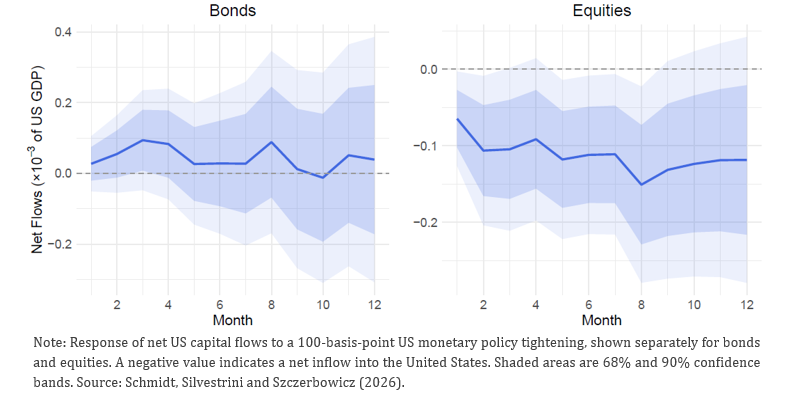
It is tempting to read the aggregate picture, but net flows can be misleading. A decline in net equity flows could reflect US investors selling foreign equities, foreign investors buying more US equities, or both at once; a flat net bond response could equally hide two offsetting movements that cancel out. Only by separating the two sides of the balance sheet – what US investors do abroad, and what foreign investors do in the US – can we identify who actually moves.
Chart 2. Effects of a US monetary tightening on bilateral capital flows
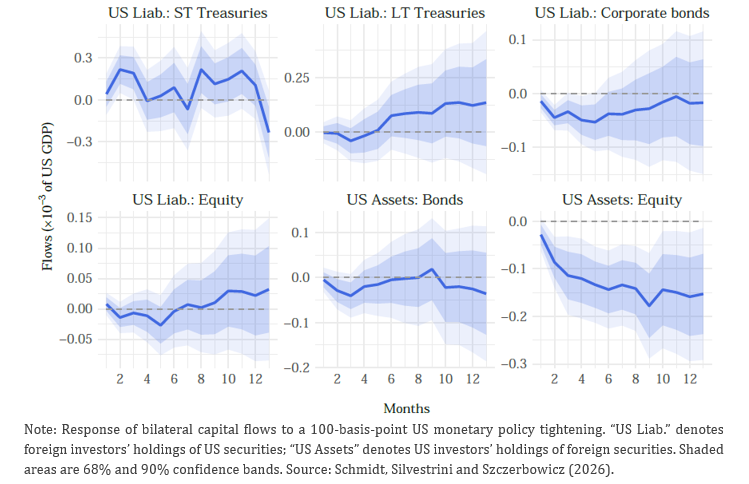
Chart 2 decomposes the response by investor and asset class. On the liability side – foreign holdings of US securities – foreign investors shift towards short-term US Treasuries and away from corporate bonds, a modest flight towards safe, dollar-denominated assets. The striking result is on the asset side: US investors sharply and persistently cut their holdings of foreign equities. This is the largest and most durable response we find. A 100-basis-point tightening triggers a cumulative repatriation of around $2.4 billion in foreign equities over nine months – roughly 5% of the average US foreign equity position.
The retrenchment is not confined to advanced economies. While our results are driven mainly by flows with advanced economies – which dominate US cross-border positions – we also find significant repatriation from emerging-market equities. Foreign demand for US Treasuries differs across groups, too: emerging markets tilt towards short-term Treasuries, valued for their liquidity and safety, whereas advanced economies, with deeper markets and longer horizons, increase their holdings of long-term Treasuries.
Why do US investors react so much more than their foreign counterparts? In principle, if all investors read a shock the same way, prices would simply adjust and little trading would occur. Observable flows arise precisely when beliefs or constraints differ across investors. Our results point to balance-sheet constraints that bind more tightly for US investors when the Fed tightens. As for example shown by Drechsler et al. (2018), leveraged US-based institutions fund themselves from households and must hold liquidity buffers. When policy rates rise, the cost of liquidity increases, compressing their balance-sheet capacity and forcing them to shed risky positions – including foreign equities. Foreign investors, by contrast, do not face the same direct funding squeeze from US policy.
The contrast between equities and bonds reinforces this reading. Foreign equities tend to be held by institutional investors such as mutual and hedge funds, which are more exposed to currency swings and often leave positions unhedged. Foreign bonds are held mainly by long-term investors – pension funds and insurers – who hedge currency risk more systematically, both as part of asset-liability management and to meet regulatory requirements (Campbell et al., 2010; Du et al., 2024). A tightening that raises hedging costs and currency volatility therefore prompts sharper adjustment in equity portfolios, while bond holdings remain comparatively stable. Consistent with this, the retrenchment from foreign equities is robust across alternative shock measures, scalings and country groups, and is even stronger following monetary easing.
Capital inflows through US investors repatriating their funds appreciate the US dollar. Yet, the familiar link between higher rates and a stronger dollar does not always hold. During the 2008 financial crisis, the Fed slashed rates while the dollar strengthened – driven by its safe-haven role, not by relative returns. This is because monetary policy surprises also carry information about the economy. We capture this through central bank information (CBI) shocks, which isolate the market reaction to economic information conveyed by the Fed beyond the rate decision itself.
Chart 3. Effects of a central bank information shock on bilateral capital flows
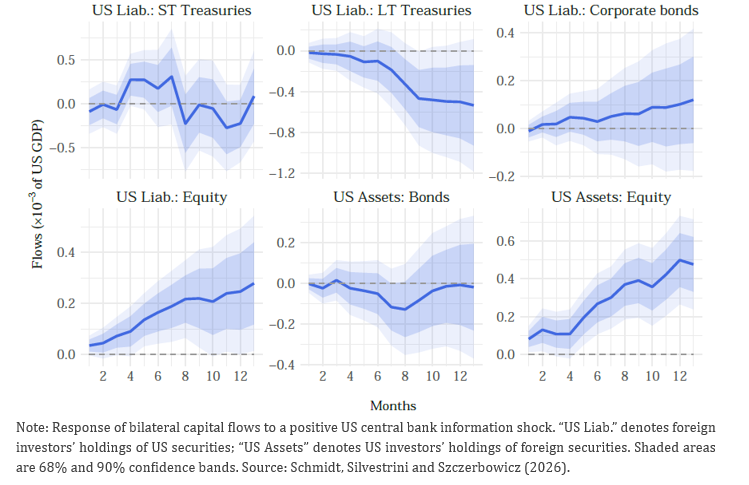
These shocks produce a strikingly different pattern. A positive CBI shock – one that markets read as conveying favourable news about the economy – triggers a global “risk-on” rebalancing (Chart 3). US investors increase their purchases of foreign equities, while foreign investors simultaneously buy more US equities. Foreign investors also trim their long-term Treasury holdings. The result is a synchronised, cross-border rotation into risky assets, consistent with a decline in perceived global risk and a more optimistic outlook. Unlike a pure tightening, which provokes retrenchment, an information shock lifts risk appetite on both sides of the border.
These findings refine the conventional understanding of why capital flows into the United States when interest rates rise. The answer lies less in foreign demand for US safe assets and more in US investors withdrawing from foreign risky markets. This points to foreign equity markets – rather than the US Treasury market – as the main channel through which US tightening transmits globally, consistent with tighter balance-sheet constraints on US-based institutions.
These dynamics also bear on financial stability beyond US borders. Because the adjustment runs largely through US investors pulling back from foreign – including emerging-market – equity markets, a US tightening can squeeze financial conditions abroad even where local fundamentals are sound, with second-round effects as foreign investors in turn face more binding constraints.
A final implication concerns central bank communication. Because pure policy surprises and the information the Fed reveals about the economy move capital in opposite directions, distinguishing the two is essential to anticipating how US monetary policy reverberates across the world – and whether Fed communication calms or unsettles global portfolios.
Bertaut, C. and Judson, R. (2014), “Estimating US cross-border securities positions: new data and new methods”, mimeo.
Campbell, J. Y., Serfaty-de Medeiros, K. and Viceira, L. M. (2010), “Global currency hedging”, Journal of Finance, 65(1), 87–121.
Drechsler, I., Savov, A. and Schnabl, P. (2018), “A model of monetary policy and risk premia”, Journal of Finance, 73(1), 317–373.
Du, W. and Huber, A. (2024), “Dollar asset holdings and hedging around the globe”, NBER Working Paper.
Jarocinski, M. and Karadi, P. (2020), “Deconstructing monetary policy surprises – the role of information shocks”, American Economic Journal: Macroeconomics, 12(2), 1–43.
Rey, H. (2015), “Dilemma not trilemma: the global financial cycle and monetary policy independence”, NBER Working Paper No. 21162.
Schmidt, J., Silvestrini, M. and Szczerbowicz, U. (2026), “Federal Reserve shocks: which securities really flow?”, Banque de France Working Paper No. 1040.