

This policy brief is based on Bank of Greece Working Paper 330. The views expressed are those of the authors and not necessarily those of the institutions the authors are affiliated with.
Abstract
The rise in unit profits, though not among the original root causes of the post-pandemic inflation episode, amplified inflation pressures in all euro-area economies and rendered monetary policy less effective, while traditional macroeconomic determinants alone cannot explain this rise. In the present study, after employing a simple theoretical model to derive unit profits as a component of the GDP deflator, we focus on seventeen [out of the twenty] euro-area economies in the post-pandemic years 2021 and 2022, to identify the factors behind their rise. We provide evidence that structural features of the product and labor market played a critical role, namely that unit profits grew more under conditions of low market competitiveness and a highly flexible labor market. In light of our findings, policy makers should direct their attention to the institutional and market-structure features that need to be addressed if similar phenomena are to be avoided in the future.
In the face of renewed fears of an inflation spiral driven by rising energy prices and supply disruptions, re-examining the role of profits in the recent inflation episode of the 2021/2 period can offer a critical lesson for policy makers today. Despite the fact that inflation rises sparked from other factors like the covid pandemic, higher energy prices, supply chain disruptions and later, geopolitical tensions, the swift subsequent growth of profit margins refueled inflation dynamics and proved particularly difficult to curb.
The effect of profits on domestic price pressures in 2021/2 inflation crisis has been exceptionally high in a historical perspective (see e.g. Arce et al, 2023). This raised questions regarding the effectiveness of monetary policy tools in fighting inflation and stabilizing output (Duval et al., 2021), and triggered criticism regarding the tightening monetary policies that central banks actually followed (see, inter alia, Stiglitz and Regmi, 2022). Moreover, following the increase in profit margins, there has been a concomitant shift in the distribution of value added among firms and labor, with the profit share decisively rising from 2021 onwards (European Commission, 2023). This raises serious concerns regarding the sharing of the distributional burden of inflation and growing inequality in societies.
We use a simple theoretical model to decompose the GDP deflator into three components, namely unit profits, unit labor costs and unit taxes. More precisely, we exploit the decomposition of GDP from the income side into labor remuneration, gross operating surplus and net taxes (as in e.g. Hansen et al, 2023) and use national accounts data in order to calculate the components of the GDP deflator decomposition identity for eurozone countries. We therefore estimate these three components as the determinants of domestic price pressures, abstracting from imported inflation.
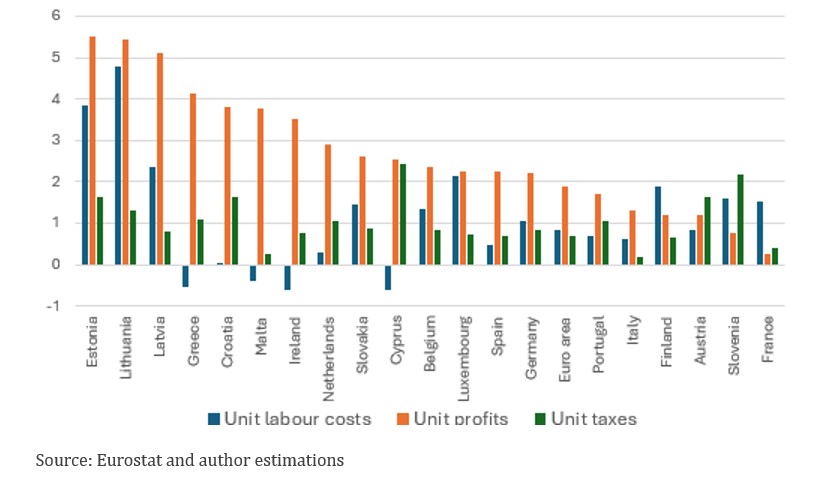
As is evident from Figure 1, domestic price pressures increased strongly in 2021 and picked up further in 2022, with unit profits becoming the strongest contributing factor. Unit labor cost had a positive effect in domestic price pressures only in 2022, while the quite high positive effect of unit taxes mainly reflects the gradual phasing out of fiscal measures which had been adopted in 2020 in the context of the COVID-19 pandemic. However, the components of the GDP deflator are highly variable across the euro-area countries (Figure 2).
Figure 1. Domestic price pressures in the euro area
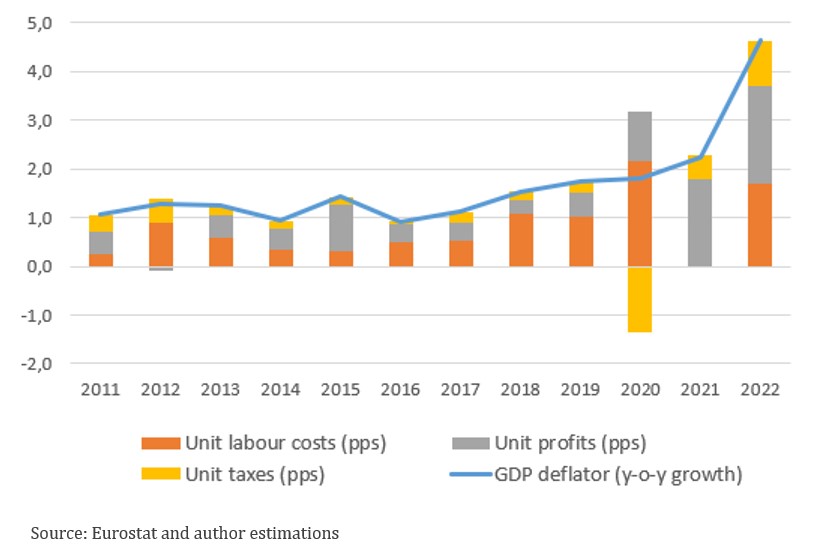
Figure 2. Unit profits, Unit labour costs and Unit taxes
(average contributions in pps, in 2021-2022)
An emerging literature suggests that the growth in profit margins in the post-covid period cannot be explained by traditional macroeconomic determinants alone, implying that it has been driven by less usual factors (Hahn, 2023). We focus attention on institutional and market-structure features, in an attempt to identify the factors underpinning the rise in unit profits, arguing that the degree that firms could increase unit profits depends on the market structure of the economy, namely that where competition is low and oligopolistic structures prevail, there is more room for firms to raise profits. We further argue that this rise is facilitated under conditions of weak labor market regulations, which imply restricted bargaining power of employees.
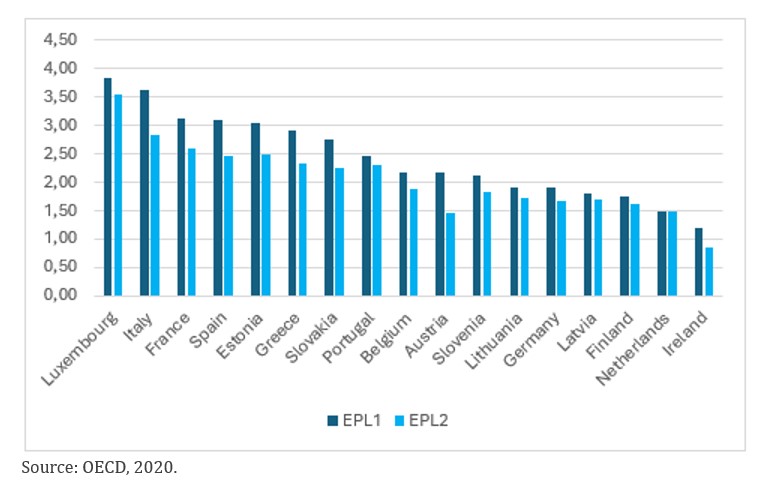
We thus regress the rise in unit profits on, apart from a demand proxy, a set of indices regarding market structure and labor market flexibility. Regarding market structure, we use alternatively two indices obtained by the World Economic Forum (2019), the domestic market competitiveness index (MS1) and the market dominance index (MS2). In both indices low values indicate less competitive market structure. Regarding labor market flexibility, we alternatively use two indices obtained by OECD (2020), covering mainly the employers’ hiring and firing costs and national and sectoral collective bargaining agreements, EPL1 and EPL2. The lower the value of the indices, the more flexible the labor market is. As is evident from Figures 3 and 4, the values of these indices vary a lot across euro-area countries.
A random effect model for panel data is applied, and a large number of specifications have been estimated (see Sideris and Pavlou, 2024). Market competitiveness, as measured mainly by MS1, exerts a large impact on the formation of unit profits, indicating that as the market becomes more oligopolistic, unit profits rise considerably. Labor market conditions, as measured by the EPL indicators, also play a critical role in unit profit formation. High flexibility in the labor market implies weak bargaining power of workers, which facilitates unit profit increases. Rising demand also leads to higher unit profits, as expected, in the period under consideration.
According to the most robust specification based on statistical criteria (t-stats, F-stat, R2) in Sideris and Pavlou (2024), measures towards enhancing market competition, which would lead to an increase of the MS1 index by 1%, would result in a 0.5% decline in unit profits. Labor market flexibility exerts a lower but critical impact on unit profits: an increase in flexibility (EPL2) by 1% would lead to an increase in unit profits by 0.25%. Private consumption also supports unit profits with the hysteresis of one period. The results, thus, verify the theoretical assumptions.
Figure 3. Domestic competition and market dominance
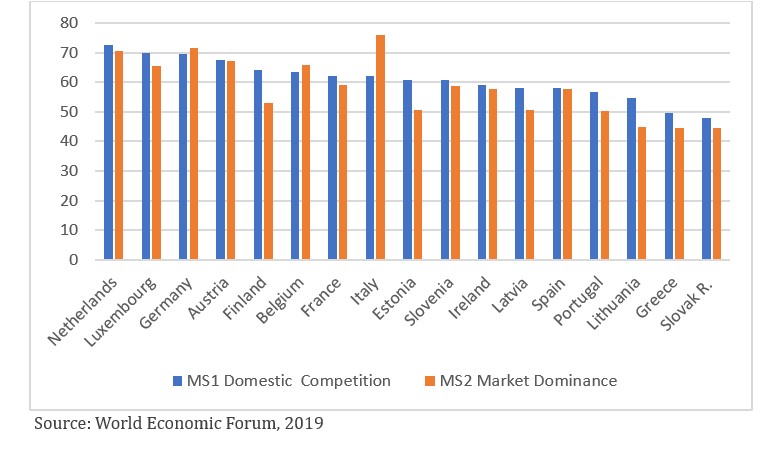
Figure 4. Labour market flexibility
We provide evidence that the rise in unit profits sustaining the 2021-2022 inflation episode in the euro area was facilitated decisively by institutional factors, namely low market competitiveness, especially where the position of labor was weak, as implied by highly flexible labor market conditions. Our results indicate that more research needs to be directed at understanding competition policy and labor market institutions as factors influencing the effectiveness of monetary policy and rebalancing the functional distribution of income without triggering an inflation spiral. Given current renewed uncertainties due to multiple geopolitical tensions, threats of an escalating trade war, and Europe’s growing reliance on more expensive sources of energy, this is an important policy lesson.
Arce, I., Hahn, E. and Koester, G. (2023). How to tit-for-tat inflation can make everyone poorer. The ECB Blog, 30.03.2023.
Duval, R. A., Furceri, D., Lee, R. and Tavares M.M. (2021). Market power and monetary policy transmission, IMF Working Paper, 2021/184.
European Commission (2023). European Economic Forecast – Spring 2023, European Economy, Institutional Paper 200.
Hahn, E. (2023), How have unit profits contributed to the recent strengthening of euro area domestic price pressures?, ECB Economic Bulletin, 4.
Hansen, N., Toscani, F. and Zhough J. (2023). Euro area inflation after the pandemic and energy shock: import prices, profits, and wages. IMF Working Paper, 2023/131.
OECD (2020). Recent trends in employment protection legislation, in OECD Employment Outlook 2020: Worker Security and the COVID-19 Crisis.
Sideris, D. and Pavlou, G. (2024). Market power and profit margins in the euro area countries, Bank of Greece working paper, 2024/330.
Stiglitz, J.E. and Regmi, I. (2022). The causes of and responses to today’s inflation. The Roosevelt Institute, New York, NY.
World Economic Forum (2019). The Global Competitiveness Report 2019, WEF, Geneva.