

This policy brief is based on Bank of Italy Working Paper No. 1504. The views expressed in the paper are entirely the responsibility of the authors and should not be attributed to the Bank of Italy.
Abstract
This policy brief investigates how Italian households’ views about the European Union shaped their portfolio allocations following the Brexit referendum. Using granular security-level data, we show that residents of provinces with lower trust in European institutions significantly increased their allocations to UK securities relative to other provinces after Brexit. This pattern is consistent with more EU-critical investors interpreting Brexit as a positive event for UK prospects. Robustness checks indicate that the results are not driven by demographic, geographic, or economic confounders, nor by banks’ advice or broader portfolio rebalancing. Overall, our findings suggest that political polarization, when coupled with major geopolitical shocks, can influence international investment decisions and cross-border capital allocation.
Do political beliefs influence how households allocate their savings across borders? We investigate this question by examining whether Italian retail investors’ views on the European Union (specifically Euroscepticism) shaped their portfolio choices in response to the Brexit referendum. Our findings highlight how polarization in political beliefs, when coupled with pivotal geopolitical events, can drive international investment decisions.
While existing research often focuses on the effects of domestic political preferences on domestic financial decisions (e.g., Bonaparte et al., 2017; Meeuwis et al., 2022), less is known about the financial impact of political beliefs in a cross-border context. Furthermore, there is limited evidence on whether ideologies that fall beyond the traditional left-right spectrum1 matter in a financial context.
In the lead-up to the Brexit referendum, the consensus among experts was almost unanimous: nine out of ten of Britain’s top economists believed that leaving the European Union would harm the economy,2 and the IMF warned that Brexit could precipitate a stock market and housing crash.3 Despite these dire predictions, we posit that individuals’ expectations about the financial consequences of such shocks are filtered through their prior beliefs, in this case their stance on the EU. We hypothesize that more EU-critical investors, contrary to the prevailing expert consensus, interpreted Brexit as a positive event for the UK’s financial prospects and consequently increased their relative allocation to UK securities.
Analyzing this question through the behavior of Italian investors is ideal because the Brexit referendum occurred in a foreign country, making it unlikely that the event had a significant direct and differential economic impact on Italian more Eurosceptic individuals compared to others. Moreover, the most recent elections in Italy before the Brexit referendum (the 2014 European elections) were, according to political scientists, the first in the country’s history to be particularly focused on EU issues (e.g., Morini, 2017; Conti et al., 2020), with some parties placing particular emphasis on their pro-EU or anti-EU positions (e.g., Conti et al., 2020). This makes analyzing Italian investors’ behavior toward UK securities, depending on their attitudes toward EU institutions, an effective way to address potential identification issues that might arise when conducting the same analysis in other countries.
We compile a detailed dataset on financial investments owned by households in Italy and managed under the custodianship of banks or other financial institutions. The dataset relies on the Bank of Italy’s supervisory data, which provide detailed insights into securities owned by Italian households at the security level. The data span the period from 2012 to 2018. In particular, we exploit the total market value of each security in each year and in each province for each bank operating in Italy and acting as custodian for retail investors. The richness and size of the dataset allow us to employ several granular fixed effects in our regressions, controlling for time-varying factors at the level of the province, security and bank where households hold their securities.
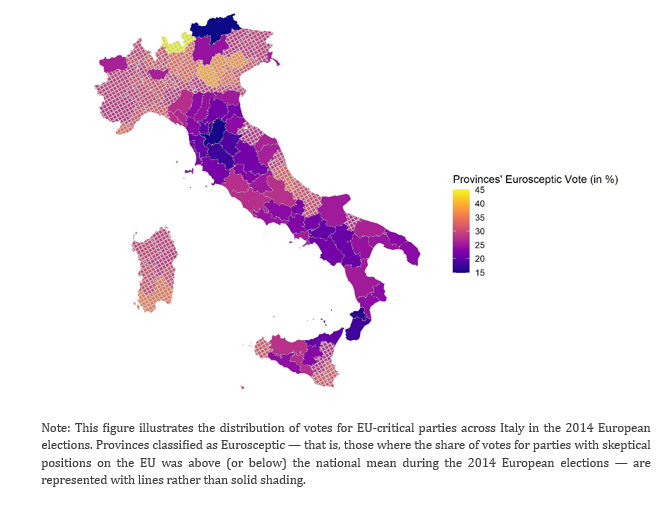
To approximate Italian households’ EU views, we examine electoral support for EU-critical parties4 in the 2014 European elections in each province. These elections were the first in the country’s history to be particularly focused on EU issues, characterized by distinctly pro- or anti-EU views. We define Eurosceptic provinces as those where the share of votes for parties with cold attitudes towards the EU was above the national mean5. Figure 1 provides a visual overview of the geographic distribution of votes for such parties across Italian provinces, as measured in the 2014 European elections.
Our empirical strategy exploits a triple-differences design that compares changes in the holdings of UK versus non-UK securities before and after the Brexit referendum across Italian provinces with higher versus lower trust in EU.
Figure 1. Geographic distribution of votes across Italian provinces
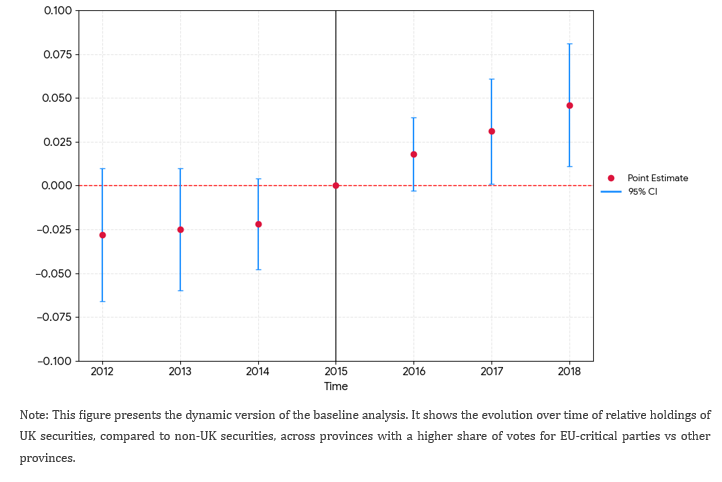
Our results show that, following the Brexit referendum, households in more Eurosceptic provinces invest more heavily in UK securities compared to those in other provinces, relative to securities from other countries. This divergence in investment patterns represents approximately a 4.5% relatively larger investment in UK securities. An analysis of the dynamics (Figure 2) reveals that this investment gap in UK securities was absent prior to the 2016 referendum, emerging only as a response to the vote’s outcome.
Figure 2. Dynamic effects
To further investigate how differences in political orientation affect investment behaviors, we also disaggregate UK securities into categories: UK stocks, UK government bonds, UK corporate bonds, and UK mutual funds. Our results show that, following the Brexit referendum, on average, households in provinces with more EU-critical views particularly increased their holdings of UK stocks and UK mutual funds relative to non-UK securities within the same asset class, while no comparable effect emerges for UK government or corporate bonds relative to their non-UK counterparts. This suggests that Brexit-related optimism fostered an increase in riskier investments among investors more critical of the EU. These results align with previous findings in the literature that individuals increase their share of risky assets when the parties with which they identify take power (e.g., Bonaparte et al., 2017; Meeuwis et al., 2022).
We perform additional analyses to rule out alternative explanations.
Figure 3. Estimated Effects on Investments across Geographic Areas after Brexit
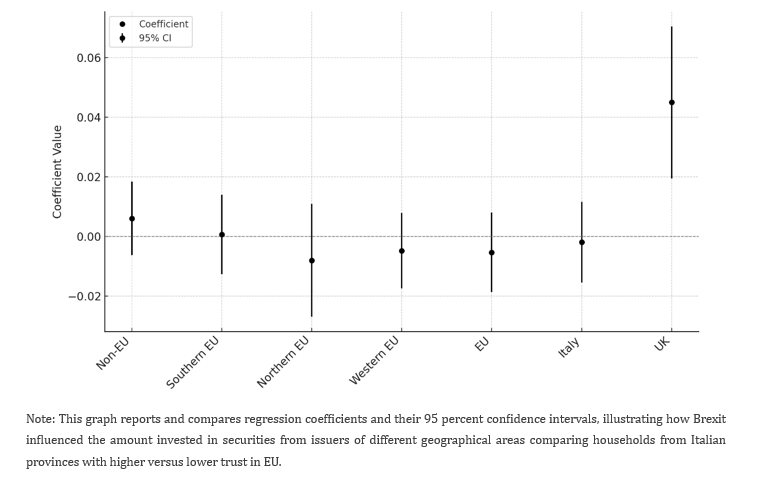
This study provides evidence that EU views influence the investment behavior of Italian households following the Brexit referendum. Residents of more Eurosceptic provinces increase their allocations to UK securities relative to other investments, compared to their counterparts in other areas.
These findings imply that investors interpret major international events through the lens of their political attitudes, even when such events have minor direct economic bearing on domestic markets. Consequently, political beliefs appear to function alongside traditional economic fundamentals in shaping expectations and perceptions of global investment opportunities.
From a policy standpoint, this heterogeneity is crucial for understanding household reactions to geopolitical uncertainty. While the estimated aggregate effects are moderate, they conceal significant underlying divergences in investment behavior. Policymakers and supervisors should therefore account for the role of political sentiment when assessing financial stability risks and monitoring capital flows in an increasingly polarized and integrated financial environment.
Bonaparte, Y., Kumar, A., and Page, J. K. (2017). Political climate, optimism, and investment decisions. Journal of Financial Markets, 34:69–94.
Borin, A., Macchi, E., and Mancini, M. (2021). EU transfers and euroscepticism: Can’t buy me love? Economic Policy, 36(106):237–286.
Conti, N., Marangoni, F., and Verzichelli, L. (2020). Euroscepticism in Italy from the onset of the crisis: Tired of Europe? South European Society and Politics, pages 1–26.
Hooghe, L., Marks, G., and Wilson, C. J. (2002). Does left/right structure party positions on European integration? Comparative political studies, 35(8):965–989.
Meeuwis, M., Parker, J. A., Schoar, A., and Simester, D. (2022). Belief disagreement and portfolio choice. The Journal of Finance, 77(6):3191–3247.
Morini, M. (2017). The Italian 2014 EP Election: A Route To Euroscepticism? Springer.
Van Elsas, E. J., Hakhverdian, A., and Van der Brug, W. (2016). United against a common foe? The nature and origins of euroscepticism among left-wing and right-wing citizens. West European Politics, 39(6):1181–1204.
This is because, unlike standard political divisions, attitudes towards EU often follows a “U-shaped” pattern that unites voters from the radical left and right (Hooghe et al., 2002; Van Elsas et al., 2016).
Reuters, 2016: Most economists say Brexit will harm economy: poll.
The Guardian, 2016: Brexit would prompt stock market and house price crash, says IMF.
Eurosceptic parties were identified following the same method as in Borin et al. (2021), which is standard in political science.
Findings are confirmed when considering the national median.