

This Policy Brief is based on BIS Papers No 165 and the Federal Reserve Board’s IFDP No. 1429. The views expressed in this article are those of the authors and do not necessarily reflect those of the Bank for International Settlements or the Federal Reserve Board.
Abstract
We examine the changing role of the US dollar over the past decades by using the comprehensive global international debt securities (IDS) data of the Bank for International Settlements (BIS). The results indicate that the dollar’s dominance has waxed and waned in waves. The paper identifies three dollarisation waves since the late-1960s. The latest wave, coming after the Great Financial Crisis, pushed the dollar’s share up to almost what it was when the euro was launched in 2000. This current level is also close to the dollar share seen at the demise of the Bretton Woods system. We also document a “euro moment” before the Great Financial Crisis, when the euro’s share in new issuances came very close to the dollar’s share.
Policymakers and economists have focused much on the roles of different currencies, particularly on the dollar’s dominance, in the post-Bretton Woods international monetary system. The creation of the euro in 1999 and the internationalization of the Chinese renminbi, starting in 2010 seemed to pose threats to the dollar’s dominance. These threats appear to have faded. The current consensus view is that the lack of alternatives leaves the dollar’s primacy unchallenged.
We provide new evidence on the dollar’s role in international finance using the international debt securities (IDS) data compiled by the Bank for International Settlements (BIS). The BIS IDS are defined as bonds listed in, registered in or following the legal covenants of financial markets outside the country in which the issuer resides. Outstanding IDS grew from $2 billion in 1970 to $30 trillion at the end of 2024, which is about $6 trillion more than the outstanding cross-border loans of banks in BIS reporting countries. This highlights the importance of IDS in global finance. The currency denomination of IDS is informative about the relative prominence of different currencies in global financial markets.
We find that the dollar’s dominance waxed and waned in a wavelike pattern since 2000 rather than increasing or decreasing monotonically (Graph 1). The share of the dollar in outstanding stocks of IDS (red line) fell from about 60% in the early 2000s to about 43% in 2008, before surging back to about 60% in the latter half of the 2010s. Strikingly, the share of the dollar in 2024 is close to its share in 2000. Plus ça change, plus c’est la même chose!
Graph 1. Outstanding stocks of IDS by currency of denomination, 2000–24
(Shares in per cent of total in all currencies)
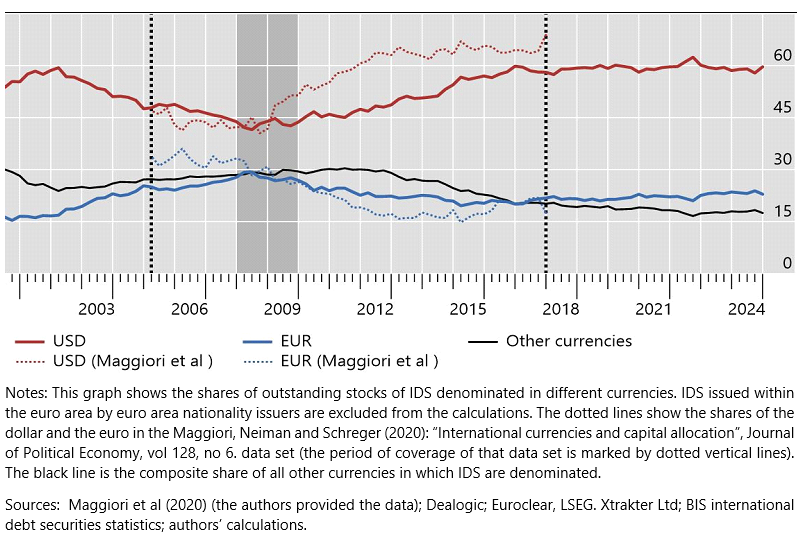
The euro’s share increased sharply after it was created in 2000, which suggests a distinct “euro moment.” The euro’s share (blue line) doubled from around 15% of the outstanding stocks in 2000 to around 30% in 2008. Although the euro’s share declined in the wake of the Great Financial Crisis, it remained markedly higher in 2024 than it had been at the euro’s introduction in 2000. Therefore, assertions about the decline of the euro seem to overstate a relatively short-term trend.
While providing new insights, our analysis also confirms the findings of the seminal Maggiori et al (2020) analysis. Using data on institutional investors’ portfolios, Maggiori et al (2020) find that the dollar’s share of global cross-border holdings of corporate debt (shown as the dotted red line in Graph 1) was relatively stable from 2005 to 2008 but then increased sharply until 2017. This period of apparent dollarization leads the authors to conclude: “The US dollar appears today to be the world’s only international currency. As recently as 10 years ago, however, this was not the case.” Our findings confirm these results over the period they analyze (2005–17 – marked with vertical dotted lines on Graph 1). However, our longer sample provides a wider context: the “trend” of dollarization appears to be particular to the 2008-17 period and does not seem to reflect broader patterns beyond.
Looking back to the pre-Bretton Woods period (1966 and later) reveals two additional waves of dollarization (Graph 2). The dollar’s share rose twice — once in the early 1980s and again in the late 1990s — before it fell back. The dollar’s share at the peak of the current wave is basically the same as the peaks in 1984 and 2000. Despite 50 years and three-dollar waves, the dollar’s share remains close to what it was in 1973, when the Bretton Woods system ended.
Graph 2. A historical perspective on outstanding stocks of dollar-denominated IDS,1966–2024
(In per cent of total in all currencies)
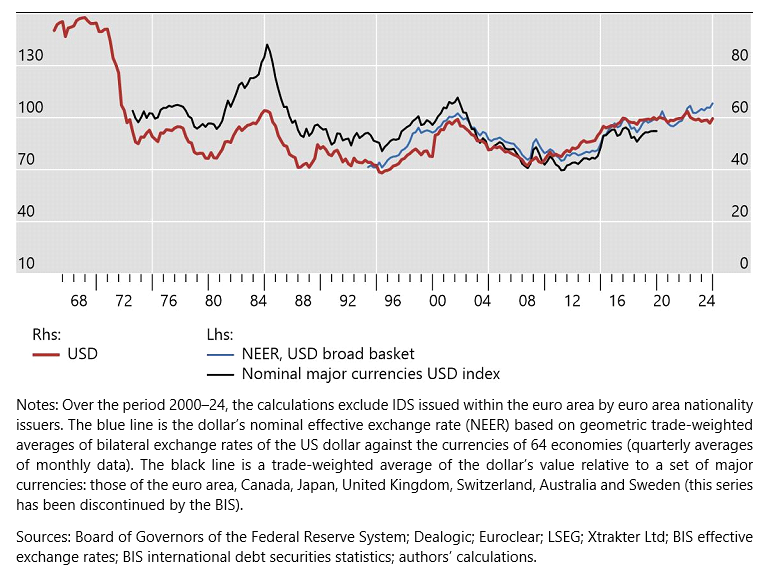
The historical analysis also highlights a key pattern: the dollar waves move closely together with the dollar exchange rate (see black and blue lines on Graph 2). The dollar’s share waxes when the dollar appreciates and wanes when the dollar depreciates. Therefore, the observed waves are partly due to exchange rate movements. The wavelike pattern remains, but it is more muted, once the analysis controls for exchange-rate effects.
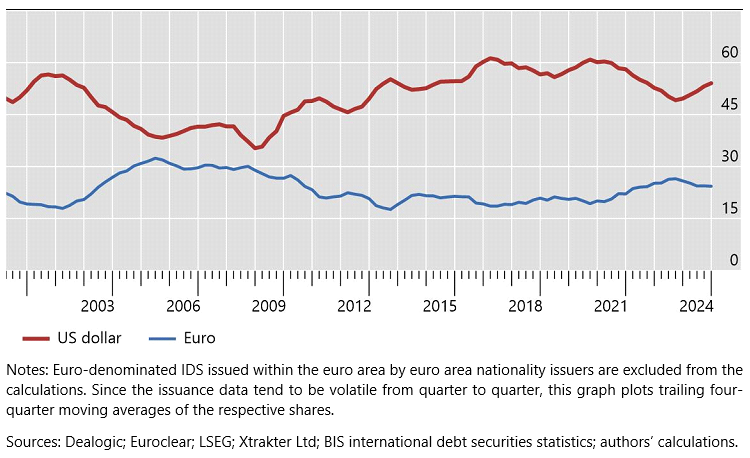
The IDS data set allows us to examine currency denomination trends in new issuances in addition to outstanding stocks (Graph 3). The issuance of euro-denominated IDS (blue line) came strikingly close to dollar-denominated new issuance (red line) in the few years preceding the Great Financial Crisis.
Graph 3. Gross issuance of international debt securities by currency
(Four-quarter moving average, in per cent of total in all currencies)
Lastly, we briefly review how the role of other major currencies has shifted in IDS issuance, using the black line in Graph 1. The data show that promoting the renminbi internationally did not materially change its use in IDS issuance. Even so, the renminbi gained momentum from near-zero levels beginning in 2000. By 2024, the renminbi’s share of outstanding IDS was still modest, yet it exceeded the Swiss franc and was comparable to the Japanese yen. Over the last quarter-century, the Japanese yen and Swiss franc accounted for much smaller shares of IDS issuance than before. In 2024, the British pound sterling’s share remained comparable to its level in 2000.
The dollar’s dominance has waxed and waned in waves rather than rising or falling in a monotonic fashion, belying narratives about both rising dollar dominance and de-dollarization. During the “euro moment” before the Great Financial Crisis, the euro’s share in new issuances approached the dollar’s share.