

This policy brief is based on BIS Working Paper no 1371. The views expressed in this policy brief are those of the authors and do not necessarily reflect those of the Bank for International Settlements. The authors acknowledge the use of artificial intelligence in editorial refinement. Responsibility for all errors remains with the authors.
Abstract
We provide new evidence on the drivers of exchange rate pass-through into consumer prices across four decades and for close to a hundred countries, combining econometrics with machine learning. We find that the size of the economy – which tends to be related to the extent of pricing-to-market – and the level of inflation are most strongly associated with the extent of pass-through, followed by product homogeneity and exchange rate volatility. Several of these factors display a highly non-linear relationship with pass-through, including a U-shaped pattern for exchange rate volatility. We also document that the pass-through is lower when positive deviations of inflation from the inflation target remain small and when fiscal fragilities are lower.
The extent to which exchange rate movements feed through into consumer prices varies considerably across countries and over time. While there is a large empirical literature that measures the magnitude of exchange rate pass-through, much less is known about which specific factors drive it and their relative importance.
This question has taken on renewed relevance in the aftermath of the pandemic, given the unexpected surge in global inflation, shifts in pricing behaviour, changes in the fiscal and monetary policy landscape, and evolving trade patterns, against a backdrop of geopolitical fragmentation. Understanding how exchange rate pass-through relates to the macroeconomic and structural characteristics of economies matters for interpreting inflation dynamics. It also helps to anticipate how the exchange rate-inflation relationship might evolve if these characteristics were to change more persistently.
In Kohlscheen and Mehrotra (2026), we analyse a broad panel of close to 100 countries over four decades, using a two-step empirical strategy. In the first step, we estimate country-decade specific exchange rate pass-through coefficients using the Pesaran and Smith (1995) mean group estimator. This unrestricted approach allows the transmission of exchange rate changes into inflation to differ across countries rather than imposing a common coefficient. Our estimation sample includes both advanced economies (AEs) and emerging market and developing economies (EMDEs). In the second step, we apply random forests (see Breiman (2001)). This machine learning technique allows us to quantify the relative importance of different economic factors that the theoretical literature has identified as potential drivers of pass-through.
The non-parametric nature of random forests is particularly useful for capturing highly non-linear relationships without imposing a specific functional form, identifying threshold effects and inflection points.
First, exchange rate pass-through has declined over time in AEs but not in a broad sample of EMDEs. The estimated average one-year pass-through for the full sample of 98 countries (both AEs and EMDEs) is around 13%. Pass-through in advanced economies is around 8% over the full sample and 4% during the 2010s. Among the more heterogeneous group of EMDEs, by contrast, the one-year pass-through has remained broadly stable, at around 17% for the full sample and 20% during the 2010s.
Second, we find that the size of the economy and the level of inflation are the two factors most strongly associated with the extent of exchange rate pass-through, followed by the degree of product homogeneity and exchange rate volatility. Trade openness, despite its prominence in the earlier literature, emerges as the least important of the factors considered. These rankings are based on Shapley values, shown in Figure 1 below. These measure how much each variable contributes to the predictive accuracy of the random forest model.
Third, several of the relationships that we uncover are strongly non-linear. One example is the relationship between exchange rate volatility and pass-through, where our results point to a U-shape rather than a monotonic pattern. The pass-through is highest when volatility is either very low or very high, and is minimised at an intermediate level of volatility. This finding helps reconcile conflicting results in earlier studies, some of which found pass-through rising with volatility and others the opposite. Based on our results, the relationship depends on where volatility sits relative to this intermediate minimum. One interpretation is that when the exchange rate is firmly anchored, moves are seen as more likely to persist, prompting firms to adjust prices; when volatility is very high, weak fundamentals and repeated depreciations similarly force price adjustment; but at intermediate exchange rate volatilities, price setters may wait to see whether a given move persists before adjusting prices.
Figure 1. Mean absolute Shapley values by factor
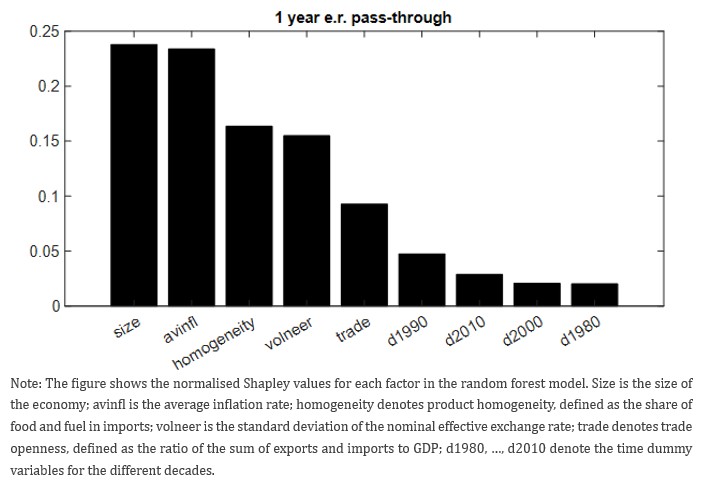
Figure 2. Exchange rate pass-through as a function of the level of inflation and exchange rate volatility
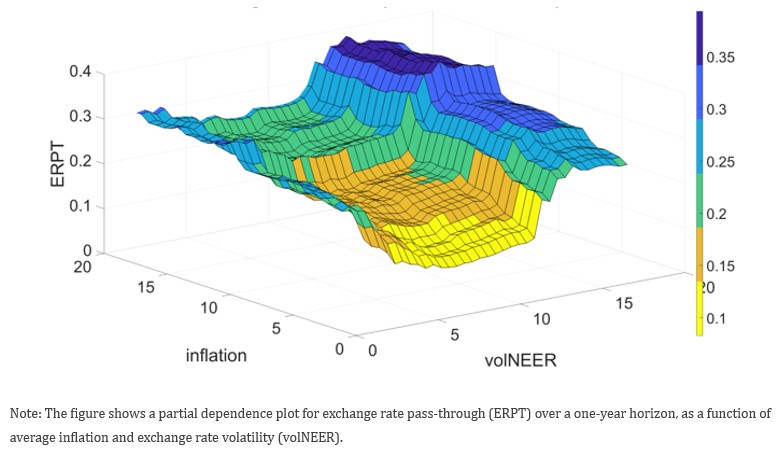
The joint importance of the average level of inflation and exchange rate volatility for exchange rate pass-through is illustrated in Figure 2. The graph shows that the lowest exchange rate pass-throughs obtain when average inflation is low and when exchange rate volatility is neither too low nor too high (yellow region in Figure 2). Moreover, exchange rate pass-through becomes high with elevated inflation, both when exchange rate volatility is very low as well as when it is high (blue regions).
Finally, we document that macroeconomic policy variables matter for pass-through beyond their role via average inflation. Among inflation-targeting countries, larger positive deviations of inflation from the target are associated with higher pass-through once the gap exceeds around 3 percentage points. Within the subsample of inflation targeters, the deviation of inflation from its target ranks as the most important predictor. More flexible de facto exchange rate regimes tend to be associated with lower pass-throughs than fixed arrangements. Fiscal variables also matter: the pass-through rises with the size of the budget deficit, and it also rises with the level of government debt, although generally debt is not one of the most prominent predictors of pass-through. These results are consistent with the idea that fiscal fragilities raise inflation risk and are, in turn, reflected in a stronger pass-through from exchange rate movements to consumer prices.
Our paper shows how combining econometric estimation with machine learning enables a better understanding of the economic and structural factors associated with the strength of exchange rate pass-through, both across countries and across time. For many of the factors, such as exchange rate volatility, the relationship with exchange rate pass-through is non-linear and thus more suitable for investigation via a non-parametric approach. Our approach that combines first-stage econometric estimates with a second-stage random forest-based analysis of coefficients can be used to address other important macroeconomic questions.
Breiman, L (2001): “Random forests”, Machine Learning, vol. 45, pp. 5–32.
Kohlscheen, E and A Mehrotra (2026): “What drives exchange rate pass-throughs? Evidence from a non-parametric method”, BIS Working Papers, no. 1371.
Pesaran, M and R Smith (1995): “Estimating long-run relationships from dynamic heterogeneous panels”, Journal of Econometrics, vol. 68, pp. 79–113.