

A first version of this note was published on SSRN on 4th May, 2026. It represents my individual opinions and not necessarily those of any organization to which I have been affiliated or have given professional advice. I am especially grateful, in preparing this revised version, for detailed comments from David McNulty.
Abstract
This note examines the use of ‘tokenized’ bank deposits for achieving automated, real-time processing of financial transactions. Two possibilities for tokenization are compared: representation on decentralized ‘programmable’ ledgers; and on conventional account-based centralized ledgers. Conventional ledgers are also programmable, so the automated transfer of tokenized deposits does not require decentralized ledgers (this is only needed for pseudonymous transfers, such as those executed in decentralized finance without any intermediaries). Thus, it is unimportant if deposits are tokenized on a decentralized or centralized ledger. Tokenized deposits do offer new possibilities for ‘on us’ transactions, i.e. on the balance sheet of the issuing bank. This is of particular appeal in global multicurrency cash management. In other contexts however, tokenization of deposits appears to offer little new, compared to established conventional deposit accounts.
Much has been recently written on ‘tokenization’, not only of money (tokenized deposits and also stablecoins and central bank digital currency), but also of other assets (government bonds, equities and physical assets such as real estate).1 This current interest in tokenization is well captured in a recent speech, by Andrea Machecler, acting head of the BIS Innovation Hub, at the Bank for International Settlements (Maechler, 2025):
“Tokenisation creates digital tokens that represent assets on a programmable decentralised platform,
potentially expanding the universe of economic arrangements in the same way
as with the shift from cash to electronic money.”
Statements such as this, though, beg more questions than they answer: (i) what is a programmable platform? (ii) what is the role of decentralization? (iii) what novel economic arrangements can these support? (iv) are programmable decentralized platforms the only way to pursue these new opportunities? (v) are they the best way to pursue them?
Deeper insight is provided by (McLaughlin, 2021), noting that many major developments in financial transactions – such as faster payments and e-money platforms – are “… based on plain old double-entry bookkeeping across digital ledgers/ accounts run by bank and regulated non-bank intermediaries.” He characterizes the situation (which has not changed so much in the five intervening years) thus:
“So, we have two very different paths towards tomorrow’s money — one powered by the promise of cryptographic
tokens and the other building on recent developments in account-based payments….
tokenization is often presented as a silver bullet solution ….
A serious debate about the future of money will weigh up both sides so that it becomes clear
that there is more than one way to bring payments into the 21st century.”
This note examines this issue, how best to take advantage of new technological opportunities, in one particular case: that of tokenized bank deposits. After an initial review of deposit tokenization, it then examines potential applications and discusses exactly how they might be supported by tokenization.
A motivation for writing this note is a concern about group think in the current discussions of tokenization and the adoption of technology in financial transactions. Strong claims are made about the benefits of tokenization. These claims are often accepted without challenge or very much explanation at an operational level of what new economic arrangements are possible with tokenization and how they are achieved.
This note finds that while tokenization of deposits has a strong appeal in some specific applications – notably for global cash management by major international companies – the key to this appeal is not the underlying ledger technology (this appears to be more of marketing than operational value) but rather for conduct of a sub-set of transactions, those that can be executed ‘on-us’ i.e. on the balance sheet of the bank. For these transactions there is no need to deal with the complexities of inter-bank settlement and it relatively easy to automate and program financial transactions In line with the views of (McLaughlin, 2021) quoted above, this outcome could as well be achieved with a traditional centralized database as with a decentralized ledger. Other possibilities for tokenized deposits appear limited.
A now widely shared perception is that tokenization — recording the holdings of financial or other assets on a ‘blockchain’, or distributed ledger of the kind first developed for holding cryptocurrencies such as Bitcoin – is an inevitable development set to revolutionize the exchange of financial value, making financial transactions faster, safer, cheaper and more transparent than current established arrangements.2
It is too early yet to say whether such a revolution will transpire or in what form. While holdings of tokenized money, especially of stablecoins, have indeed grown rapidly, the total still remains extremely small compared to established forms of holding money.3 The tokenization of securities and other non-monetary assets are even smaller, relative to conventional established asset holdings.4
The benefits of tokenization on decentralized ledgers are overstated
What can be said, even now, is that the benefits of tokenization on ‘decentralized programmable ledgers’ are overstated. This is for two reasons:
All the computer programs used to manipulate data on the Ethereum ledger or other blockchains are data records on the ledger itself. This means that the programming is inherently transparent, and any user can contribute new programs. This arrangement does not though provide any more programming functionality than the conventional approach – used for example for updating of relational databases – where programs are developed and curated outside of the ledger. In this traditional approach development and curation is either by the intermediary operating the ledger or (for transactions involving multiple ledgers) through collaboration between intermediaries.
This implies that, in principle, all the benefits of automation and programmability, e.g. in cross-border payments and in banking and financial markets, associated with decentralized programmable ledgers could be implemented using conventional centralized databases.
This most radical form is what is supported by so-called ‘permissionless’ blockchains. There is no intermediary or group of intermediaries operating the ledger and deciding who participates. This absence of any intermediaries requires ‘decentralization’: anyone can obtain a copy of the database and propose changes. Consistency of the multiple instances of the database is ensured through a consensus mechanism such as proof-of-stake. ‘Programmed-within-the-ledger’ makes it possible for ledger participants to agree (through the blockchain consensus mechanism) on any proposed arrangements for data exchange and manipulation (for example the so-called ‘decentralized apps’ or D-Apps, of which the use of public-private key cryptography to give participants control over their own data records is the most fundamental). With no institutional involvement, the participants in such a permissionless blockchain do not share their real-world identities; they are ‘pseudonymous’, identified only by public keys that identify their asset holdings.
The motivation for tokenized deposit projects has been the stablecoin threat
Commercial banks are not seeking, when tokenizing deposits, to remove their roles as intermediaries (such as maintaining records of asset holdings, supporting their exchange, providing other related services to account holders and earning an interest margin off deposits held with them). Current projects for tokenization of deposits employ so called ‘permissioned’ rather than ‘permissionless’ decentralized ledgers, with programmability and the opportunity for 24/7 immediate transfers and exchange of deposits. Technically though as indicated, decentralization is unnecessary; with a single institution controlling the ledger all the advantages of programmability, including 24/7 exchange are achievable with conventional centralized ledgers.6
Tokenization of deposits therefore appears to be a defensive move. Banks fear loss of their transactions deposit business from new competitors such as stablecoin issuers whose coins are transferred on decentralized permissionless blockchains.7 By promoting a similar technology, transfers on decentralized permissioned ledgers, banks seek to persuade their major customers not to explore alternative offerings, whether from stablecoin issuers or from other banks.8 The choice of decentralized ledgers is though more about the marketing than about the functions they provide. These new tokenized deposit services could equally well be provided on conventional centralized ledgers.
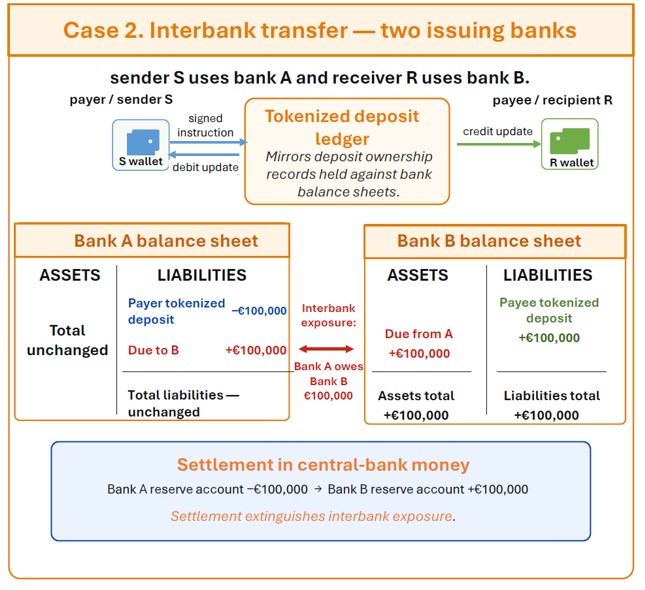
Figures 1.1 and 1.2 illustrate a key point. Tokenized deposits are operationally valuable for transfers on the books of a single bank i.e. a simple ‘on-us’ transaction. They do not avoid the risk and regulatory complexity of interbank transfer.
Figure 1.1 shows the changes in assets and liabilities when both the sender S and the recipient R hold their accounts with the same bank A i.e. an ‘on-us’ transfer. This is simple, requiring only two ledger changes: a debit of €100,000 from the account of the payer; and a credit of €100,000 to the account of the payee. No interbank settlement is required.
Figure 1.2 shows the corresponding changes when the sender S and the recipient R hold their accounts at different banks A and B. There is now an additional interbank exposure: Bank A owes Bank B €100,000. This interbank exposure must be settled by a transfer of central bank money (either gross in real time or netted and deferred).
‘On-us’ deposit transfers are simple, because they involve no counterparty or liquidity risks. The bank’s responsibilities are purely operational. Interbank transfers create fundamental and complex challenges of counterparty credit risk and liquidity management and associated regulatory compliance. These fundamental challenges are a primary reason for delay and uncertainty in interbank payments and they are not resolved by tokenization of deposits.
Figure 1.1: Transfer within a single bank
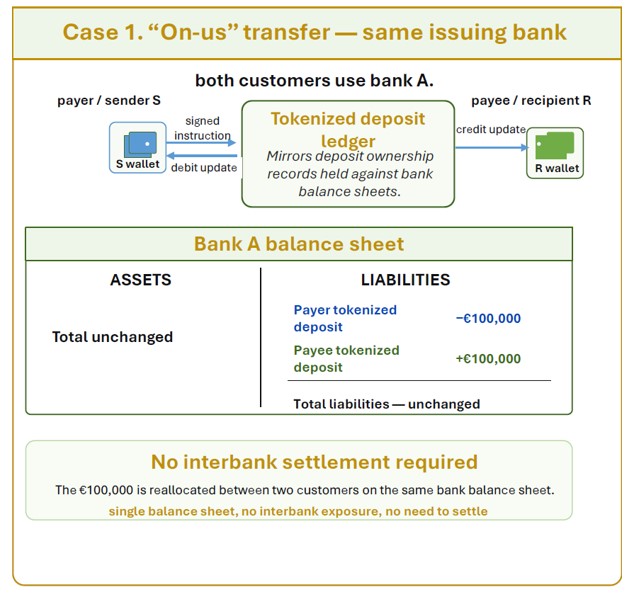
Figure 1.2: Transfer between two banks
The conventional definition of tokenization as holding assets on decentralized programmable ledgers is unsatisfactory – since the asserted benefits of tokenization (other than pseudonymous exchange without any role for intermediaries) can be equally well realized through holding assets on conventional centralized ledgers. This section offers a broader perspective addressing this limitation.
A broader definition of tokenization
The opportunities available from tokenization, of both deposits and of other financial and non-financial assets, are better captured using a broader definition of tokenization, not one restricted to the special case of decentralized ledgers:
Tokenization. An asset is tokenized if the holder directly controls
transfers of their asset to others using private cryptographic keys.
This highlights the association of tokenization with the use of cryptographic wallets, software for securing and managing private keys, giving the holder direct, rather than intermediated control. It is a departure from the conventional established arrangements for holding of financial assets, where the owner transfers assets by sending instructions to an intermediary providing them with an asset account. This trusted intermediary could be a commercial bank (for fiat money), a custodian bank (for conventional securities) or a centralized crypto-exchange such as Coin Base for crypto assets including UST, BTC and ETH. Even in this last case the holder no longer directly controls the assets (as reflected in the well-known saying ‘not my keys, not my crypto’).
This definition of tokenization includes as a special case the accepted understanding of tokenization as holding of assets on decentralized ledgers, distributed ledgers or blockchains, whether these are ‘permissionless’ or ‘permissioned’. It is though, importantly, more general. The logic of the previous section applies: wallet-based control, the direct holding and exchange of financial assets through the use of cryptographic private keys, does not require the assets to be held on a decentralized ledger.
On this definition, ‘tokenized’ assets could equally well be held on a centralized ledger, as long as private cryptographic keys are used to initiate updates to the records of asset holdings (a simpler arrangement, there is then no need for a consensus mechanism, and the private keys can be linked to real world identities). The account operator then maintains the record of holdings and exchange and provides the supporting software; but because transfers are based on private cryptographic keys, the wallet services can be provided separately; yielding the possibility for example of a holder of assets using a single software wallet for both crypto and traditional financial assets.
Tokenization of deposits through direct control with private cryptographic keys – whether on a centralized or decentralized ledger – has limitations:
This first limitation could be addressed by the possibility of a more radical shift: making all tokenized deposits, controlled by private cryptographic keys, 100% reserved in central bank money; and then ensuring that the software for transfer of tokenized deposits between banks simultaneously: (i) transfers the deposit from one bank A to another bank B; and (ii) transfers from the tokenized deposit reserve of Bank A to the tokenized deposit reserve of Bank B. This would avoid creating unsettled obligations between banks. Taken a step further, this could be a direct wallet-based holding of central bank money, i.e. a retail central bank digital currency with the banks becoming the wallet providers. Such more radical tokenization of deposits would also make bank deposits safer, reducing systemic and prudential risks, and arguably making deposit insurance redundant. This is not however what is being implemented in existing tokenized deposit projects.
This section reviews four prominent anticipated use cases for tokenized deposits.9 Successful application of tokenized deposits to these use cases appears to be limited to ‘on us’ transactions on the balance sheet of the issuing bank.10 In this they are similar to stablecoins, whose rapid automated processing also depends on their being transactions on a single balance sheet: that of the stablecoin issuer. The appeal to corporates, for example in their cross-currency cash and liquidity management is that, unlike stablecoins, tokenized bank deposits are offered within the well-established framework for regulation of commercial bank deposits.
The most commercially advanced tokenized deposit project is JP Morgan’s Kinexys.11 This has been adopted by a number of major financial and non-financial corporates for their global cash and liquidity management (while client usage is not all in the public domain, Kinexys does seem to be providing commercially scaled services for a number of clients, including Siemens, FedEx, Cargill, BMW, Mitsubishi Corporation and First Rand Bank).12
The motives for adoption are not technological but rather business logic. JP Morgan is one of the most globally active commercial banks and has a large customer base. Kinexys appears to allow the provision of integrated global cash and liquidity management off its own balance sheet, offering corporates holding accounts in multiple currencies the opportunity to transact against JP Morgan for 24-7 cross border and foreign exchange transfers.
There does not appear to be any compelling technological reason why JP Morgan did not develop their Kinexys services using a traditional centrally operated ledger rather than a permissioned blockchain.13
Kinexys is not the only promising example of corporate adoption of tokenized deposits. Other global banks, for example Citigroup and HSBC, are similarly well placed and actively exploring the use of tokenized deposits (permissioned blockchain) to provide global cash management to their corporate clients.14 Another prominent example is the co-operation of Ant International – the international payments and transaction subsidiary of Ant Financial, which is also the parent of the mobile money solution AliPay in China – with a number of major global banks to offer global cash management and transaction services to their clients across Southeast Asia.15
This has been a major area of attention for potential use of tokenized deposits, because of the competitive threat posed to banks by the increasing use of stablecoins such as USDC and also Tether’s USDT in cross-border payments.
The most prominent tokenized deposit initiative on cross-border payments is the Project Agora collaboration between the BIS Innovation Hub, seven central banks and forty private institutions.16 This is a platform solution (with seven distinct ledgers for the different central bank monies and a single unified ledger for tokenized commercial bank deposits). Commercial bank deposits are held on a shared decentralized ledger (a ‘permissioned blockchain’) providing the record of deposit balances and issuer identity, locking balances before settlement and then executing the cross-border payment and accompanying settlement in central bank money. The deposits on the unified ledger are legally equivalent to conventional bank deposits. They are not however tokenized, in the definition of tokenized deposits proposed in the previous section of this paper, where “the holder directly controls transfers of their asset to others using private cryptographic keys.” The private keys for initiating payments are held and managed by the participating commercial banks, not the depositors.
The project Agora solution demonstrates: 24/7 availability; rapid transaction execution with atomic settlement (either the agreed credits and debits to the unified ledger and required supporting changes in central bank ledgers all take place, or none take place); end-to-end payment visibility; and incorporates controls for fraud and financial crime. Agora does not address the governance of the shared ledger, acknowledging this as a further issue to be addressed for any commercial implementation.
Another notable ledger-based cross border payment initiative is the announcement by Swift in 2025 of a ledger solution to complement its global payment messaging services. “It is envisaged that the ledger — a secure, real-time log of transactions between financial institutions — will record, sequence and validate transactions and enforce rules through smart contracts.”17 However, like the BIS Project Agora, this is not actually tokenizing of deposits, but rather providing a communication service to support automated validation of payment instructions and avoid time consuming manual exception resolution. This is a response to competitive pressure, similar to the earlier initiative, the Swift GPI, that developed as a response to the threat in cross-border payments from the blockchain company Ripple.18 Swift GPI went live in 2017, providing improved automation and transparency in the processing of payment instructions communicated through SWIFT, especially through establishing the unique end-to-end transaction reference (UETR). Swift say this has reduced median processing time to below two hours.19
There has been strong interest in the use of blockchain to support automation of trade finance for more than a decade, so well before the current interest in tokenized deposits. A number of promising initiatives were launched then and have subsequently failed.20 This has not ended all interest in digital platforms for trade processing and finance; there are a number of newer startups, some but not all highlighting use of decentralized programmable ledgers.21 These solutions do not yet appear to be attracting the same level of commercial adoption as corporate cash and liquidity management. There are some attractive solutions which seem close to commercial viability – for example, the canal fee payment service developed by Citigroup.22 Overall though, it is unclear to what extent tokenized deposit solutions limited to the customers of a single bank can reduce the transaction frictions in trade finance.
The other area of interest in tokenized deposits is in capital market transactions. Financial clients, such as hedge funds, have benefited from the support of Kinexys for instantaneous execution of the two legs of repo financing transactions, based on the interaction with JP Morgan’s custodian banking and prime brokerage business lines. JP Morgan, as the largest global broker-dealer and also one of the largest global custodian banks, is able to provide an internalized, ‘on us’ service which overcomes the problematic delays in both initiating and then closing repo transactions, substantially decreasing liquidity and counterparty risks for market participants. It seems that JP Morgan’s strong market position has made this a commercially viable service; but serving only a small share of transactions for the entire market.23
Again, it is unclear whether a tokenized deposit solution limited to the customers of a single bank, an ‘on-us’ service providing the cash leg of settlement only when both sides of the trade use the same bank, can attract widespread usage in capital markets. Some form of tokenized money may come to support settlement in financial markets, but this would seem to require 100% reserving and legal recognition as a settlement asset.24
While there is interest in adoption of tokenized deposits by international corporate clients, it is far less clear that there are sufficient adoption incentives for domestic clients, even larger corporations. One attractive possibility for domestic clients will be the ability to make 24-7 payments at scale, beyond the limitations imposed by domestic faster payment schemes. Here, the interoperability of individual institution’s tokenized deposit solutions and the provision of underlying settlement between them are crucial if there are to be strong incentives for adoption.
A leading example of work of this kind is the GBTD project of UK Finance (UK Finance, 2025), an industry pilot exploring the interoperability of the various tokenized deposit projects that emerged from the UK Regulated Liability Network RLN project (UK Finance, 2023). This project deals with the challenge that, rather than UK banks placing all their tokenized deposits on a single, programmable, shared distributed ledger, each bank operates their own separate tokenization ledger. GBTD addresses this problem through the development of application programming interfaces (APIs), analogous to those employed in open banking, to facilitate seamless cross-institution operations. GBTD is a promising offering for UK bank clients, but something of this kind could again operate as well with traditional centralized deposits.
The incentives for adoption of tokenized deposits are likely to be weaker still for smaller companies and households. For clients such as these, the key requirements for strong incentives for a new payment technology are two-fold: (i) it must meet a real payment need, and (ii) it must also be convenient and easy to use. For households, there is no obvious need for tokenized deposits. Effective payment solutions are already provided by the global card networks, using credit and debit cards for merchant payments, and by faster payment systems for account-to-account payments, without any reliance on tokenization. While there are unmet payments needs, for example in person-to-person payments in some jurisdictions, it is unclear that tokenization provides much of additional value to smaller companies and households.
Arguably, for business-to-business payments, especially for smaller companies, there are gaps in payment needs, so it may be here that projects such as GBTD may find user interest. Businesses are still though likely to be cautious about moving away from existing solutions based on ACH payments (in the UK, the BACs payment scheme). Using the API tools of open banking to automate transactions employing these established payment arrangements may, for these users, turn out to be more promising than the tokenization of payments on new ledgers.
This note has examined the choice between tokenized deposits – held on programmable, decentralized ledgers – and conventional account-based money held on centralized ledgers for providing automated, 24/7 transaction services.
The central conclusion is that this is not fundamentally a technology issue at all: any preferred underlying ledger architecture, centralized or decentralized, can support the 24/7, automated real-time processing promised by the tokenization of deposits. Moreover, the appeal of tokenized deposits is limited to ‘on-us’ transactions on the balance sheet of a single institution, avoiding the need for interbank settlement of payments between banks.
There is a persuasive case, though it is more about marketing than technology, for the employment of emerging tokenized deposit solutions in global cash management. Other use cases remain less compelling. This somewhat cautious assessment is only for one form of tokenization – the tokenization of commercial bank deposits as a response to the perceived competitive threat from stablecoins. It is conceivable that tokenization is of greater value in capital market transactions, but this is a quite different claim that requires separate discussion.
Overall, the current enthusiasm for tokenized deposits seems to be more about the packaging – the bottles – than innovation in underlying operational and business processes – the wine they contain.
Adrian, T. (2026). Tokenized Finance (NOTE/2026/01; IMF Notes). IMF Note 2026/001, International Monetary Fund, April. Available at: https://www.imf.org/-/media/files/publications/imf-notes/2026/english/insea2026001.pdf
Aldasoro, I., Frost, J., & Ito, H. (2026). The impact of stablecoins on the international monetary and financial system. In Available at SSRN (SSRN Working Paper). https://papers.ssrn.com/sol3/papers.cfm?abstract_id=6465640
Ant International. (2026). AI Enabled Solutions | Platform Tech. https://www.ant-intl.com/en/platform-tech
Bank of England. (2026). Consultation paper: Extending RTGS and CHAPS settlement hours – next steps towards near 24×7 settlement. https://www.bankofengland.co.uk/paper/2026/cp/extending-rtgs-and-chaps-settlement-hours-next-steps
Banu, E., Born, A., Evrard, J., Lambert, C., & Spolaore, A. (2026). Towards an efficient and integrated digital capital market in Europe: the role of tokenisation and the Eurosystem’s policy response. Macroprudential Bulletin, 33. https://www.ecb.europa.eu/press/financial-stability-publications/macroprudential-bulletin/html/ecb.mpbu202604_02.en.html
BIS. (2023). Blueprint for the future monetary system: improving the old, enabling the new. In Annual Economic Report (pp. 85–118). Bank for International Settlements. https://www.bis.org/publ/arpdf/ar2023e.htm
BIS. (2025). The next-generation monetary and financial system. In Annual Economic Report (pp. 77–113). Bank for International Settlements. https://www.bis.org/publ/arpdf/ar2025e3.pdf
BIS Innovation Hub. (2026). Project Agorá: a shared programmable platform for wholesale cross-border payments. https://www.bis.org/publ/othp110.htm
Bloomberg. (2026, May 12). JPMorgan, Wall Street Use Blockchain in $13 Trillion Repo Market. Bloomberg News. https://www.bloomberg.com/news/features/2026-05-12/jpmorgan-wall-street-use-blockchain-in-13-trillion-repo-market
CargoX. (2026). Effortless global trade with e-trade documents. https://cargox.io/trade-finance
CBDC Resources. (2026). Adoption Monitor: Every live CBDC at a glance. https://cbdcresources.com/cbdc-adoption?utm_source=copilot.com
CCAF. (2026). Tokenised Money Use Cases, Interoperability and Regulation.
Cenicola, A., Friedrichs, M., Mann, R., & Olson, L. M. (2025). Sizing the U.S. Repo Market | Office of Financial Research. In Office of Financial Research Blog. https://www.financialresearch.gov/the-ofr-blog/2025/12/04/sizing-us-repo-market/
Circle. (2026a). Circle page on Edgar. 2025. https://www.sec.gov/edgar/browse/?CIK=0001876042
Circle. (2026b). The Official Blog of Circle and USDC. https://www.circle.com/blog?utm_source=copilot.com
Citigroup. (2023). Citi Develops New Digital Asset Capabilities for Institutional Clients. https://www.citigroup.com/global/news/press-release/2023/citi-develops-new-digital-asset-capabilities-for-institutional-clients
Citigroup. (2026). Citi Token Services for Cash. https://www.citigroup.com/global/insights/citi-token-services-for-cash
Danielsson, J., & Macrae, R. (2026a). Stablecoins: Policy, sovereignty and backstops (1448; SUERF Policy Brief). https://www.suerf.org/publications/suerf-policy-notes-and-briefs/stablecoins-policy-sovereignty-and-backstops/
Danielsson, J., & Macrae, R. (2026b). The geopolitics of stablecoins (1440; SUERF Policy Brief). https://www.suerf.org/publications/suerf-policy-notes-and-briefs/stablecoins-are-run-optimised-instruments/
DL News. (2026). JPMorgan expands digital assets push with Mitsubishi deal as it targets $10bn in daily transactions. https://www.dlnews.com/articles/markets/jpmorgan-expands-digital-assets-push-with-mitsubishi-deal-as-it-targets-dollar10bn-in-daily-transactions/
ECB. (2026). Tokenisation and DLT. https://www.ecb.europa.eu/paym/dlt/html/index.en.html?utm_source=chatgpt.com
Fnality. (2026). Fnality: About Us. https://www.fnality.org/about-fnality
Genfinity. (2025). BMW Group Adopts Kinexys Blockchain for Automated FX Treasury Transfers. https://genfinity.io/2025/12/09/bmw-group-kinexys-blockchain-automatic-fx-transfers/
GFMA. (2026). The Role of Digital Money in Capital Markets. https://www.sifma.org/research/white-papers/the-role-of-digital-money-in-capital-market
HSBC. (2026). Tokenised Deposit Service Solutions. https://www.business.hsbc.com/en-gb/products/tokenised-deposit-service
IMF. (2026). Data Explorer. https://data.imf.org/en/Data-Explorer
JP Morgan. (2026a). FirstRand Bank Adopts Kinexys for Blockchain Treasury Management. https://www.jpmorgan.com/payments/newsroom/firstrand-bank-kinexys-blockchain-south-africa
JP Morgan. (2026b). Kinexys Digital Payments – Payments Developer Portal. https://developer.payments.jpmorgan.com/docs/treasury/global-payments/capabilities/global-payments/jpm-coin-system
Komgo. (2026). Trade Finance Platform & Solutions. https://www.komgo.io/
Ledger Insights. (2023, December 14). Fnality launches DLT wholesale payment system in UK. Webpages. https://www.ledgerinsights.com/fnality-launch-dlt-wholesale-payment-system-in-uk/
LogChain. (2026). Home. https://thelogchain.com/
Maechler, A. M. (2025). How deposits can harness tokenisation: speech to the 2025 Singapore fintech festival. Bank for International Settlements. https://www.bis.org/speeches/sp251128.htm
Maersk. (2022). A.P. Moller – Maersk and IBM to discontinue TradeLens, a blockchain-enabled global trade platform | Maersk. In Press release. https://www.maersk.com/news/articles/2022/11/29/maersk-and-ibm-to-discontinue-tradelens
McLaughlin, T. (2021). Two paths to tomorrow’s money. Journal of Payments Strategy & Systems, 15(1), 23–36.
McNulty, D., Milne, A., Williams, J., & Wood, J. (2024). Digital assets in UK payments and transaction banking. https://papers.ssrn.com/abstract=4928001
Milne, A. (2022). Defining Digital Assets. https://www.swift.com/swift-resource/252238/download
Nili, C., & Waliczek, S. (2025). Asset Tokenization in Financial Markets: The Next Generation of Value Exchange. https://reports.weforum.org/docs/WEF_Asset_Tokenization_in_Financial_Markets_2025.pdf
Nilsson, T., Bouther, R., Van Acoleyen, M., & Cohen, L. (2022). SWIFT gpi data indicate drivers of fast cross-border payments. https://www.bis.org/cpmi/publ/swift_gpi.pdf
NOBO Finance. (2026). The Future of Trade Finance. https://nobofinance.co.uk/
PYMNTS. (2023). JPM Coin Programmable Payments Goes Live With Siemens. https://www.pymnts.com/blockchain/2023/j-p-morgan-launches-programmable-payments-through-jpm-coin/
Sharma, R. (2026, May). Tokenized Deposits Market Research Report 2034. https://dataintelo.com/report/tokenized-deposits-market
SIFMA. (2025). Capital Markets Fact Book. https://www.sifma.org/research/statistics/fact-book
SWIFT. (2025, September 29). Swift to add blockchain-based ledger to its infrastructure stack in groundbreaking move to accelerate and scale benefits of digital finance across more than 200 countries and territories worldwide. https://www.swift.com/news-events/press-releases/swift-add-blockchain-based-ledger-its-infrastructure-stack-groundbreaking-move-accelerate-and-scale-benefits-digital-finance
SWIFT. (2026). Swift GPI . https://www.swift.com/products/swift-gpi?utm_source=chatgpt.com
TradeFinex. (2026). Trade Finance Distribution powered by XinFin [XDC] Blockchain Network. https://www.tradefinex.org/
Treasury Today. (2025a). Blockchain solution facilitates real-time flows between Cargill treasury hubs. https://treasurytoday.com/asa-asia-winners-2024/blockchain-solution-facilitates-real-time-flows-between-cargill-treasury-hubs/
Treasury Today. (2025b). FedEx delivers blockchain for 24/7/365 real-time payments. https://treasurytoday.com/asa-2025-winners/fedex-delivers-blockchain-for-24-7-365-real-time-payments/
UK Finance. (2023). Regulated Liability Network UK Discovery Phase. https://www.ukfinance.org.uk/policy-and-guidance/reports-and-publications/regulated-liability-network-uk-discovery-phase
UK Finance. (2025). Tokenised sterling deposits. https://www.ukfinance.org.uk/tokenised-sterling-deposits
Wragg, E. (2022, June 6). we.trade calls it quits after running out of cash. Global Trade Review. https://www.gtreview.com/news/top-stories/we-trade-calls-it-quits-after-running-out-of-cash
Wragg, E. (2023a, February 23). Marco Polo brings in liquidators as funds run dry. Global Trade Review. https://www.gtreview.com/news/top-stories/marco-polo-brings-in-liquidators-as-funds-run-dry/
Wragg, E. (2023b, October 27). Exclusive: Contour to shut down as bank shareholders pull funding. Global Trade Review. https://www.gtreview.com/news/top-stories/exclusive-contour-to-shut-down-as-bank-shareholders-pull-funding
See for example (CCAF, 2026), a review of industry and regulatory views on the tokenization of money and (Banu et al., 2026) on other forms of tokenization.
Tokenization has achieved considerable recent prominence, for example in initiatives and commentary supported by the World Economic Forum (Nili & Waliczek, 2025), the IMF (Adrian, 2026), the European Central Bank (ECB, 2026) and also by industry bodies (eg GFMA, 2026). Much of the interest seems to have been stimulated by the endorsement of tokenization by the Bank for International Settlement (BIS, 2023, 2025).
(Sharma, 2026) reports that the total value of tokenized deposits amounted to $4.8bn at end 2025. The other two forms of tokenized money are stablecoins, with a market value of around $300bn (Aldasoro et al., 2026; Danielsson & Macrae, 2026b) and CBDC $2.5bn of which the Chinese e-yuan accounts for $2.3bn (CBDC Resources, 2026). These compares to global bank deposits of around $40trn and of notes and coin of around $10trn (IMF, 2026).
The tokenization of non-monetary assets is similar: growing rapidly but still nascent. (Banu et al., 2026) chart 1 reports the total value of tokenized financial assets, other than tokenized money, increasing from around €5bn in late 2022 to nearly €40bn in 2026. are all still much smaller than the market value of traditional traded securities (SIFMA, 2025) reports these as of end 2024, as $127trn equities, $145trn bonds.
Proponents of crypto and decentralised finance highlight the removal of reliance on financial intermediaries and a shift to direct peer-to-peer exchange. This has its roots in the cypherpunk tradition which prizes personal privacy and is suspicious of all forms of oversight by government and corporations (McNulty et al., 2024; Milne, 2022 discuss further, providing fuller comparison of decentralised and traditional finance).
This does not mean that permissioned decentralized ledgers do not have a role in other contexts other than tokenization of deposits e.g. in financial market transactions. The key issue – beyond the scope of this note – is then the support for other governance arrangements, less radical than that of ‘permissionless’ blockchain: what of many possible arrangements for holding and transferring assets (e.g. a centralized ledger run by a utility, multiple centralized ledgers with API access, a decentralized ledger with permissioned access) best support regulatory oversight and efficient investment and innovation in transaction technologies?
This note does not address the business models of stablecoin issuers and the extent to which they threaten bank transaction services. For review of the emergence of stablecoins, especially their application in cross-border transactions, see (Danielsson & Macrae, 2026a, 2026b). Note that, while the ledgers on which the leading stablecoins are transferred are ‘permissionless’, their redemption and issue is ‘permissioned’ (this contrasts with so-called algorithmic stablecoins with a fully permissionless architecture). These permissioned activities can be subject to regulation. Circle, the issuer of USDC, has aligned with the Genius Act on reserving, transparency, redemption rights and also with Mica e-money rules; their 2025 IPO highlights opportunities from payments services for financial institutions and non-financial corporations (Circle, 2026b, 2026a).
An open question is whether the greater threat, motivating the pursuit of tokenized deposit projects, is from other banks rather than stablecoin issuers. Once one bank ‘tokenizes’ others may have to follow.
See (CCAF, 2026) chapter II.
24/7 transaction processing of payments between banks introduces considerable additional complications, especially if accompanied by real-time settlement in central bank money to removes any accompanying interbank exposure. Central banks such as the Bank of England are moving closer to 24/7 transactions in central bank money, but still envisage a downtime period each day for maintenance (Bank of England, 2026).
The Kinexys functionality is set out in the Kinexys webpages (JP Morgan, 2026b).
(DL News, 2026; Genfinity, 2025; JP Morgan, 2026a; PYMNTS, 2023; Treasury Today, 2025b, 2025a).
Much of the development of Kinexys is based on the Ethereum based open-source permissioned ledger solution Quorum, which utilizes the conditional pull payment functionality built into Ethereum; but the same functionality could be provided with a centralized database, decentralization plays no essential role here.
(Citigroup, 2026; HSBC, 2026).
(Ant International, 2026).
(BIS Innovation Hub, 2026).
(SWIFT, 2025).
(SWIFT, 2026).
(Nilsson et al., 2022)
TradeLens (Maersk, 2022), WeTrade (Wragg, 2022), MarcoPolo (Wragg, 2023a) and Contour (Wragg, 2023b).
Examples include CargoX (CargoX, 2026) , Komgo (Komgo, 2026), Logchain (LogChain, 2026), Nobo (NOBO Finance, 2026) and XFin (TradeFinex, 2026). These more recent initiatives emphasise integrated digital processing of the all trade related documents, such as bills of lading, not just financial, and sometimes tailoring solutions to particular segments such as commodities.
(Citigroup, 2023).
(Bloomberg, 2026) report that this has recently amounted to cumulative transaction volume of $3trn in five and a half years. However, this is an average daily transaction volume of around $2.5bn, so still very small compared to the daily US repo exposure of $12.6trn reported by the US Office of Financial Research (Cenicola et al., 2025).
This is what is being provided by some tokenized money initiatives, for example Fnality which is not blockchain based, see (Fnality, 2026; Ledger Insights, 2023).