

This Policy Brief is based on Banque de France Working Paper #1017: Herbert, Hubert and Lé (2026), “When Does Monetary Policy Matter? Asset Price Responses to Conflicting Signals”. The views expressed are those of the authors and do not necessarily reflect those of the Banque de France or the Eurosystem.
Abstract
Central bank announcements convey two signals at once: news about the current policy decision and signals about the future policy path. This paper asks what happens when these two signals conflict. We classify monetary policy announcements as “reversal” statements when the signal about the future policy path reverses the current-decision news. These statements account for nearly half of scheduled FOMC meetings between 1994 and 2026. We document that the transmission of these monetary policy decisions to long-term interest rates is significantly stronger than in the case of announcements with consistent signals, revealing a fundamental and unexplored heterogeneity in the transmission of monetary policy.
Central bank announcements are not unidimensional. They contain news about the current policy decision, such as whether the policy rate is raised or left unchanged, and they also embed signals about the future policy path. These two signals may point in the same direction, but they may also conflict. For instance, a central bank may raise rates today more than anticipated while signaling that future hikes will be fewer or slower than expected. Conversely, it may surprise by keeping rates unchanged while signaling that the pace of future tightening will be faster than previously thought.
When the signal about the future policy path reverses the current-decision news, investors face a specific challenge: they must reconcile two conflicting pieces of information and decide which signal is most important for the future path of interest rates. In Herbert, Hubert and Lé (2026), we identify these announcements and labelled them “reversal” statements. They are not rare episodes. In the United States, they account for 123 of the 254 scheduled FOMC meetings between February 1994 and January 2026, close to half of all meetings.
To identify reversal statements, we build on the seminal decomposition of Gürkaynak, Sack and Swanson (2005), which separates monetary policy surprises into a Target factor and a Path factor. The Target factor captures news about the current federal funds rate decision. The Path factor captures residual signals about the expected future policy path. A reversal statement occurs when the Path factor moves in the opposite direction to the Target factor and is larger in absolute value. In such cases, the net signal is forward-looking because the news about the current decision is overturned by the news about the future path.
To understand how investors process these conflicting signals, we examine how the transmission of monetary policy varies depending on whether the policy announcement is a reversal or a non-reversal statement.
It would be natural to assume that non-reversal statements have a stronger effect because their signals are easier to interpret. When the current decision and the future path of monetary policy point in the same direction, investors receive an unambiguous signal. However, the evidence shows the opposite. Reversal statements have much stronger effects on medium- and long-term interest rates than other announcements (Figure 1). This difference between reversal and non-reversal statements is large: a 10 basis point (bp) monetary surprise from a reversal statement moves 10-year Treasury yields by 6.7 bp. The same surprise from a non-reversal statement moves them by only 3 bp. By contrast, non-reversal statements have a sizable impact on stock prices and short-term rates, with effects declining along the maturity spectrum. Our results suggest that most of the effect of monetary policy on long-term interest rates, as documented by Nakamura and Steinsson (2018), come from the subset of reversal statements.
Figure 1. Interest rate responses to monetary policy surprises
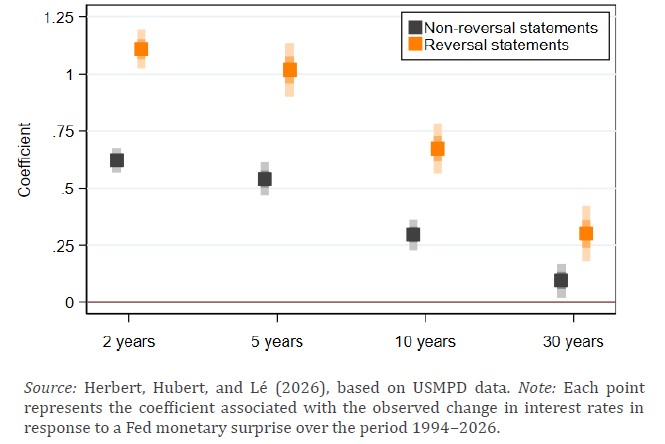
This finding matters for the measurement of monetary policy effects. Standard event-study estimates usually treat all announcements as homogeneous. Our results show that this mixes two qualitatively different types of statements. The effect of monetary policy on long-term interest rates comes mainly from reversal statements, while the effects on stock prices and short-term rates come mainly from non-reversal statements.
The strong effect of reversal statements on long-term interest rates is not driven by larger surprises. Monetary surprises are, on average, smaller in absolute value on reversal days than on non-reversal days. The result also does not depend on the specific factor decomposition used to identify Target and Path surprises. We obtain the same pattern with two model-free classifications: one using raw current-month and one-year-ahead futures surprises, and another using a single principal component split into current-decision and future-path components.
The result is also robust to controlling for large Path factors, small Target factors, quantitative easing, explicit forward guidance, press conferences, FOMC projections, dissent, central bank information effects, monetary policy uncertainty, and turning points in the policy cycle.
Strikingly, the same pattern appears outside the United States. Applying the same logic to the European Central Bank and the Bank of England shows that reversal statements also generate stronger effects on long-term yields in the euro area and the United Kingdom.
The next question we investigate in this paper is why reversal statements matter so much for long-term rates. We tackle this question by analyzing several decompositions of the response of nominal yields.
First, the effect operates primarily through expected future short rates. Traditionally, and as Hanson and Stein (2015) show, monetary policy announcements affect long-term rates through two mechanisms: (i) the compounding effect of the short-term rate over a long horizon (“expectations hypothesis”), and (ii) the premium that investors demand for holding a long-term asset in the face of uncertainty regarding the evolution of short-term rates over that horizon (“term premium”).
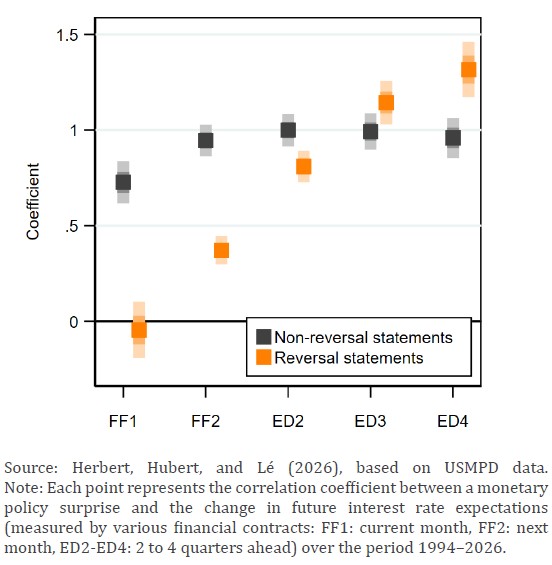
The decomposition of nominal interest rate responses into the expectations hypothesis component and the term premium component helps us better understand what distinguishes the two types of announcements. We observe that non-reversal announcements, in which the two signals (“target” and “path”) move in the same direction, primarily affect the expectations hypothesis component and have very little impact on the term premium component. By contrast, reversal announcements affect both components simultaneously. On the one hand, they have a stronger effect on the expectations hypothesis component (because the forward-looking information is more pronounced). On the other hand, when the target and path signals move in opposite directions, this implies not a parallel shift but a rotation of the expected future interest rate path (Figure 2), increasing uncertainty about that path and thus the term premium. These two effects add up, which explains the much stronger transmission to long-term rates.
Second, forward rates show that the revision is concentrated at medium-term horizons. This pattern is consistent with a revision in the pace of future policy adjustments rather than a revision in the long-run level of interest rates. This is a central feature for the interpretation of our findings. Reversal statements do not simply tell investors whether the central bank is tightening or easing. They tell investors something about the speed at which the central bank intends to move in the future. The expected rate path rotates rather than shifting in parallel (Figure 2).
Option-implied uncertainty measures support this interpretation. Reversal statements do not generate a differential increase in monetary policy uncertainty, the interest rate probability distribution, or the VIX. The secondary term premium response is therefore better interpreted as compensation for duration risk associated with a change in the shape of the expected rate path, rather than as an increase in uncertainty about the policy direction.
Figure 2. Term structure of policy expectation adjustments
These results have direct implications for empirical work on monetary policy transmission. Standard event-study estimates usually use a single monetary policy surprise or the Target and Path factors separately. This approach treats all announcements as if they transmitted monetary policy in the same way. But our findings show that for long-term interest rates, the identifying variation comes primarily from reversal statements while for equity prices and short-term rates, it comes primarily from non-reversal statements. Pooling all statements therefore introduces an aggregation bias.
The broader lesson is that neither the total monetary surprise nor the Target and Path factors taken separately are sufficient. What matters is also the joint distribution of the Target and Path factors. The interaction between the current-decision signal and the future-path signal contains information that is not captured by either factor in isolation.
This matters because long-term rates are central for household and firm borrowing, investment decisions, and asset prices. If the effect of monetary policy on long-term rates is concentrated in a specific subset of announcements, then empirical strategies that ignore this heterogeneity may misidentify the source and strength of monetary policy transmission.
The findings also speak to central bank communication. They show that, when the current-decision and the future-path signals conflict and the latter dominate, markets appear to infer information about the pace of the policy cycle, and the announcement can have a particularly strong effect on the yield curve. For policymakers, the implication is that investors attach substantial weight to the way future-path signals interact with the current decision.