

This policy brief is based on Danisewicz et al. (2026): Central Clearing, Counterparty Risk, and Repo Specialness. The views expressed are those of the authors and not necessarily those of their institutions.
Abstract
Central clearing is often viewed as a tool to reduce counterparty risk and improve market resilience. We show that it also changes the pricing of scarce collateral in repo markets. Using transaction-level data from the euro-area repo market, we compare bilateral OTC and centrally cleared trades backed by the same securities around the COVID-19 shock. In normal times, special securities trade at higher borrowing costs in OTC markets than in CCP-cleared markets. During stress, this differential compresses sharply. The mechanism is counterparty-risk pooling: OTC lenders price borrower-specific risk, while CCPs price pooled counterparty risk. The results matter for ongoing reforms expanding central clearing in repo markets.
Repo markets are central to the functioning of modern financial systems. They provide short-term secured funding, allow financial institutions to source specific securities, support market making, and influence the transmission of monetary policy. Repo market stress has played a central role in several recent episodes of financial instability, including the global financial crisis, the September 2019 repo turmoil, and the March 2020 dash for cash (Brunnermeier, 2009; Duffie, 2020). At the same time, repo markets have become increasingly important for the circulation and pricing of scarce collateral, especially safe sovereign bonds (Corradin and Maddaloni, 2020).
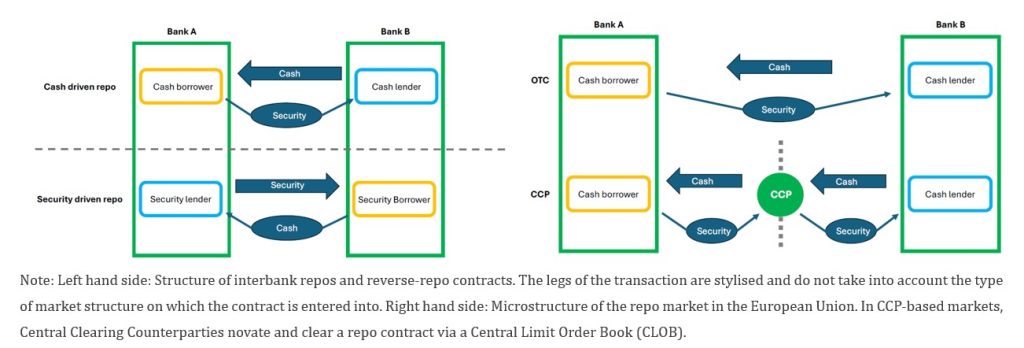
In security-driven repo trades, the main objective is not simply to borrow cash but to obtain a particular security, effectively reversing the roles of borrowers and lenders (Figure 1, left panel). Such transactions are especially important when demand for safe collateral rises, for example during periods of market stress, margin calls, short-selling pressure, or delivery obligations.
The same repo transaction can be cleared in different ways (Figure 1, right panel). In a bilateral over-the-counter market, the two counterparties face each other directly and observe each other’s identity. In a centrally cleared market, a central counterparty becomes the buyer to every seller and the seller to every buyer. This changes how counterparty risk is allocated and priced. In the bilateral market, the lender can price the specific borrower’s risk. In the CCP market, the relevant exposure is pooled across CCP members through novation, margining, and default-fund arrangements.
This distinction is highly relevant for current policy debates. The expansion of central clearing is often motivated by its potential to improve market resilience, reduce bilateral counterparty exposures, and support multilateral netting. Previous work shows that repo market structure and CCP clearing can matter for stability and pricing during stress (Mancini, Ranaldo and Wrampelmeyer, 2016; Boissel et al., 2017; Affinito and Piazza, 2021). Our evidence from the euro-area interbank repo market suggests that central clearing does more than reallocate default risk. It also affects the prices at which scarce collateral is borrowed and the way counterparty uncertainty is transmitted into repo rates.
Figure 1. Structure of repo transactions and markets
We study euro-area interbank repo transactions that are cleared either bilaterally or through CCPs. We focus on security-driven reverse repos, where the borrower obtains a specific security against cash collateral. In these trades, more negative repo rates indicate a higher cost of borrowing the security and therefore greater “specialness”. The concept of specialness has a long tradition in repo-market research: scarce securities can trade at repo rates below general collateral rates because borrowers are willing to pay a premium to obtain them (Duffie, 1996; Vayanos and Weill, 2008).
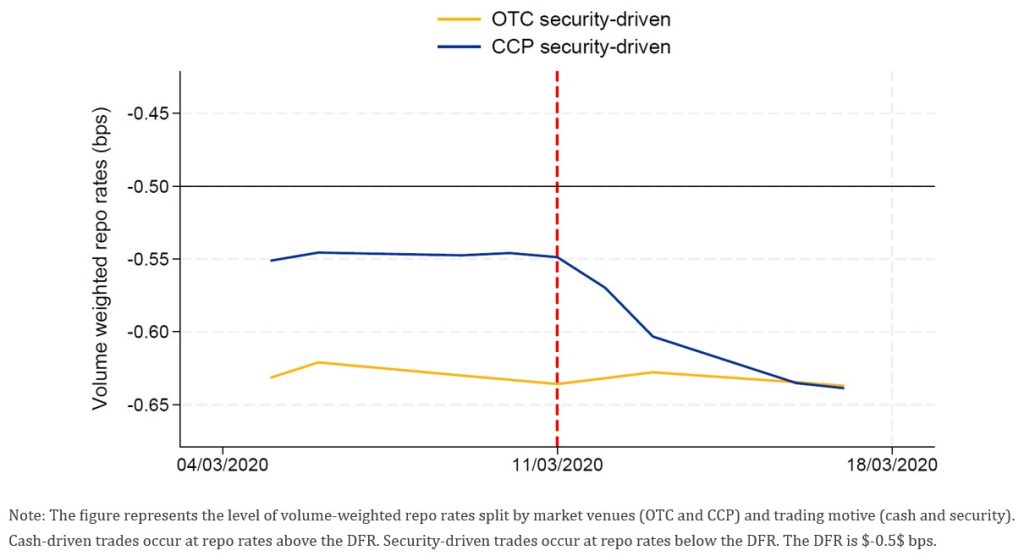
The key empirical puzzle is simple. Even when two trades are backed by the same security and have similar contractual features, borrowing costs differ systematically across clearing venues. Before the COVID-19 shock, borrowing the same security was more expensive in bilateral OTC trades than in CCP-cleared trades. In other words, special securities traded at more negative rates in OTC markets. Figure 2 shows that after the World Health Organization declared COVID-19 a pandemic on 11 March 2020, this CCP-OTC differential compressed sharply.
This pattern is difficult to explain with standard theories of repo specialness alone, which emphasize collateral scarcity, limited security supply, and search frictions as drivers of specialness premia (Duffie, 1996; Vayanos and Weill, 2008). Scarcity of the underlying bond can explain why repo rates become special, but it does not explain why the same bond should trade at different rates across clearing venues. Similarly, standard counterparty-risk explanations can explain why borrower quality matters, but they do not directly account for why the pricing difference between OTC and CCP trades should narrow during stress. The paper therefore links two topics that are usually treated separately: the pricing of scarce collateral and the pricing of counterparty risk in wholesale funding markets.
Figure 2. Repo rates for security-driven transactions by market
The main mechanism at play works as follows. Repo lenders care about two risks. First, the borrower may fail to return the security. Second, the value and availability of the collateral may change. These risks interact. Losses are especially relevant in states where the borrower defaults and the collateral outcome is adverse. As a result, the repo rate is a non-linear function of borrower risk.
This non-linearity matters for the difference between bilateral and centrally cleared markets. In OTC markets, lenders price each borrower separately. The average OTC rate is therefore an average of borrower-specific prices. In CCP markets, by contrast, borrower identities are pooled. The CCP becomes the counterparty and losses are mutualised through the clearing structure. The CCP-cleared rate therefore reflects the risk of the average borrower in the pool.
When pricing is non-linear, averaging borrower-specific pricing is not the same as pricing the average borrower. This difference generates a systematic wedge between OTC and CCP repo rates. In normal times, bilateral pricing produces stronger specialness than pooled CCP pricing. During stress, when perceived counterparty uncertainty rises, the wedge compresses because the CCP rate reacts to the deterioration of the pooled borrower, while OTC prices continue to reflect borrower-specific risk.
This mechanism also explains the following findings. First, the compression should be weaker for riskier borrowers, because they benefit more from being pooled in the CCP. Second, the compression should be stronger for high-quality collateral, because the scarcity value of safe securities interacts more strongly with pooled counterparty risk.
The analysis uses transaction-level data from the European Central Bank’s Money Market Statistical Reporting dataset. The data cover the largest euro-area banks and contain detailed information on repo rates, volumes, maturities, collateral securities, counterparties, and clearing arrangements. This allows to compare OTC and CCP trades backed by the same securities over the same short time window.
The empirical design focuses on the days around the WHO pandemic announcement on 11 March 2020. This event sharply increased counterparty uncertainty, as reflected in bank CDS spreads, but it occurred before major policy interventions such as the ECB’s Pandemic Emergency Purchase Programme. The short window is important because it limits the scope for slow-moving institutional differences – such as balance-sheet netting benefits or relationship lending – to drive the results.
The main outcome variable is the cost of borrowing the security, measured as the absolute distance between the repo rate and the ECB deposit facility rate. The analysis controls for transaction characteristics such as volume, haircut, tenor, collateral type, collateral rating, issuer country, and a rich set of fixed effects. The underlying paper also verifies that volumes and borrower composition do not shift in a way that could mechanically explain the compression of the CCP-OTC differential (Danisewicz et al , 2026).
The first finding is that special securities trade at higher borrowing costs in bilateral OTC markets than in CCP-cleared markets in normal times. This is consistent with the idea that bilateral lenders price borrower-specific counterparty risk, while CCP trades price pooled counterparty risk.
The second finding is that the differential compresses sharply after the COVID-19 shock. CCP borrowing costs increase relative to OTC borrowing costs, narrowing the gap between the two markets. This is the central empirical result: a shock to counterparty uncertainty changes prices differently across clearing arrangements.
The third finding is that the compression is weaker for riskier borrowers. Borrower risk is measured using non-performing loan ratios and CDS spreads. This result supports the mechanism that riskier borrowers benefit more from counterparty-risk pooling in CCP markets. When uncertainty rises, the CCP-OTC differential therefore compresses less for these borrowers.
The fourth finding is that the compression is stronger for high-quality collateral. The paper identifies safe collateral as government bonds issued by core euro-area countries, including Germany, France, and the Netherlands. For these securities, the interaction between collateral scarcity and counterparty pooling is particularly strong. This result complements evidence that repo specialness is sensitive to collateral scarcity and safe-asset supply (Corradin and Maddaloni, 2020).
The results are robust to alternative fixed effects, borrower-risk measures, collateral-quality measures, relationship-lending controls, sovereign-bond-only samples, and matched counterparty samples. Dynamic estimates show no evidence that the rate differential adjusted before the WHO announcement.
The findings have three implications for policy.
First, central clearing changes prices, not only risk allocation. Policy discussions often emphasize that CCPs reduce bilateral counterparty exposures, improve multilateral netting, and support market resilience. These benefits are important. But the paper shows that central clearing also changes how counterparty risk enters repo rates. Expanding central clearing can therefore affect the pricing of scarce collateral and the allocation of securities across market participants.
Second, CCPs can dampen borrower-specific risk pricing but create pool-level pricing effects. In bilateral markets, weak borrowers may face higher borrowing costs because their risk is priced directly. In centrally cleared markets, these risks are pooled. This can support market access during stress, consistent with evidence that centrally cleared repo markets can absorb shocks (Mancini, Ranaldo and Wrampelmeyer, 2016; Affinito and Piazza, 2021). But it also means that shocks to perceived pool risk can affect all CCP-cleared trades. Policymakers should therefore monitor not only aggregate cleared volumes but also the risk composition of CCP participants and the sensitivity of CCP-cleared repo rates to changes in counterparty uncertainty.
Third, collateral scarcity and counterparty risk should be supervised jointly. The paper shows that the CCP-OTC compression is stronger for high-quality collateral. This matters because safe collateral is precisely the segment most relevant for market functioning, margining, liquidity management, and monetary policy implementation. During stress, demand for safe securities rises at the same time as counterparty uncertainty increases. Clearing arrangements shape how these two forces interact.
These implications are directly relevant for jurisdictions expanding mandatory clearing. A move toward more central clearing may strengthen resilience, improve netting, and reduce bilateral counterparty exposures. But it may also alter collateral pricing, redistribute the benefits of pooling across borrowers, and change the transmission of stress into repo rates. Central clearing should therefore be evaluated not only as a risk-management reform but also as a market-structure reform.
Central clearing is often presented as a mechanism for reducing counterparty risk. This paper shows that it also changes the pricing of special collateral. In the euro-area repo market, identical securities trade at different borrowing costs depending on whether they are cleared bilaterally or through a CCP. In normal times, OTC trades show stronger specialness. During the COVID-19 shock, the CCP-OTC differential compressed sharply.
The mechanism is counterparty-risk pooling. Bilateral markets price borrower-specific risk. CCP markets price the pooled borrower. Because repo rates are non-linear in borrower risk, these two pricing systems generate different outcomes. The compression of the differential is weaker for riskier borrowers and stronger for high-quality collateral, consistent with the model.
For policymakers, the message is that central clearing affects both resilience and price formation. As clearing mandates expand, especially in repo markets backed by safe sovereign collateral, the pricing consequences of counterparty-risk pooling deserve close attention.
Affinito, M. and Piazza, M. (2021), “Always look on the bright side? Central counterparties and interbank markets during the financial crisis,” International Journal of Central Banking, 17(1), 231-283.
Boissel, C., Derrien, F., Ors, E. and Thesmar, D. (2017), “Systemic risk in clearing houses: Evidence from the European repo market,” Journal of Financial Economics, 125(3), 511-536.
Brunnermeier, M. K. (2009), “Deciphering the liquidity and credit crunch 2007-2008,” Journal of Economic Perspectives, 23, 77-100.
Corradin, S. and Maddaloni, A. (2020), “The importance of being special: Repo markets during the crisis,” Journal of Financial Economics, 137(2), 392-429.
Duffie, D. (1996), “Special repo rates,” Journal of Finance, 51, 493-526.
Duffie, D. (2020), “Still the world’s safe haven? Redesigning the U.S. Treasury market after the COVID-19 crisis,” Hutchins Center Working Paper No. 62.
Mancini, L., Ranaldo, A. and Wrampelmeyer, J. (2016), “The euro interbank repo market,” Review of Financial Studies, 29(7), 1747-1779.
Vayanos, D. and Weill, P.-O. (2008), “A search-based theory of the on-the-run phenomenon,” Journal of Finance, 63(3), 1361-1398.