

This policy brief is based on Federal Reserve Bank of Boston, 26-3 Research Department Working Papers. The views expressed are those of the authors and not necessarily those of the institutions the authors are affiliated with.
Abstract
We develop an econometric model to jointly estimate the neutral rate and identify monetary policy shocks, allowing us to address this question. The results point to four main conclusions. First, U.S. contractionary monetary policy shocks reduce the neutral rate. Second, the effect is modest but statistically significant and accumulates over time. Third, monetary policy shocks do not explain the long-run decline in the neutral rate, which remains primarily driven by structural forces. Fourth, international evidence points to similar effects for advanced economies.
The real neutral rate of interest, r_t^*, is a central concept for monetary policy analysis. It represents the real interest rate consistent with output at potential and stable inflation once shocks dissipate. Because r_t^*, is not directly observed, central banks rely on empirical models to infer its level and evolution.
Traditional approaches treat the neutral rate as driven primarily by slow-moving structural forces, such as productivity growth, demographics, and global saving-investment balances (Laubach and Williams, 2003; Holston, Laubach and Williams, 2017; Del Negro et al., 2017). In this view, monetary policy affects real activity only temporarily and does not influence the level of r_t^*,.
A growing body of evidence challenges this assumption. Recent contributions show that monetary policy can have persistent effects on innovation, productivity, and output, thereby affecting long-run equilibrium interest rates (Jorda et al., 2024; Moran and Queralto, 2018). These findings suggest that the neutral rate may be, at least in part, endogenous to monetary policy.
This policy brief summarizes evidence from Leiva-Leon, Sekkel, and Uzeda (2026), which develops a Trend-Cycle Bayesian VAR (TC-BVAR) to jointly estimate the neutral rate and identify monetary policy shocks. A key innovation of the framework is that it allows cyclical shocks –most notably monetary policy shocks– to affect the trend component of macroeconomic variables. This provides a direct way to assess whether transitory disturbances have persistent effects on the neutral rate.
A key feature of the employed empirical framework is that cyclical shocks can affect the evolution of trends. Standard models impose orthogonality between trend and cycle. Here, the two components interact. This allows us to test directly whether monetary policy shocks leave a persistent imprint on the neutral rate.
The approach also avoids the generated-regressor problem that arises in two-step procedures, where r_t^*, is estimated first and then regressed on policy shocks. Joint estimation delivers internally consistent inference on the elasticity of r_t^* to monetary policy shocks.
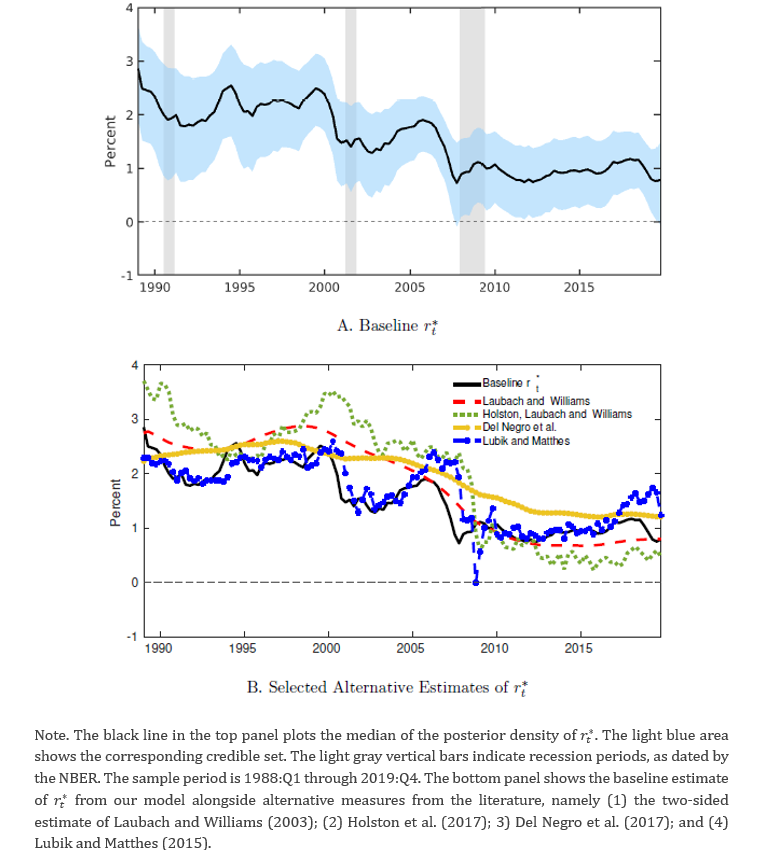
The estimated neutral rate aligns closely with standard benchmarks. In the U.S. it declines from about 3 percent in the early 1990s to roughly 1 percent by 2019, consistent with estimates by Laubach and Williams (2003), Holston et al. (2017), Lubik and Matthes (2015), and Del Negro et al. (2017) (see Figure 1).
The central parameter in the analysis is the elasticity of the neutral rate to monetary policy shocks. The posterior distribution is concentrated below zero, indicating that contractionary shocks reduce the neutral rate. The probability of a positive effect is close to zero.
Figure 1. Baseline and Comparative Estimates of r_t^*
Quantitatively, a 25 basis-point contractionary shock lowers the neutral rate by about 4 basis points. While modest in isolation, the effect becomes economically meaningful as shocks accumulate over time.
These results imply that monetary policy can affect the economy beyond business-cycle frequencies. They are consistent with evidence that policy shocks have persistent effects on output, productivity, and employment. In this sense, the neutral rate is not fully exogenous to monetary policy.
A statistically significant effect does not imply that monetary policy drives the long-run decline in the neutral rate. To assess this, we decompose the evolution of r_t^*, into the cumulative contribution of monetary policy shocks and other shocks.
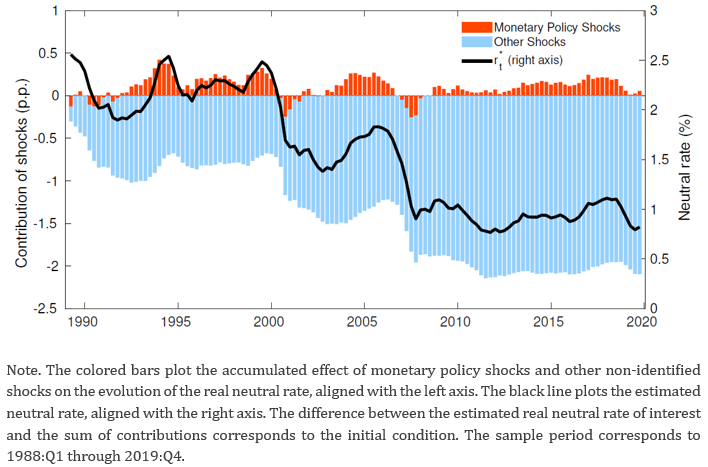
The results show that monetary policy shocks account for only a small share of long-run movements in r_t^*,. Most of the decline reflects other forces, which capture broader structural drivers (see Figure 2).
Monetary policy shocks matter at specific points in time. They contribute to declines in r_t^*, around recessions, including 2001 and the global financial crisis. However, these effects are limited relative to the overall downward trend. Over the full sample, the cumulative contribution of policy shocks is slightly positive, suggesting that policy may have mitigated the decline rather than caused it.
Figure 2. Cumulative Impact of Monetary Policy Shocks on r_t^*
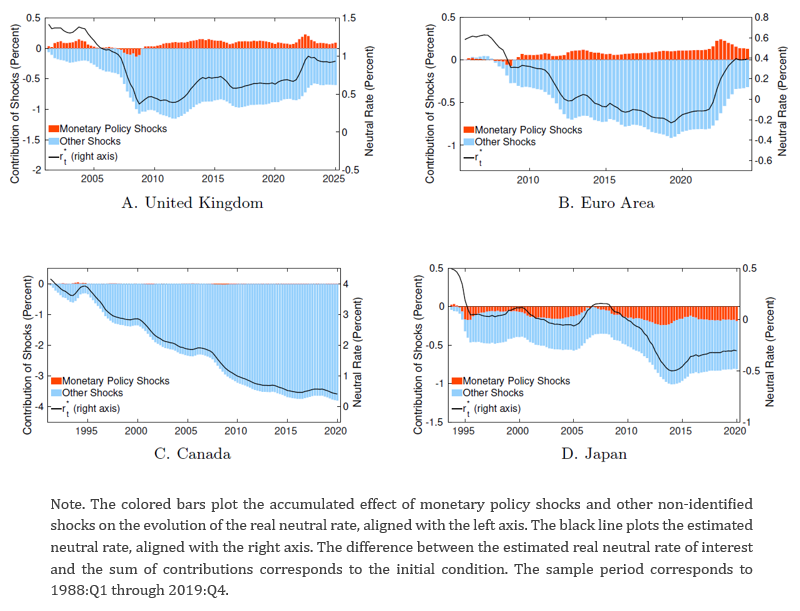
Extending the analysis to other advanced economies -including the United Kingdom, the euro area, Canada, and Japan- shows that the r_t^* estimates consistently align with independent benchmarks, showing a synchronized secular decline that became particularly pronounced following the Global Financial Crisis.
The international data supports the core finding that monetary policy is not neutral in the long run in that contractionary shocks are associated with declines in r_t^* across economies. While the magnitude of this effect varies by country, overall, monetary policy exerts a statistically significant influence on the neutral rate, except for Canada. However, as in the case of the U.S., these shocks account for only a modest portion of the total decline, which remains primarily driven by structural forces.
Figure 3. Cumulative Impact of Monetary Policy Shocks on r_t^* across Selected Economies
The results have the following implications for policy.
First, the neutral rate may be partly endogenous. Models that treat r_t^* as fully exogenous may overlook interactions between short-run policy actions and long-run outcomes.
Second, structural forces remain the main drivers of the long-run evolution of r_t^*. While monetary policy shocks can have sizable effects on r_t^* at times, they do not account for its secular decline. This reflects the relatively systematic conduct of monetary policy over the past three decades, which has been associated with smaller and less volatile shocks. In contrast, in environments characterized by less systematic and more volatile monetary policy — such as the 1970s — policy shocks could have a more substantial cumulative influence on the neutral rate.
Del Negro, M., Domenico G., M. P. Giannoni, and A. Tambalotti (2017). “Safety, Liquidity, and the Natural Rate of Interest.” Brookings Papers on Economic Activity.
Holston, K., Thomas L., and J. C. Williams (2017). “Measuring the Natural Rate of Interest: International Trends and Determinants.” Journal of International Economics, 108(S1), S59–S75.
Jorda, O., Moritz S., and A. M. Taylor (2024). “The Long-Run Effects of Monetary Policy.” Review of Economics and Statistics. Forthcoming.
Laubach, T., and J. C. Williams (2003). “Measuring the Natural Rate of Interest.” Review of Economics and Statistics, 85(4), 1063–1070.
Leiva-León, D., R. Sekkel, and L. Uzeda (2026). “Do Monetary Policy Shocks Affect the Neutral Rate of Interest?” Bank of Canada Staff Working Paper, 2026-6.
Lubik, T. A., and C. Matthes (2015). “Calculating the Natural Rate of Interest: A Comparison of Two Alternative Approaches,” Economic Brief 15-10, Federal Reserve Bank of Richmond.
Lubik, T., B. Merone, and N. Robino (2024): “Stargazing: Estimating r* in Other Countries,” Economic Brief 24-10, Federal Reserve Bank of Richmond.
Moran, P., and A. Queralto (2018). “Innovation, Productivity, and Monetary Policy.” Journal of Monetary Economics, 93, 24-41.