

This policy brief is based on SNB Working Paper No. 2026/01. The views expressed are those of the authors and do not necessarily represent those of the Swiss National Bank.
Abstract
Non-bank financial intermediaries now hold more than half of global financial assets, making their response to changes in monetary policy increasingly relevant for policymakers. Using a unified framework across four major economies, bond fund flows are shown to react significantly — yet heterogeneously — to monetary policy surprises. Contractionary surprises in these economies lead to increased inflows towards safe haven currency destinations, notably Switzerland and the US, while inflows to the Eurozone and the UK decline. Fund characteristics further shape these dynamics: Passively managed and foreign-domiciled funds exhibit stronger flow responses to monetary policy surprises. Importantly, domestic monetary policy decisions are globally transmitted via funds, resulting in sizable international spillovers.
Following the global financial crisis, regulatory reforms reshaped financial intermediation and accelerated the growth of non-bank financial intermediaries (NBFIs), which now hold more than half of global financial assets (FSB, 2025). NBFIs engage in banks’ core functions, are sensitive to liquidity shocks (Farhi and Tirole, 2021), and have substantial cross-border portfolios (Yeşin, 2023). Their growing systemic importance has recently increased interest in how monetary policy (MP) is transmitted through this sector and the vulnerabilities it may create.
Yet the transmission of MP through bond funds remains poorly understood. Blanco et al. (2026) address this gap with the first unified multi-country analysis of bond fund flow responses to MP surprises. The sample includes nine Eurozone countries, Switzerland, the UK, and the US for the period of 2010 to 2025. The analysis documents substantial heterogeneity in the fund flow responses to MP surprises and sheds new light on the cross-border transmission of MP. The key findings are summarized below.
The study adopts a two-step empirical approach. It first measures MP surprises using high-frequency movements in futures contracts around MP decisions in the Eurozone, Switzerland, the UK, and the US. These surprise measures are then linked to weekly bond fund flow data in a panel local projection framework (Jordà, 2005) to quantify the impact of MP surprises on bond fund flows.
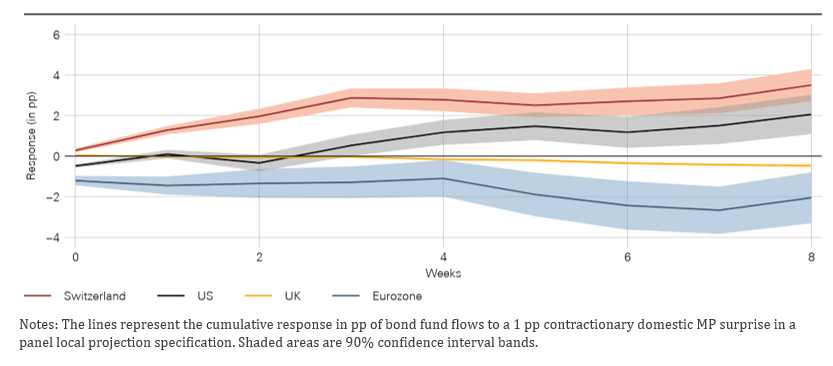
As shown in Figure 1, bond fund flow responses differ markedly across countries. A one percent contractionary[1] domestic MP surprise generates a cumulative increase in inflows of about 4 percentage points into Switzerland and 2 percentage points into the US over an eight-week horizon. In contrast, inflows to the Eurozone decline by roughly 2 percentage points and to the UK by 0.5 percentage points over the same period.
These patterns suggest that investors respond to MP surprises by reallocating portfolios toward bond markets that are perceived to be safer, underscoring the importance of safe-haven currency status in shaping international capital flows.
Figure 1. Total cumulative bond flows response to a 1 pp contractionary domestic MP surprise
Fund characteristics play an important role in shaping bond fund flow responses to MP surprises. In particular, differences in investor base composition across jurisdictions may underlie the heterogeneous responses of fund flows to MP surprises.
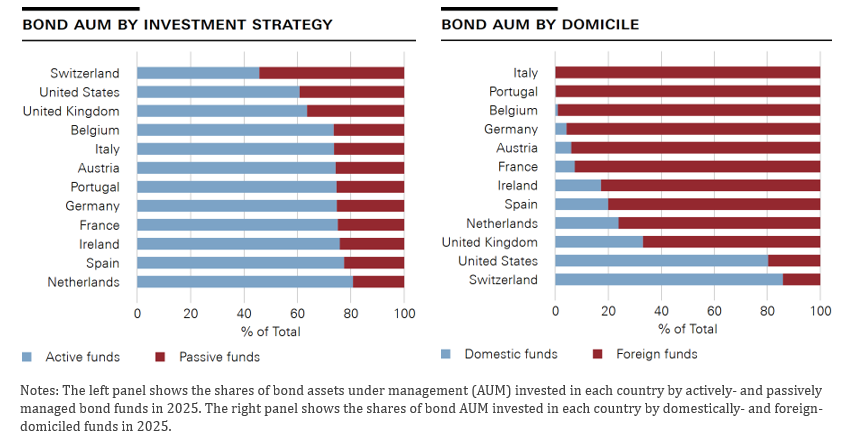
First, passive funds react more strongly and persistently to contractionary MP surprises than active funds as they rebalance mechanically to track benchmarks, suggesting that countries receiving more investment from passive funds may be more vulnerable to sharp flow adjustments and financial market volatility following an MP surprise. While the share of passive funds in aggregate more than doubled between 2010 and 2025, there is also significant variation across jurisdictions (Figure 2, left panel).
Second, flows from foreign-domiciled funds exhibit stronger and more immediate responses to MP surprises than those from domestically domiciled funds. The stronger response of foreign-domiciled funds may be driven by differential currency and country exposures of funds domiciled in different countries. As a result, countries receiving more investment from foreign funds can be exposed to an accelerated cross-border portfolio reallocation following an MP surprise. The share of foreign-domiciled funds investing in different jurisdictions varies markedly (Figure 2, right panel).
Figure 2. Heterogeneity of fund characteristics across countries
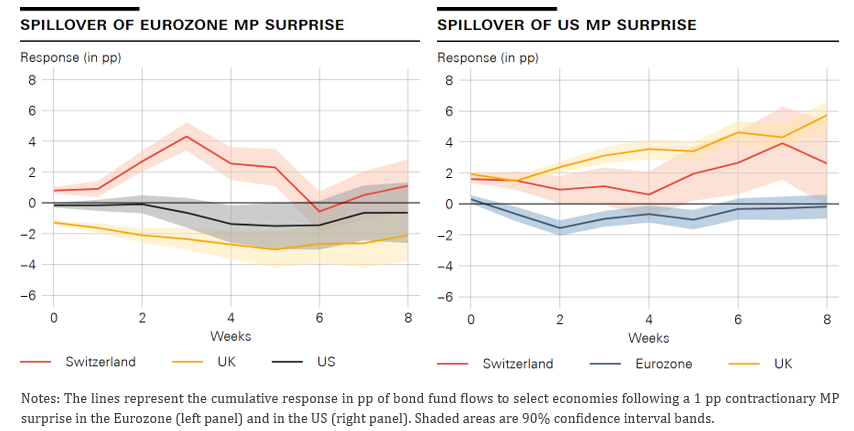
The study also examines the response of domestic bond fund flows to foreign MP surprises. The empirical analysis shows that responses differ markedly depending on the origin of the MP surprise. Contractionary Eurozone surprises increase bond fund flows to Switzerland, reduce flows to the UK, and have no significant effect on the US (Figure 3, left panel). By contrast, contractionary US surprises reduce flows to the Eurozone while increasing flows to both Switzerland and the UK (Figure 3, right panel).
This finding identifies the fund sector as an important international transmission channel of MP. US MP emerges as the dominant source of cross-border spillovers consistent with the global financial cycle. The study further illustrates that MP surprises originating in the Eurozone also trigger substantial portfolio reallocation across other jurisdictions.
Finally, the comparatively muted response of US fund flows to foreign MP surprises suggests that the size and depth of US financial markets and the dominant international role of the dollar provide insulation from external monetary developments.
Figure 3. Total cumulative bond flows response to a 1 pp foreign contractionary MP surprise
These findings have important policy implications. Empirical results illustrate that investment funds are an important channel of MP transmission, both domestically and across borders. Monitoring how NBFIs respond to MP decisions may therefore help policymakers better assess the transmission and spillover effects of policy actions.
The findings also highlight the importance of international cooperation in macroprudential oversight. Because investment funds transmit MP surprises across jurisdictions, risks can emerge outside the reach of domestic regulators. Greater coordination is therefore needed to monitor vulnerabilities associated with globally active NBFIs.
Blanco, S., M. Koomen, and P. Yeşin (2026). Heterogeneous effects of monetary policy surprises on bond fund flows. SNB Working Paper 2026-01. Swiss National Bank.
Farhi, E. and J. Tirole (2021). Shadow banking and the four pillars of traditional financial intermediation. The Review of Economic Studies 88 (6), 2622–2653.
FSB (2025). Global monitoring report on non-bank financial intermediation 2025. Financial Stability Board Report, December.
Jordà, O. (2005). Estimation and inference of impulse responses by local projections. American Economic Review 95 (1), 161–182.
Yeşin, P. (2023). How prevalent are investment funds in cross-border investment? SUERF Policy Brief 556. The European Money and Finance Forum.
A contractionary MP surprise corresponds to an increase in the futures rate following an MP announcement, irrespective of whether the prevailing policy cycle is one of tightening or easing.