

This policy brief is based on Pfarrhofer and Stelzer (2026), “Are there asymmetries in euro area monetary policy?” OeNB Working Paper 276, containing research conducted within the network “Challenges for Monetary Policy Transmission in a Changing World Network” (ChaMP). It consists of economists from the European Central Bank (ECB) and the national central banks (NCBs) of the European System of Central Banks (ESCB). Opinions expressed by the authors of studies do not necessarily reflect the official viewpoint of the Oesterreichische Nationalbank or the Euro system.
Abstract
Using a flexible machine learning model that jointly analyses monthly and quarterly data – including ECB Bank Lending Survey indicators of credit conditions – we estimate how monetary policy shocks propagate through bank-based transmission channels. The central finding is that contractionary monetary policy reliably tightens credit conditions and slows output and inflation, while expansionary monetary policy has limited and often statistically insignificant effects. This asymmetry holds across different shock sizes, business cycle phases, and even at the effective lower bound of interest rates. Credit demand is the only partial exception: it responds similarly to easing than it does to tightening. These findings challenge assumptions of symmetric transmission embedded in standard policy frameworks and suggest that central banks may need stronger actions or complementary tools to achieve the same impact from monetary easing as from tightening.
The euro area economy relies mainly on bank-based finance. Corporate lending, household mortgages, and consumer credit are channeled mostly through banks rather than capital markets, making the banking sector a critical link in the monetary policy transmission chain. When the European Central Bank (ECB) adjusts its policy stance, the expectation is that banks will pass the change through to lending conditions, credit standards, and ultimately to spending and prices. In theory, rate hikes and rate cuts should exert broadly symmetric effects – tightening credit when rates rise and loosening it when rates fall. In practice, the recent literature suggests that it may be substantially harder to stimulate the economy through monetary easing than to cool it through tightening.
This brief draws on Pfarrhofer and Stelzer (2026), studying asymmetries, nonlinearities, and state dependencies in euro area monetary policy transmission using a novel nonparametric mixed-frequency model. The dataset covers January 2003 to September 2023, spanning the global financial crisis, the euro area sovereign debt crisis, the effective lower bound period, the pandemic, and the recent tightening cycle. The analysis focuses on how monetary policy shocks propagate through the real and financial economy, specifically tracing the broad credit, the bank lending, and the borrower balance sheet channels.
Many models of monetary policy assume that its effects are linear and symmetric: a one-unit shock in either direction produces proportional responses of equal magnitude and opposite sign. This assumption simplifies estimation but may obscure important features of how banks and borrowers respond to policy changes.
In our more flexible approach, we combine a Bayesian machine learning method – Bayesian Additive Regression Trees (BART) – with a mixed-frequency vector autoregressive model. The advantage of this framework is that it does not impose a specific functional form for the relationship between shocks and economic outcomes. Instead, the nature of any nonlinearities is estimated from the data directly, allowing it to determine whether transmission is linear, asymmetric, or state-dependent. A central feature of the analysis is the ECB’s Bank Lending Survey (BLS), a quarterly survey of senior loan officers at euro area banks conducted since 2003. The BLS provides direct information on banks’ willingness to lend, covering changes in credit standards, factors affecting those standards, and changes in loan demand. This information is not captured by interest rates alone and is particularly valuable when rates are constrained near their lower bound. From the BLS responses, three composite indicators of transmission channels are constructed, following Ciccarelli et al. (2013), which are complemented by an indicator of loan demand:
The quarterly BLS indicators are combined with real GDP and monthly data on industrial production, inflation, stock prices, credit spreads and interest rates. Monetary policy shocks using market reactions in tight windows around ECB announcements to isolate unexpected policy changes (Jarociński and Karadi, 2020) provide causal identification.
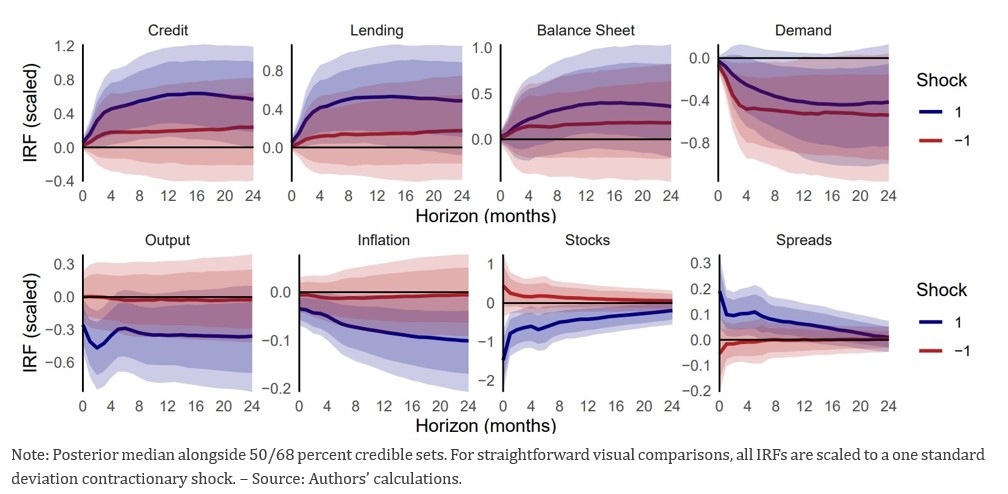
The most consistent finding is a sharp asymmetry between contractionary and expansionary monetary policy (Figure 1). Contractionary surprises – where the ECB signals a tighter-than-expected stance – generate significant and theory-consistent responses across all variables examined. Credit conditions tighten and credit demand falls. Output and inflation decline, and financial conditions deteriorate. These effects are statistically significant and persistent, lasting up to two years. Expansionary monetary policy surprises, by contrast, have limited effects. Across bank lending channels, output, and inflation, estimated responses are either small in magnitude or statistically indistinguishable from zero. Credit demand is a partial exception to this pattern: households and firms do seek more credit when conditions ease, quantitatively comparable to a contraction in demand from a similarly sized tightening shock.
Figure 1. Impulse response function to a monetary policy shock: asymmetries due to shock sign
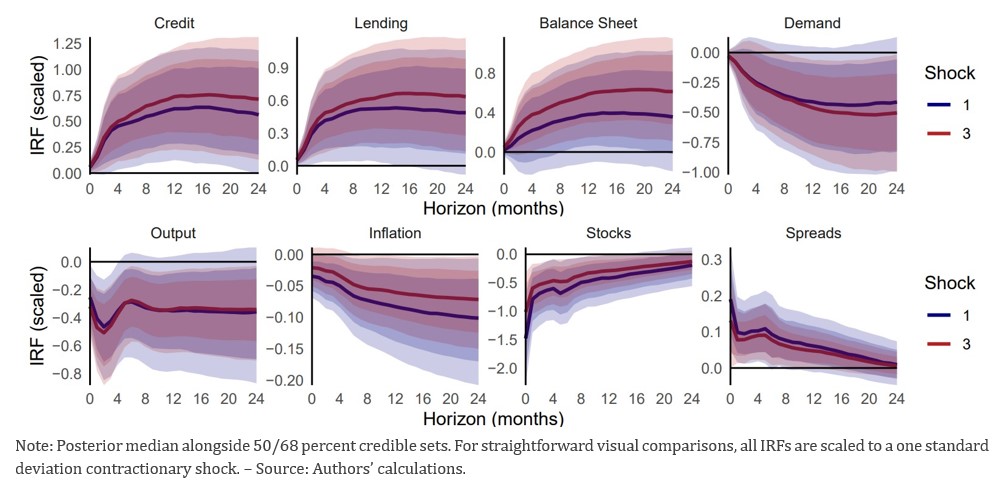
Beyond the direction of the shock, we also investigate whether the magnitude of a monetary policy surprise matters (Figure 2). A larger contractionary shock does generate stronger and more sustained responses in credit conditions, however, responses to a larger shock are not statistically different from a smaller shock. For inflation and stocks, there is evidence that larger contractionary shocks produce disproportionately smaller reductions – suggesting diminishing returns to large tightening, while larger expansionary shocks produce proportionally larger effects on inflation (not shown in Figure 2). The key takeaway, however, is that size-related nonlinearities are secondary and not statistically significant. The direction of the shock is by far the more important determinant of the responses. Doubling the size of an expansionary shock does not overcome the fundamental ineffectiveness of easing in the bank-based transmission channels.
Figure 2. Impulse response function to a monetary policy shock: asymmetries due to shock size
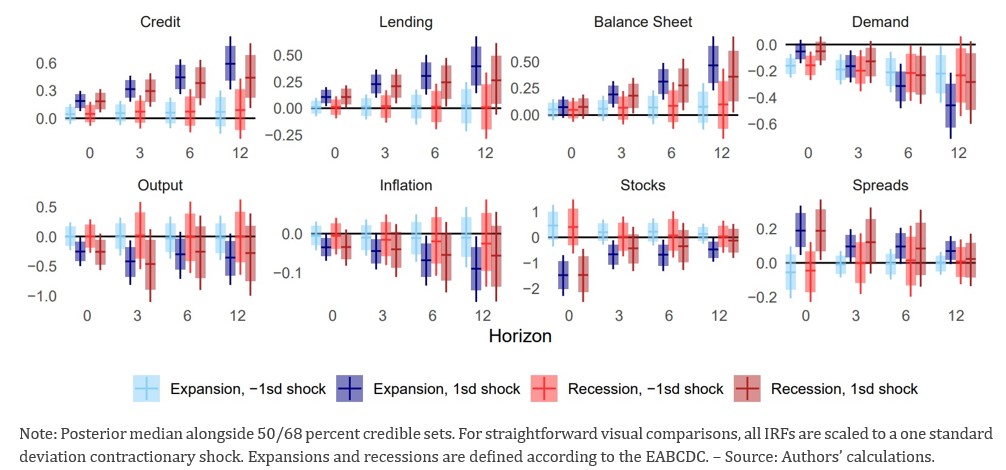
A natural question for policymakers is whether these asymmetries reflect the economic environment rather than a structural feature of transmission. Easing might be more effective in recessions, or perhaps the effective lower bound (ELB) changes how banks respond to policy signals. The evidence finds little support for either interpretation. Comparing responses during recessions and expansions (as dated by the Euro Area Business Cycle Dating Committee), the pattern in Figure 3 is unchanged: contractionary shocks work in both states; expansionary shocks remain muted in both. Responses to tightening are somewhat larger during expansions, but the difference is not statistically significant. Responses to easing show no meaningful improvement during recessions, when the need for stimulus is greatest. The same conclusion holds for the ELB period (defined as when the short-term rate was below 25 basis points, not shown here). Periods at the ELB account for a significant share of the sample, yet they do not produce materially different transmission dynamics. Expansionary policy remains largely ineffective through the bank-based channels during and outside ELB episodes alike. This finding implies that the asymmetric nature of monetary policy transmission is structural rather than cyclical. It is not a product of specific economic conditions but a persistent feature of how banks and borrowers respond to policy signals.
Figure 3. Sign asymmetries for state dependent (scaled) impulse response functions in expansions and recessions for a subset of credit, macroeconomic and financial variables across selected horizons
The evidence consistently points to a fundamental asymmetry in euro area monetary policy: tightening is a reliable and powerful instrument; easing is not. This has several practical implications.
Projections and policy frameworks that treat rate hikes and rate cuts as mirror images are likely to overstate the stimulative effect of easing. The same change in interest rates applied in opposite directions does not produce symmetric economic effects. Assuming otherwise risks miscalibrating the required policy response when inflation is below target. This also implies that achieving inflation goals from below may require proportionally larger policy actions. For inflation in particular, the research suggests an asymmetry in how the price level responds to policy surprises of different signs. Moving inflation upward through easing may require greater policy effort than bringing it down through tightening. Central banks aiming to return inflation to target should factor in this asymmetry when calibrating the required stimulus.
Because state dependence is limited, policymakers cannot rely on the expectation that easing becomes more effective in downturns. The weak transmission of expansionary policy persists across economic states. This makes the asymmetry a structural constraint rather than a temporary feature of specific episodes. This difficulty in policy calibration makes monitoring bank lending conditions essential. Bank lending channels respond significantly to tightening and credit demand does respond to easing. This makes BLS indicators a valuable and early source of information about whether monetary policy is transmitting as intended. Regular monitoring of credit standards, lending factors, and loan demand provides actionable signals about transmission effectiveness.
To summarize, the evidence reviewed in this brief supports a simple but consequential conclusion: monetary tightening and monetary easing are not equivalent. Contractionary shocks reliably tighten credit conditions and reduce inflation and output. Expansionary shocks largely fail to do the reverse, and this failure is not remedied by conducting easing during recessions or at the interest rate floor. The asymmetry is structural, not cyclical, and should be reflected in how central banks design, communicate, and calibrate their policy strategies. These conclusions are grounded in euro area data from 2003 to 2023 – a period that encompasses a wide range of economic and financial conditions – and are specific to a financial system in which bank-based intermediation plays a dominant role.
Ciccarelli, Matteo, Maddaloi, Angela and José-Luis Peydró. 2013. “Heterogenous transmission mechanism: monetary policy and financial fragility in the eurozone.” Economic Policy 28(75): 459-512.
Jarociński, Marek, and Peter Karadi. 2020. “Deconstructing Monetary Policy Surprises – the Role of Information Shocks.” American Economic Journal: Macroeconomics 12 (2): 1–43.
Pfarrhofer, Michael, and Anna Stelzer. 2025. “Are there asymmetries in euro area monetary policy” OeNB Working Paper 276.