
This policy brief is based on Bank of Italy, Occasional Papers No. 1001. The views expressed are those of the author and not necessarily those of the institutions the author are affiliated with.
Abstract
Central banks produce large volumes of policy documents — from monetary statements to internal reports — to support transparency, coordination, and institutional accountability. However, the complexity and frequency of these documents create significant operational and analytical burdens. Agentic AI systems combine large language models with autonomous workflows and tool-calling capabilities combining large language models with autonomous workflows and tool-calling capabilities, could automate key tasks such as drafting, summarisation, consistency checks, and data integration. The paper explores how such systems can be applied to central bank document workflows through two practical open-source examples aimed at cost-effective deployment. It concludes by weighing the efficiency gains against the governance safeguards needed for trustworthy adoption.
Despite impressive advances, the reliability of large language models in high-stakes settings remains uncertain. In central banking, the practical question is not whether such models reason exactly like humans, but whether they can support complex analytical workflows in a way that is accurate, traceable, and consistent with institutional accountability. This is particularly relevant for policy briefing, where document production often requires the coordinated execution of multiple tasks, including data retrieval, consistency checks, synthesis, and drafting.
Recent frontier and open-weight language models such as GPT-5, DeepSeek, and LLaMA have significantly expanded the capabilities of AI systems, especially in generating fluent, context-sensitive text. Yet, because these models rely primarily on fixed training data, they can still produce outdated information or hallucinated outputs. One important response to this limitation is Retrieval-Augmented Generation (RAG), which supplements model outputs with information retrieved from external sources at inference time.
The emergence of these systems builds on decades of progress in natural language processing, culminating in the transformer architecture (Vaswani et al., 2017), which enabled language models to scale far beyond earlier recurrent approaches. Early LLMs remained essentially passive: they could generate text fluently, but could not plan, act, or interact directly with external tools. Two developments began to change this. Instruction tuning and Reinforcement Learning from Human Feedback (RLHF) improved alignment with user intent, while plugin and tool-use integrations allowed models to operate within broader software environments. The ReAct framework (Yao et al., 2023) then formalised the idea of interleaving reasoning and action in an iterative loop.
These developments laid the foundation for agentic AI: systems able to interpret instructions, plan tasks, call tools or APIs, and iteratively refine their outputs. Frameworks such as LangChain, LangGraph, and AutoGen now provide practical building blocks for implementing such systems in complex, multi-step workflows across industry and government.
Agentic AI systems can extend analytical workflows in economics and public policy beyond simple chat-based interaction by supporting planning, tool use, and iterative refinement. This is especially relevant for policy brief generation, which typically involves a sequence of interdependent tasks rather than a single prompt-response exchange.
One important development is the move from single-model interactions to multi-agent systems (MAS), in which specialised agents handle distinct tasks within a coordinated pipeline. In a typical policy brief workflow, a planning agent decomposes the overall task, followed by specialised components for data discovery, data representation, narrative generation, and editorial review.
In such a pipeline, data discovery agents retrieve and validate macroeconomic information from sources such as IMF or Eurostat databases. Data representation agents transform raw inputs into publishable tables and charts, while vision-language models can assist with chart generation, description, and validation. Narrative generation agents then synthesise the evidence into structured prose — including summaries, key messages, and policy options — sometimes using self-critique loops or multi-agent collaboration to improve coherence and factual consistency.
Related advances in text-to-SQL interfaces also allow non-technical economists to query databases in natural language, with schema validation and provenance tracking supporting transparency and reproducibility.
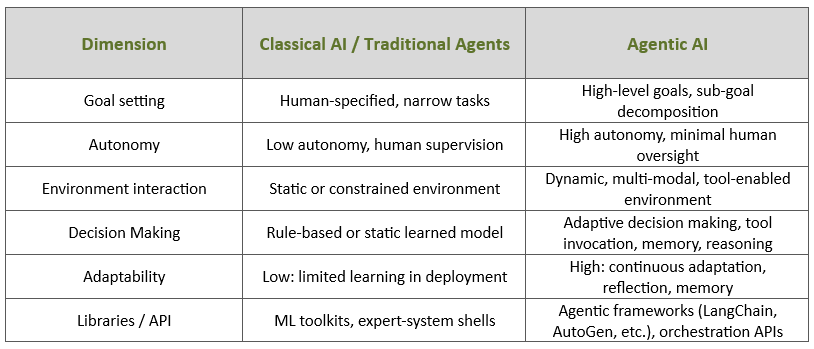
In the following we show a comparison table among the classical AI and traditional agents against the agentic AI framework:
A growing ecosystem of frameworks and libraries has emerged to support the development of agentic AI systems. Recent comparative work examines platforms such as LangChain, AutoGen, CrewAI, and LangGraph, focusing on differences in architecture, communication mechanisms, and memory management (Derouiche et al., 2025). At the same time, emerging protocols such as the Model Context Protocol (MCP) aim to standardise interactions between large language models, external tools, and execution environments (Hou et al., 2025).
From an implementation perspective, agentic AI systems are typically characterised by three core features. First, they exhibit a degree of autonomy: they can accept a high-level objective, decompose it into sub-tasks, plan intermediate steps, and execute actions with limited human intervention. Second, they operate in dynamic, tool-enabled environments, interacting with external resources such as web APIs, databases, and user interfaces under changing constraints. Third, they display adaptive decision-making: they can select tools, monitor intermediate outcomes, revise their strategy, and in some settings collaborate with other agents. Together, these features distinguish agentic systems from static language models that generate text but do not actively manage multi-step workflows.
The first example presents a practical application of agentic AI: an Automated Inflation Reporter designed to support — not replace — economists’ judgement by handling the routine, time-consuming steps of data retrieval, validation, visualisation, and narrative drafting.
The system is built through a two-phase process. First, ChatGPT (LLM1) is used to design and develop the software components. Then, the resulting application runs autonomously, drawing on an open-source LLaMA model (LLM2) to generate the final narrative summary.
The pipeline covers four major euro-area economies — Germany, France, Italy, and Spain — pulling monthly HICP year-on-year inflation data directly from the ECB Data Portal. It operates through four sequential agents: Ingest (data retrieval), Validate (checking for missing values and outliers), Analyse (identifying trends and cross-country differences), and Compose (producing charts, tables, and a written brief).
Governance is built into the system from the outset: every output is traceable to its exact data source and timestamp, and monthly snapshots of both data and narratives are retained to ensure reproducibility and accountability — essential requirements in a central banking context.
The sample briefing generated by the system shows all four economies hovering in the 2–3% inflation corridor in late 2025, with Spain at the higher end, France at the lower end, and Italy recovering modestly after pronounced disinflation in 2024. Energy base effects are fading, with food and services now the dominant drivers of inflation across the group.
The second example shows an automated Financial Stability Index (FSI) built using an agentic AI system, designed to support the routine but operationally intensive task of monitoring financial stability conditions at central banks.
As with the Inflation Reporter, the process begins with ChatGPT assisting in the design phase — here, identifying a parsimonious set of indicators drawn from standard central banking practice. The chosen variables capture key risk dimensions of the Italian banking sector: the NPL ratio (credit risk), the CET1 capital ratio (solvency), the Liquidity Coverage Ratio (liquidity risk), and a market-based risk indicator.
The four standardised variables are then combined into a single FSI using a weighted average, with NPLs and CET1 each carrying a 30% weight and the LCR and market risk indicator 20% each. The resulting index is straightforwardto interpret: values between -1 and +1 reflect normal stability, values below -2 signal systemic stress, and values above +2 indicate exceptional resilience.
Finally, the system generates a narrative commentary by prompting an open-source vision-language model (LLaVA) (see Haotian et al., 2023) with both the FSI chart and explanatory text. The model successfully identified key trends, peaks, and troughs in the index — demonstrating the potential of multimodal AI in automated policy reporting.
While agentic AI holds considerable promise for streamlining economic analysis, deploying it without effective oversight could undermine trust, propagate errors, and amplify existing biases in policy processes. This paper has shown how agentic AI can be applied in practice to support short-term policy reporting, using multimodal systems, autonomous task coordination, and traceable data workflows to improve efficiency and reproducibility.
Looking ahead, sustainable adoption will require more than technological investment alone. It also depends on the development of appropriate skills, robust explainability frameworks, clear accountability mechanisms, and sound institutional governance. More broadly, the wider socio-economic implications of these systems should remain part of an open public and policy debate.
The central message is that public institutions, including central banks, must adapt their organisational practices and governance frameworks to ensure that agentic AI is deployed in a way that is both effective and trustworthy.
Abdollahzadeh, B. et al. (2021). {Artificial gorilla troops optimizer: A new nature-inspired metaheuristic algorithm for global optimization problems}. International Journal of Intelligent System https://doi.org/10.1002/int.22535
Bandi, A., et al. (2025). {The Rise of Agentic AI: A Review of Definitions, Frameworks, Architectures, Applications, Evaluation Metrics, and Challenges}. Future Internet,1–50.
Derouiche, A., et al. (2025). {Agentic AI Frameworks: Architectures, Protocols, and Design Challenges}. ArXiv: 2508:10146
Haotian L., et al. (2023). {Visual Instruction Tuning}. arXiv:2304.08485
Hou, X., et al. (2025). Model Context Protocol (MCP): Landscape, Security Threats, and Future Research Directions. ArXiv: 2503.23278
Vaswani, A., et al. (2017). {Attention is All you Need}. ArXiv:1706.03762
Yao, S., Jeffrey Zhao, et al (2023). {REACT: Synergizing Reasoning and Acting in Language Models}. ArXiv:2210.03629v3