This policy brief represents the authors’ own views and does not necessarily represent the views of either the ECB or the Eurosystem. The authors would like to thank Oscar Arce, Luc Laeven, Caroline Willeke, Maarten Dossche, Romana Peronaci and Athanasios Tsiortas for helpful comments on an earlier version of this note. The authors thank the ECB CES team involved in collecting and processing the data and Ipsos for carrying out the survey. Any errors or omissions are the authors’ sole responsibility.
Abstract
Despite digital innovations that have made financial markets more accessible and have reduced participation costs, less than half of euro area consumers currently invest in the stock market directly or via mutual funds and private pension plans compared with 62% in the United States. Drawing on the ECB Consumer Expectations Survey (CES), this note highlights key findings from our recent research (see Christelis et al. 2026) studying who participates in equity markets in the euro area and the main reasons discouraging participation. Participation is higher among younger, male, more educated, financially literate and more trusting consumers. Among non-investors, a lack of financial resources is named as the main barrier among lower-income households, whereas higher-income households cite financial risk and limited trust in markets. Fostering trust through credible pan-European investment products (e.g. EU Savings and Investment Accounts), improving risk understanding and strengthening financial literacy emerge as complementary levers to deepen retail participation and support the plans for a Capital Markets Union.
A well-recognised puzzle in household finance is the relatively low participation of consumers in equity markets, even though equities typically outperform savings and bonds over the long term. According to CES data, less than 40 percent of Europeans are currently investing in the stock market, either directly in publicly traded stocks or indirectly via mutual funds and/or private pension plans (Chart 1). In stark contrast, the majority of US consumers (62%) invest in the stock market according to a recent Gallup survey.1
The lower level of consumer participation in the stock market is often cited as a factor weakening the link between household savings and total investments in the euro area.2 Recent research also suggests it affects monetary policy transmission (Melcangi and Sterk 2025). In this note and our associated ECB Working Paper (see Christelis et al. 2026), we use data from the Consumer Expectations Survey (CES) to understand who invests in equities and shed light on the underlying reasons for (non-) participation.3 Channeling more consumers’ savings into equity markets could be a crucial step towards building a common and robust European Capital Market Union. Understanding the barriers to household investment in equities is also important in view of the pension needs associated with an ageing population. The demographic transition poses additional challenges to pension systems, stressing the need for greater household responsibility in accumulating sufficient resources for retirement, including via long-term equity investments.4
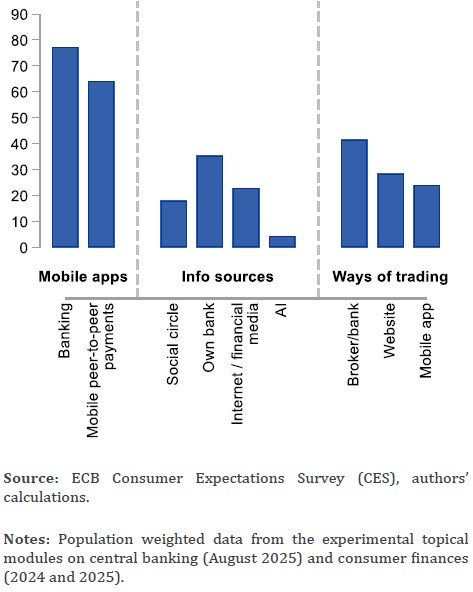
Consumer investment in stocks, directly or through mutual funds (incl. ETFs), has arguably never before been more accessible since the inception of equity markets. Many investments are just a mouse-click or finger swipe away. In fact, CES data show that most consumers, especially the younger ones, manage their finances digitally. The vast majority of consumers in the euro area (77%) engage in online banking via mobile phone apps, and more than half of all investors use websites or phone apps for executing their trades (see Chart 2). Yet, only a small fraction of about 4% of consumers report using AI as their main source of financial advice. At the same time, stock market participation in some countries, especially among younger adults in Germany, has been noticeably increasing recently.5
Despite low entry costs in terms of fees and easy access, most euro area consumers do not invest into equity markets, thereby forgoing sizeable returns over the long term. As regularly pointed out by market participants and policymakers, Europe has relatively high savings rates but may not sufficiently turn them into productive investments.6 According to recent CES data from December 2024 (Chart 1), 35% of euro area consumers invest in the equity market, including mutual funds and ETFs. An additional 12% have invested in the past but do not currently hold equity investments. This observation naturally raises the question: who participates in stock markets and why do most consumers choose not to invest?
Chart 1. Equity ownership across countries (percentage of consumers)
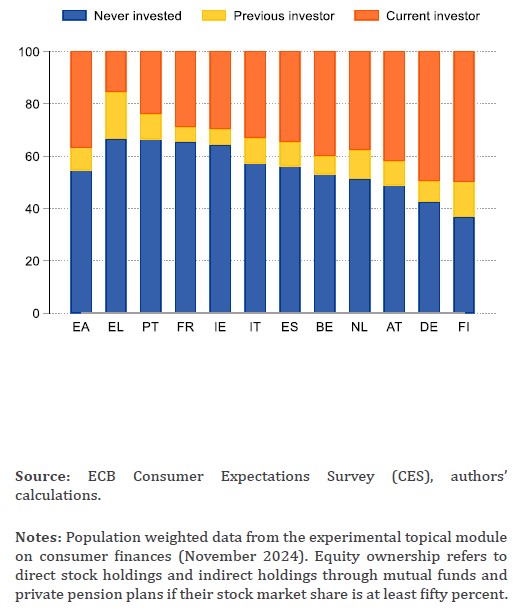
Chart 2. Digitalisation of personal finances (percentage of consumers)
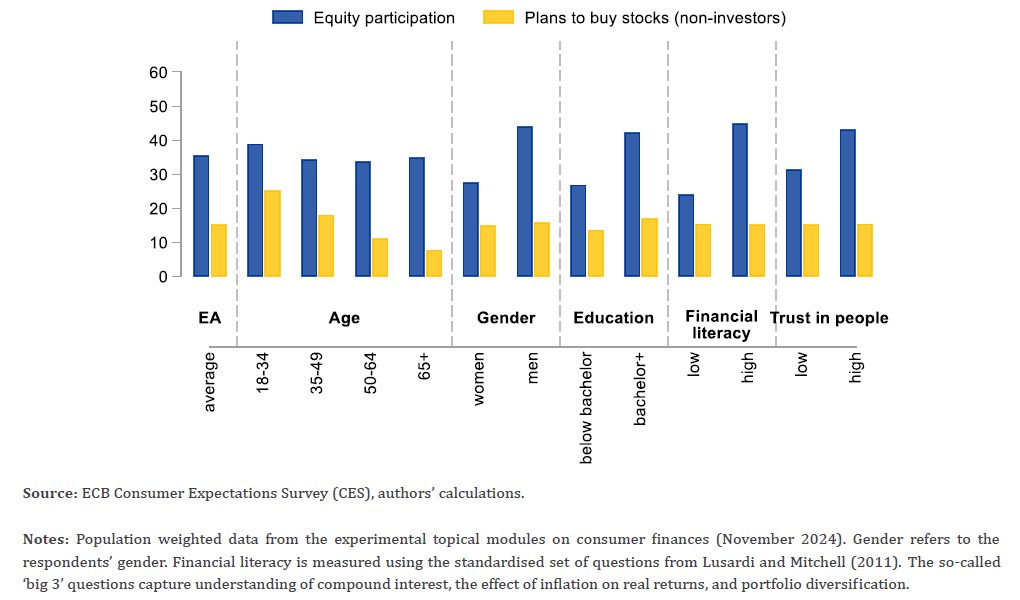
CES data show that stock market participation in the euro area displays strong socio-demographic heterogeneity, in line with the household finance literature (Chart 3).7 Consistent with life-cycle models (e.g., Campbell 2006), younger households are more likely to hold equities. Also, males, highly educated, financially literate, and those who are more trusting of people in general are more likely to hold equities (see Haliassos and Bertaut 1995; Lusardi and Mitchell 2014; Guiso, Sapienza and Zingales 2008). Gender and education gaps have been partly linked to differences in risk tolerance, confidence, and information costs (Sunden and Surette 1998; Barber and Odean 2001; van Rooij et al. 2011).
The CES also collects data on the plans of consumers to buy stocks for the first time or to increase stockholding if they already invest. At the end of 2024, on average, 29% of consumers planned to invest in the stock market in the next 12 months. This share is considerably higher for current and previous investors (54%) compared to those who have never invested (16%). Among non-investors, potential demand for stocks is higher for the young (18-34) as depicted in Chart 3.
Chart 4 shows the association between consumers’ expectations about positive stock market returns over the next 12 months and their plans to purchase stocks over the same horizon. The strength of this correlation differs between investors and non-investors. Among current investors, expected stock returns are strongly correlated with planned stock purchases. By contrast, there is a weaker correlation among households that have never invested in the stock market (Chart 4 – blue line). This suggests that for these households, optimistic return expectations alone might be insufficient to trigger a market entry. In addition, previous investors (who had held stocks at some point in the past) also display a relatively low correlation of their stockholding plans with expected stock market performance, possibly reflecting scarring effects from past investment experiences (see Malmendier and Nagel, 2011). Such households may remain reluctant to re-enter equity markets if, for example, prior losses have increased their perceived riskiness of stocks or reduced their confidence in making their own investment decisions.
Chart 3. Socio-demographic heterogeneity in stock ownership and plans to buy stocks over the next 12 months
(percentage of consumers)
One way to understand why many consumers do not participate in equity markets is to ask them directly. In the CES special modules on consumer finances fielded in 2022 and 2023, non-investors were asked why their household does not currently invest in stocks or mutual fund shares. Their answers point to distinct barriers across the income distribution (Chart 5). For less-affluent households, the dominant reason reported is a lack of resources, while for higher-income households concerns about financial risk become more relevant. This interpretation is consistent with respondents’ balance sheets. Among non-investors who cite insufficient resources, median liquid assets (bank account or cash holdings) amount to only €2,500.8 This does not imply that these households could not invest at all. Rather, it suggests that even small equity investments may be perceived as unattractive when liquidity buffers are limited and households must weigh fixed monetary and non-monetary participation costs, complexity and financial risk against the expected benefits of market participation.
Many households, especially among the higher income groups, cite financial risks as a discouraging factor for stockholding. To probe further into the role of risk attitudes, one can examine consumers’ reported willingness to take financial risks for investment decisions elicited in a separate CES question.9 CES data depicted in Chart 6, together with comparable data from the US Survey of Consumer Finances, show that the share of consumers unwilling to take any financial risk is closely linked to the share of non-investors across euro area countries. For example, in economies such as Greece, Portugal, and France, more than two-thirds of households prefer to avoid any financial risk and refrain from equity investment. Instead, in Finland and Germany, the share of consumers not willing to take financial risks is lower and comparable to the US. Yet, the share of stock ownership in Finland and Germany is still overall much lower than in the US suggesting that other factors beyond perceived risk contribute to the persistent stock market participation gap between European countries and the US.10
Chart 4. Expected stock market performance and plans to buy stocks over the next 12 months
(share of consumers)
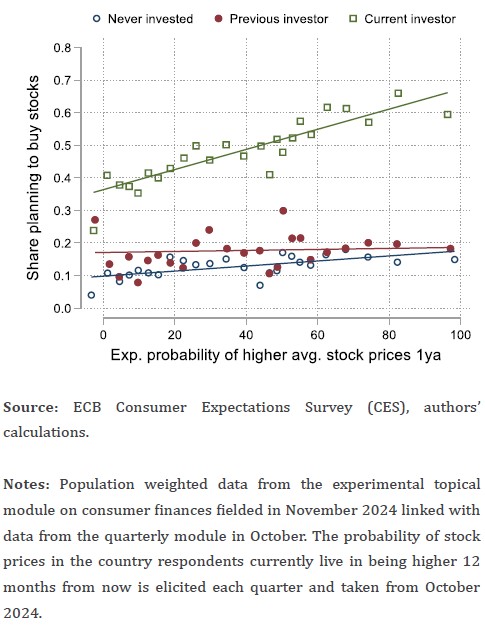
Chart 5. Reasons for people to not invest in equity (percentage of non-investors, by income quartile)
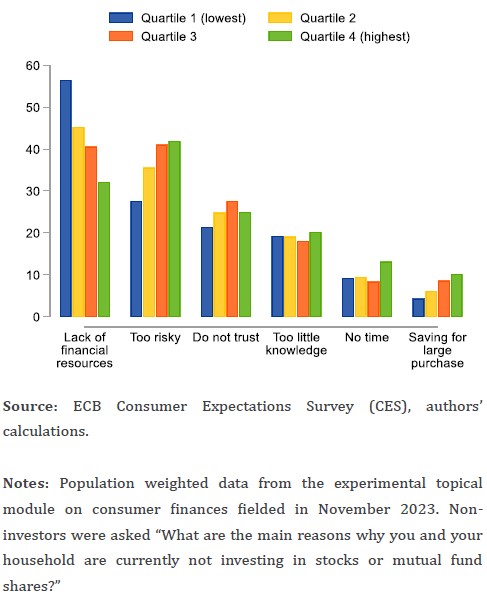
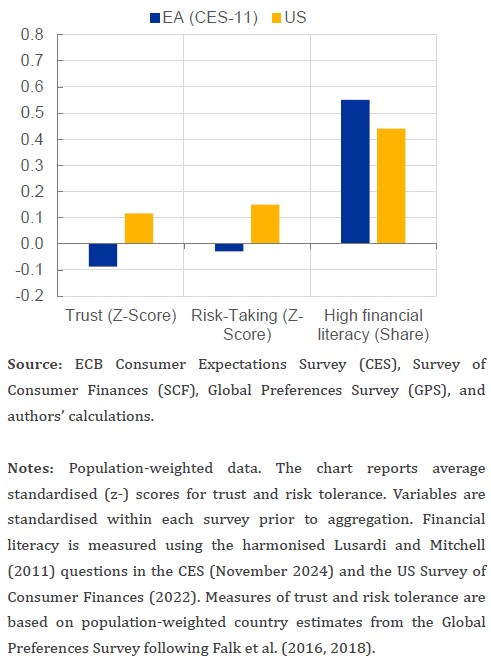
Across all income groups, a lack of trust in financial markets represents an important obstacle for those that are not constrained by a lack of financial resources (see Chart 5). This finding corroborates the limited stock market participation even among affluent households that are unlikely to be discouraged by participation fees (see Guiso et al. 2008). Using comparable data on consumer preferences collected by Falk et al. (2016, 2018) we show that differences between the euro area and the US are also found in other data sources. Chart 7 highlights that euro area households indeed score lower on trust in people and risk relative to U.S. households, indicating that, even if financial constraints are alleviated, differences in consumer preferences might still limit stock market participation among euro area households compared to their US counterparts.11 Improving the availability of trusted pan-European investment products such as recent EU initiatives to boost capital market investments, such as the EU Savings and Investment Accounts (EU-SIAs) could represent one way to possibly further encourage equity participation.
Finally, a non-negligible share of households (about 20%) report lacking the knowledge needed to invest in stocks (Chart 5). CES data further reveal that many euro area consumers struggle with even basic financial concepts, as measured by the standardised “Big Three” financial literacy questions developed by Lusardi and Mitchell (2011) and similar to US evidence (Chart 7). This highlights the importance of financial literacy programs that help consumers make informed investment decisions and navigating across complex and risky investment vehicles. Taken together, evidence from the CES suggests that a lack of financial resources, low trust and aversion to take financial risks all contribute to the persistent underinvestment in equities among euro area households. Scaling financial-literacy initiatives and practical investing advice, integrated into schools, workplaces, and pension communication would therefore likely also encourage stock market participation.12
Chart 6. Financial risk taking and stock market participation (percentage of consumers)
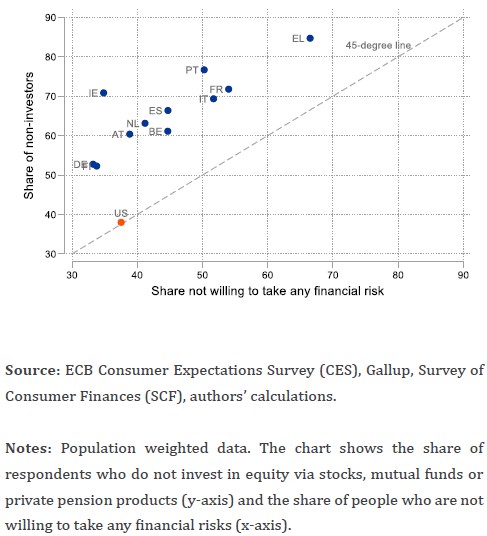
Chart 7. Differences between US and EA consumers’ trust, risk taking and financial literacy
(average z-score and share of consumers)
Drawing on CES data, we document persistently quite low levels of stock market participation in the euro area, reflecting intertwined constraints: limited financial resources, low risk tolerance, weak trust in markets, and gaps in basic financial literacy. While a lack of financial resources presents the main barrier to stock market participation, for a European Capital Markets Union building trust among consumers, improving consumers’ risk understanding and building financial literacy seem promising levers to increase equity participation among households.
For the appendix, please refer to the PDF version of this document.
Barber, B.M. and Odean, T., 2001. Boys will be boys: Gender, overconfidence, and common stock investment. Quarterly Journal of Economics, 116(1), pp.261–292.
Campbell, J.Y., 2006. Household finance. Journal of Finance, 61(4), pp.1553–1604.
Christelis, D., Georgarakos, D., Jappelli, T. and Kenny, G., 2025. Wealth shocks and portfolio choice. Journal of Monetary Economics, 149, p.103632.
Christelis, D., Georgarakos, D., Jappelli, T., Kenny, G. and Meyer, J., 2026. Stockholding in Europe: Evidence from the Consumer Expectations Survey. ECB Working Paper Series (forthcoming).
European Central Bank (ECB), 2021. ECB Consumer Expectations Survey: An Overview and First Evaluation. ECB Occasional Paper No. 287.
Falk, A., Becker, A., Dohmen, T.J., Huffman, D. and Sunde, U., 2016. The Preference Survey Module: A Validated Instrument for Measuring Risk, Time, and Social Preferences. IZA Discussion Paper No. 9674.
Falk, A., Becker, A., Dohmen, T., Enke, B., Huffman, D. and Sunde, U., 2018. Global evidence on economic preferences. Quarterly Journal of Economics, 133(4), pp.1645–1692.
Ferreira, M.A., Mendes, D. and Silva, A.F., 2026. The impact of financial literacy: Evidence from a randomized trial linked to administrative data. Working Paper.
Georgarakos, D. and Kenny, G., 2022. Household spending and fiscal support during the COVID-19 pandemic: Insights from a new consumer survey. Journal of Monetary Economics, 129, pp.S1–S14.
Guiso, L., Sapienza, P. and Zingales, L., 2008. Trusting the stock market. Journal of Finance, 63(6), pp.2557–2600.
Haliassos, M. and Bertaut, C.C., 1995. Why do so few hold stocks? Economic Journal, 105(432), pp.1110–1129.
Kaiser, T., Lusardi, A., Menkhoff, L. and Urban, C., 2022. Financial education affects financial knowledge and downstream behaviors. Journal of Financial Economics, 145(2), pp.255–272.
Lagarde, C., 2024. Out of the comfort zone: Europe and the new world order. Speech by Christine Lagarde, President of the European Central Bank, at the 34th European Banking Congress, Frankfurt am Main, 22 November.
Lusardi, A. and Mitchell, O.S., 2011. Financial literacy around the world: An overview. Journal of Pension Economics and Finance, 10(4), pp.497–508.
Lusardi, A. and Mitchell, O.S., 2014. The economic importance of financial literacy: Theory and evidence. Journal of Economic Literature, 52(1), pp.5–44.
Malmendier, U. and Nagel, S., 2011. Depression babies: Do macroeconomic experiences affect risk taking? Quarterly Journal of Economics, 126(1), pp.373–416.
Melcangi, D. and Sterk, V., 2025. Stock market participation, inequality, and monetary policy. Review of Economic Studies, 92(4), pp.2656–2690.
Menkhoff, L. and Westermann, J., 2025. Determinants of stock market participation. Journal of Economic Surveys, 39(3), pp.953–979.
Sunden, A.E. and Surette, B.J., 1998. Gender differences in the allocation of assets in retirement savings plans. American Economic Review, 88(2), pp.207–211.
Van Rooij, M., Lusardi, A. and Alessie, R., 2011. Financial literacy and stock market participation. Journal of Financial Economics, 101(2), pp.449–472.
See Gallup (2025) drawing on data from the Gallup Poll Social Series (GPSS). We include indirect investments via private pension plans and ETFs if more than half of these are invested in the stock market. Importantly, occupational saving plans sponsored by the employer are not considered. Statistics might therefore underestimate indirect stock market participation of households.
See Lagarde (2024).
For a recent review of the literature see: Christelis et al. (2025) or Menkhoff and Westermann (2025). For details on the ECB Consumer Expectations Survey, see ECB (2021), Georgarakos and Kenny (2022) and the CES Website (including the Methodological Guide).
For example, in Germany, see this FT article: Germany’s pensions crisis: can €10 a month change how people invest?.
See Deutsches Aktieninstitut (2025), available here. While CES data also shows an increase in equity ownership over time the average share of equity in households portfolios remained broadly stable and below 10 percent (see Chart A1). However, when interested in longer term time trends surveys like the Household Finance and Consumption Survey (HFCS) are more suitable. The CES is particularly well-suited for cross-sectional analysis, as it combines rich socio-demographic and financial information with targeted survey modules that allow us to better understand why some households choose not to participate in equity markets, either directly through stock ownership or indirectly via mutual funds and ETFs.
See, for example, this FT article: Can Europe finally fix its capital markets? or Lagarde (2024). Unlike the US, a “third pillar” for retirement savings, beyond public and occupational pensions, is less developed in most euro area countries. As a result, most euro area consumers do not invest in equities for financing their retirement.
See Table A1 in the Appendix for descriptive statistics and Chart A2 for regression results showing conditional correlations.
See Appendix Chart A3. In addition, Appendix Chart A4 provides information on the share of investors by income quartiles.
Each November, consumers are asked in the CES how much risk they are willing to take when saving or investing on a 5-point scale ranging from (1) “I would take substantial financial risks and expect to earn substantial financial returns” to (5) “I am not willing to take any financial risks”. A comparable question is fielded in the US Survey of Consumer Finances.
An additional factor, not discussed here, might a lower perceived need for private retirement saving in the form of equities, particularly for older cohorts in the euro area compared to households, for example, in the US.
Measures of trust in people in general are often used as proxies for trust in financial markets and institutions. CES data elicited in the topical modules on central banking (not reported here) also shows a high correlation between these concepts.
See, for example, a meta study by Kaiser et al. (2022) and a recent large-scale field experiment by Ferreira et al. (2026) demonstrating the effectiveness of financial literacy interventions.