

This brief is based on the paper by the same authors, entitled “Monetary Policy, Fragility, and Fund Flows”, published as Deutsche Bundesbank Discussion Paper No. 09/2026, March 2026. This paper is part of the ChaMP Research Network. The views expressed in this policy brief are the authors’ own and do not necessarily reflect the views of the Deutsche Bundesbank or the Eurosystem.
Abstract
Open-end investment funds (OEIFs) have grown rapidly in recent decades, yet little is known about their role in the transmission of monetary policy. We show that unexpected tightening substantially reduces net flows into German OEIFs. Crucially, this effect is highly uneven: funds whose investors are excessively flighty following bad performance — so-called fragile funds — suffer outflows roughly three times as large as their peers. Intuitively, the pattern is present only for unexpected tightening, not easing. Unlike other funds, fragile funds draw down bank deposits and shrink overall liquidity buffers to meet redemptions, generating wholesale deposit outflows at banks. Meanwhile, fragile fund investors reallocate redemption proceeds as overnight deposits at their custodian banks, redistributing rather than uniformly reducing bank deposit funding. Fund fragility thus emerges as a key state variable for monetary policy transmission and financial stability.
Since the Global Financial Crisis, OEIFs have spurred the rapid growth of the non-bank financial system. Their total net assets have nearly quadrupled globally to more than 40 trillion US dollars. In Germany, which is the euro area’s third-largest fund domicile after Luxembourg and Ireland, retail OEIFs invest in a broad range of asset classes on behalf of their investors. Their open-end structure allows investors to buy and redeem fund shares daily at the net value of the fund’s assets. This creates an inherent fragility especially for funds with illiquid assets: poor performance can trigger panic-induced withdrawals as a fund’s associated trading costs are borne by remaining investors, setting off potentially self-reinforcing spirals (Chen et al., 2010).
Despite this structural vulnerability, little is known about how OEIFs transmit monetary policy. This is what we study in this brief. Using daily fund data for German-domiciled OEIFs combined with high-frequency identified ECB monetary policy surprises from 2010 to 2023, we quantify the heterogeneous reactions of funds, in particular fragile ones, to monetary tightening shocks and study their further implications for fund portfolios and the banking sector.
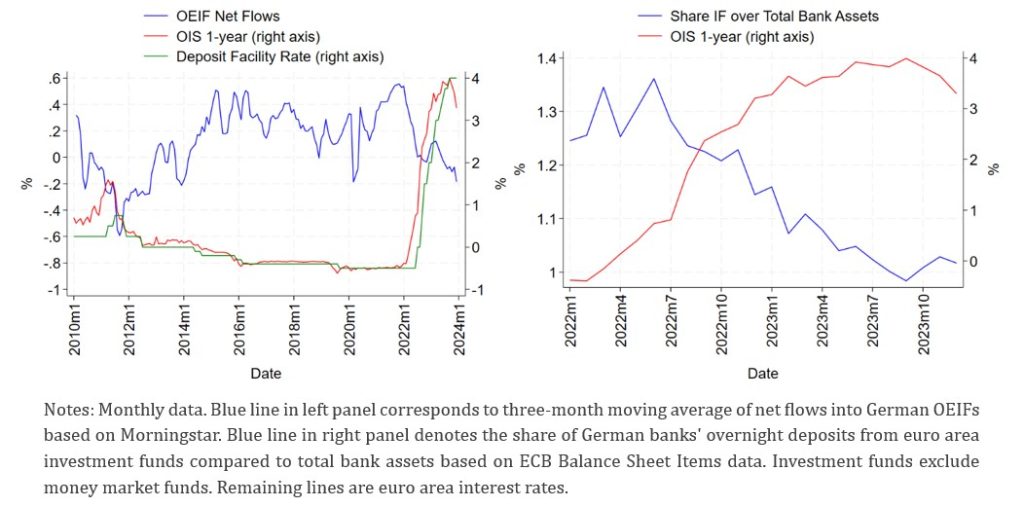
The aggregate picture already hints at a tight link between monetary policy (expectations) and OEIF flows. During the ECB’s sharp tightening cycle from 2022 to 2023, monthly net inflows into German OEIFs fell from roughly 0.5% to -0.2% of their assets. Simultaneously, investment funds’ deposits at German banks declined by about a quarter (Figure 1).
Figure 1. OEIF Net Flows, Bank Deposits, and Euro Area Interest Rates
We show that fund fragility is a key driver of this pattern. In order to do so, we create a fund-level fragility measure that captures the extent to which investors redeem not only in response to fundamentals but also in anticipation of others’ redemptions. Following the spirit of Goldstein et al. (2017), these panic-induced redemptions should be reflected in a much more sensitive response of investor flows to bad performance shocks as compared to positive news. Thus, we identify funds with high fragility potential based on the degree of fund investors’ overreaction to temporary underperformance, as opposed to overperformance. The fragility measure equals one if a fund’s flows respond both strongly and asymmetrically to its past excess returns. It can be applied across all OEIF types, from equity to bond to mixed funds.
Fragile funds are disproportionately concentrated among fixed-income funds, and especially corporate bond funds. This is intuitive as these funds hold less liquid assets and are therefore more exposed to the strategic complementarities that underlie the panic-induced dynamics. However, fragility is present across all fund types, reflecting the fact that it depends on the interplay of multiple fund characteristics such as cash buffers (Morris et al., 2017), asset liquidity (Chen et al., 2010), liquidity management tools (Jin et al., 2021, Dunne et al., 2024) and bank affiliation (Bagattini et al., 2023, Fecht et al., 2026) rather than any single feature. This makes our flow-based measure a powerful, comprehensive indicator for fund-specific fragility.
Using the unexpected component of ECB rate decisions of Jarocinski and Karadi (2020), which is identified in a narrow window around ECB press conferences, we trace how fund net flows respond in the days following a surprise tightening.
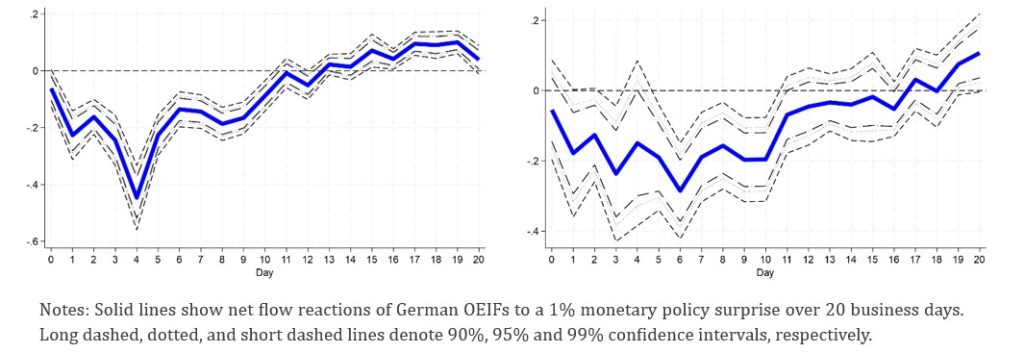
We find that an unexpected 10 basis point (bp) rate increase reduces cumulative net inflows across all OEIFs by more than 0.2 percentage points (pp) over the following two weeks (Figure 2, left panel). This effect is economically sizeable, corresponding to roughly 0.7 standard deviations of aggregate monthly sector flows. It peaks about one week after the announcement, consistent with a cascading dynamic in which investors respond not only to the rate change itself, but also to anticipated withdrawals of others.
The heterogeneity across funds is striking. Fragile funds suffer an additional outflow of approximately 0.2 pp compared to non-fragile peers (Figure 2, right panel), implying a total effect roughly three times as large (0.3 pp vs. 0.1 pp). Intuitively, the response is driven entirely by surprise tightening, not by surprise easing, consistent with the notion that it reflects panic-driven redemptions.
Figure 2. Average Flow Reaction of Funds (Left) and Differential Flow Reaction of Fragile vs. Non-Fragile Funds (Right) to Monetary Policy Surprises
We next examine whether these outflows propagate monetary shocks further through the financial system. First, large outflows can force funds to sell assets, with potential consequences for the broader market. Among fixed-income funds — where holdings of less liquid corporate bonds are concentrated — fragile bond funds reduce their corporate bond holdings by about 0.5 pp more than their resilient peers following a 10 bp tightening shock. Generally, such forced sales can depress corporate bond prices and tighten financing conditions for firms, amplifying the standard transmission channel through which higher rates raise borrowing costs (Fang, 2025).
Second, large outflows compel funds to deplete their liquidity buffers, which are partly held as bank deposits. We document this novel channel and show that changes in funds’ overall cash ratios and bank deposits following a monetary shock depend critically on their fragility.
While non-fragile funds increase their bank deposits after a monetary policy surprise, fragile funds draw down these deposits to meet the elevated redemptions they face. Beyond this, fragile funds also reduce their overall liquidity ratios by roughly 0.4 to 0.5 pp of fixed-income assets compared to other funds, making themselves more vulnerable to subsequent shocks and further accelerating the drain on banking sector liquidity.
Wholesale deposit outflows at banks with heavy exposure to fragile funds represent a spillover from funds to banks that can amplify the deposit channel of monetary policy, the mechanism by which tightening reduces the value of deposit-like claims and raises customers’ withdrawal incentives (Drechsler et al., 2017).
When investors redeem fund shares, the proceeds do not disappear — they are typically parked somewhere. Using security-by-security data on household fund holdings at custodian banks, we examine where the redeemed money goes and find that banks whose retail customers are initially more heavily invested in fragile funds receive significantly larger overnight deposit inflows after surprise tightening. An ex ante fragility exposure two standard deviations above average is associated with an increase in overnight deposit inflows of roughly 6 bp of bank assets per 10 bp shock.
This pattern indicates that when investors exit fragile funds during monetary tightening, they reallocate funds into bank deposits at their custodian banks, thereby muting ceteris paribus the deposit channel of monetary policy at those banks. Taken together, this suggests that redemptions of fund shares in response to monetary policy shocks especially at fragile funds lead to a reallocation of deposits within the banking sector, rather than a uniform contraction of bank deposit funding. Banks with a large share of fragile funds’ wholesale deposits experience deposit outflows while banks with substantial custodian business whose customers hold predominantly fragile fund shares benefit.
Our results highlight an important nexus between monetary policy transmission and financial stability and provide relevant conclusions for both macroprudential and monetary policy.
From a monetary policy perspective, our results indicate that a larger share of fragile funds amplifies the transmission of a monetary tightening to bond markets and bank wholesale funding. Conversely, potential macroprudential measures that reduce fund fragility — such as mandatory liquidity management tools like swing pricing or direct central bank access for non-banks — would dampen this channel.
From a macroprudential policy perspective, our findings suggest that large-scale monetary policy surprises can destabilize OEIFs similar to financial market turmoil with downstream spillovers into bond markets and the banking system. As non-bank financial intermediaries continue to expand, monitoring fund fragility becomes an increasingly relevant input into assessments of monetary policy side effects and systemic risk.
Bagattini, G., Fecht, F., and Maddaloni, A. (2023). Liquidity support and distress resilience in bank-affiliated mutual funds. ECB Working Paper, No. 2799.
Chen, Q., Goldstein, I., and Jiang, W. (2010). Payoff complementarities and financial fragility: Evidence from mutual fund outflows. Journal of Financial Economics, 97(2): 239–262.
Drechsler, I., Savov, A., and Schnabl, P. (2017). The deposits channel of monetary policy. The Quarterly Journal of Economics, 132(4): 1819–1876.
Dunne, P., Emter, L., Fecht, F., Giuliana, R., and Peia, O. (2024). Financial Fragility in Open-ended Mutual Funds: The Role of Liquidity Management Tools. Bundesbank Discussion Paper 36/2024.
Fang, C. (2025). Monetary policy amplification through bond fund flows. SSRN Working Paper.
Fecht, F., Genc, E., Karabulut, Y., and Weber, P. (2026). Liquidity Support in Financial Institutions. Management Science (forthcoming).
Goldstein, I., Jiang, H., and Ng, D.T. (2017). Investor flows and fragility in corporate bond funds. Journal of Financial Economics, 126(3): 592–613.
Jarocinski, M. and Karadi, P. (2020). Deconstructing monetary policy surprises — the role of information shocks. American Economic Journal: Macroeconomics, 12(2): 1–43.
Jin, D., Kacperczyk, M., Kahraman, B., and Suntheim, F. (2021). Swing pricing and fragility in open-end mutual funds. The Review of Financial Studies, 35(1): 1–50.
Morris, S., Shim, I., and Shin, H.S. (2017). Redemption risk and cash hoarding by asset managers. Journal of Monetary Economics, 89: 71–87.