

This policy brief is based on Inzunza and Madeira 2025. The views expressed in this brief do not necessarily reflect those of the Central Bank of Chile or its board members. All errors are our own.
Abstract
During the COVID‑19 pandemic, Chile approved three exceptional laws that allowed workers to withdraw part of their pension accounts. These withdrawals were exceptionally large by international standards. The withdrawals reached around 20% of GDP and depleted the contributory balances of millions of affiliates. Using administrative withdrawal records matched to the 2021 Chilean Household Finance Survey, we estimate that the withdrawals reduced contributory pensions by about 21% on average. The expansion of non‑contributory pensions in 2022 cushioned the loss in total retirement income to about 8%, although with significant fiscal costs. The Chilean pension reform of 2025 increased the future contribution rate. Our simulations show that this reduces the estimated fiscal burden from 15.8% to about 12.4% of GDP. Future policies such as increasing the retirement age could further lower this cost.
Most countries across the world are aging at an accelerated pace (Amaglobeli et al. 2019, IMF 2025). Several countries are delaying reforms that should account for higher fractions of older workers and retirees (Amaglobeli et al. 2019, OECD 2021). These reforms are especially urgent after the Covid-19 pandemic, because several countries implemented pension withdrawals that depleted savings (OECD 2021). Chile and Peru implemented the largest pandemic pension withdrawals as a share of GDP (Olivera 2023, Madeira 2022). Estonia also experienced large pension withdrawals, leading to increased deposits, consumption, debt repayment and an inflation surge (Meriküll 2026). This article summarizes some lessons from the Chilean pension reforms between 2020 and 2025 (Inzunza and Madeira 2025).
Early access to retirement savings can provide liquidity during crises and after negative shocks such as health or unemployment. However, these measures weaken future retirement income and increase public liabilities by pressing governments to expand safety nets to compensate for lower private pensions (Madeira 2022). Chile provides a unique large‑scale case study of five large pension policies: a) three pension withdrawals during 2020 and 2021; b) an expansion of non‑contributory pensions in 2022; c) a major pension reform in 2025 that increased future contributions by 60% with the goal of insuring the sustainability of the system.
Chile’s pension system is centered on individual defined‑contribution accounts funded by a mandatory employee contribution of 10% of the labor income. During the Covid-19 pandemic, Congress approved three exceptional withdrawals that allowed affiliates to withdraw up to 10% of their account balance each time or up to a limit of 1 million pesos (roughly, worth 1,300 USD at the beginning of 2020). All the pension withdrawals were allowed with no proof of need. This implied that after the 3 withdrawals, many low‑balance affiliates could have withdrawn 100% of their savings (if their contributory pension wealth was below 3 million pesos, around 5,000 USD). Furthermore, in all three rounds there was no obligation to return the withdrawn funds.
The scale of these policies was large. By the end of 2021, the three withdrawals together amounted to roughly one‑fifth of GDP, depleted the accounts of around four million workers, and reduced the future contributory pensions of more than ten million people.
To analyze the effect of these pension policies, we matched household‑level information from social security records to the 2021 Household Finance Survey (EFH). This allows us to know the balances that were withdrawn by each worker, retiree and also the sum of pension withdrawals made by each household. Furthermore, we can then use the characteristics of each worker to simulate the path of its pension wealth and final pension according to different counterfactual policies. To make this simulation, we use the probability of each worker being in a formal employment that makes contributory pension payments, based on his demographic characteristics (gender, age, education, industry of occupation, and region).
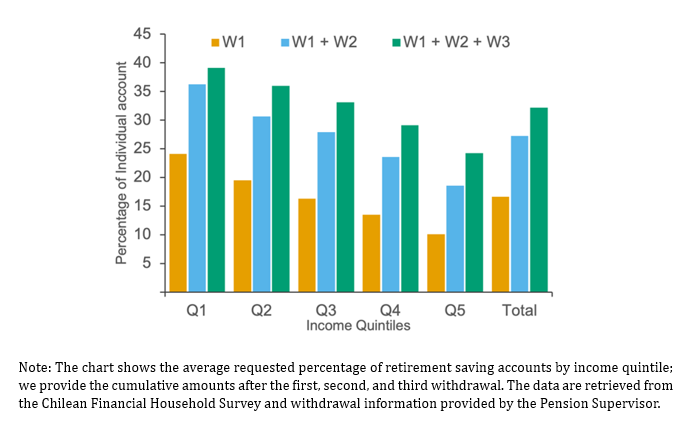
Figure 1 shows that the average cumulative withdrawal reached about 42% of initial balances for the lowest income quintile, versus about 26% for the highest quintile (Figure 1). The average affiliate withdrew 35% of its pension account. Richer households withdrew larger amounts in currency terms (because they had higher balances), but poorer households were more likely to fully deplete their accounts. Around 36.5% of affiliates fully depleted their contributory balances.
Figure 1. Cumulative withdrawals as a percentage of initial pension balances, by income quintile
We simulate future labor paths and contributions for each worker from the present until retirement. At retirement age, accumulated pension wealth is converted into a life annuity using cohort‑ and gender‑specific life expectancy projections.
Using the counterfactual in which no further pension policies were implemented after 2021, the withdrawals reduced contributory pensions by about 21% on average. This reduction in contributory pensions was larger for women and lower‑income groups. The impact is long‑lived: meaningful retirement income effects persist for cohorts retiring well into the 2040s.
However, Chile expanded solidarity pensions in 2022 by introducing the Pensión Garantizada Universal (PGU), which provides a near‑universal non-contributory pension of around 265 USD for retirees in the lowest 90% of the income distribution. When total pension income is measured as contributory pensions plus transfers, the average loss falls to around 8%.
Because solidarity pensions rise when contributory pensions are lower, the withdrawals shifted part of the retirement financing burden from private savings to public transfers. In 2023 public funds represented slightly more than 50% of the retirement payments for the first time.
Under a baseline scenario (no further reforms and a 4% real discount rate), we estimate additional fiscal costs in present value equivalent to about 78.9% of the withdrawal amounts—around 15.8% of pre‑pandemic GDP. The reform approved on 29 January 2025 increases employer contributions gradually from 10% to 16% of labor income. According to our simulation, this policy reduces the fiscal cost to 61.8% of the pandemic withdrawals amount. This implies that the contributory pension reform of 2025 creates projected fiscal savings worth 3.4% of GDP in present value.
Other policies may create further fiscal savings. Currently Chile has retirement ages of 65 years for men and 60 for women, which are relatively young ages compared to other OECD countries (OECD 2021). Chile could decide to increase the retirement age to 67 years for both genders. This would increase the simulated fiscal savings from 3.4% to 8.2% of pre-pandemic GDP.
Pension withdrawals can create liquidity and help households during crises. However, if the design is not well made, these schemes may allow workers to withdraw their entire balances. Around 36.5% of the social security affiliates in Chile fully depleted their contributory balances.
Policy makers should expect that unrestricted withdrawals will increase pressures for higher fiscal transfers to retirees. After Chile increased non-contributory pension transfers in 2022, the state was covering 79% of the pension withdrawals that households took from their private accounts.
The pension reform of Chile in 2025 increased contributory rates by 6% (to be gradually implemented over a period of 10 years). This may result in an increase of 4% in the household savings rate in steady state (Madeira 2022). According to our simulations, this policy will reduce non-contributory transfers to future retirees significantly and save fiscal costs of around 3.4% of GDP. Future policies, such as delaying retirement age, may increase fiscal savings even more.
Amaglobeli, D., H. Chai, E. Dabla-Norris, K. Dybczak, M. Soto and A. Tieman (2019), “The Future of Saving: The Role of Pension System Design in an Aging World.” IMF Staff Discussion Note 19/01.
IMF (2025), “The Rise of the Silver Economy: Global Implications of Population Aging,” World Economic Outlook, chapter 2, April, IMF.
Inzunza, A. and C. Madeira (2025), “The Chilean pension withdrawals and the 2025 reform: Fiscal and retirement consequences,” Journal of Pension Economics and Finance, 24(4), 516–542.
Madeira, C. (2022),”The impact of the Chilean pension withdrawals during the Covid pandemic on the future savings rate,” Journal of International Money and Finance, 126, 102650.
Meriküll,, J. (2026), “The impact of early pension withdrawals on household finances and inflation,” Economic Modelling, 157, 107475.
OECD (2021), “Pensions at a Glance 2021: OECD and G20 Indicators,” OECD.
Olivera, J. (2023), “The long-term scars of Peru’s COVID-19 policy response on pension security,” Global Social Policy, 23(2), 369–372.