

This policy brief is based on ECB, Working Paper Series No 3145. The views expressed are those of the authors and not necessarily those of the institutions the authors are affiliated with.
Abstract
The recent euro area inflation surge uncovered the trade-offs facing policymakers following supply-driven shocks. In this Policy Brief we summarize the findings in Campos et al. (2025) which shows that, in face of an inflationary shock, an appropriate mix of monetary and fiscal policies may be needed to ensure a swift return of inflation to target while mitigating the real impact. Monetary tightening is more effective at restoring price stability but deepens the output contraction and worsens public debt dynamics, especially in high-debt countries. Fiscal policy can cushion the downturn, but, depending on the composition of the fiscal support, the ultimate impact on inflation and debt dynamics varies greatly. Broad-based measures risk fuelling inflation and excessively strain public finances, whereas targeted transfers or higher government investment support the economy without prompting additional monetary tightening and with milder fiscal costs.
When inflation surges due to a global cost-push shock – such as those driven by energy disruptions, supply bottlenecks, or geopolitical tensions – policymaking faces a dilemma: central banks must act decisively to prevent inflation from becoming entrenched, but this weighs on the real economy; fiscal authorities may try to smooth activity through automatic stabilisers and discretionary measures to support households and firms while ensuring redistribution and fiscal sustainability. Thus, the goals of the monetary authority and those of national fiscal authorities are not always aligned, and trade-offs can emerge. Recent work exploring this complex interplay in the context of the 2021-2022 inflation surge in the euro area include Bonam et al. (2024), Dao et al. (2023) and Motyovszki (2023).
In Campos et al. (2025), we add to the existing literature by simulating a worldwide supply shock that drives consumer price inflation up, prompting an interest rate response by the monetary authority. Economic activity significantly falls while the public debt-to-GDP ratio gradually increases. Following this shock, we first analyse the different effects of alternative monetary policy responses and, second, we study how outcomes differ depending on the design of the fiscal policy response and on the level of government debt (low- vs. high-debt countries).
The analysis is conducted through the lens of a version of the EAGLE (Euro Area and Global Economy) model (Gomes et al., 2012) that includes an enhanced fiscal block allowing for a richer set of fiscal policy instruments. The model splits the euro area into three blocs – a high public debt bloc, a low-debt bloc, and the rest of the euro area. We show that, in face of an inflationary shock, the effectiveness of monetary and fiscal policies critically depends on the decisions taken by each other. In isolation, decisions on each front have benefits and costs that, in combination, can either reinforce or undermine one another.
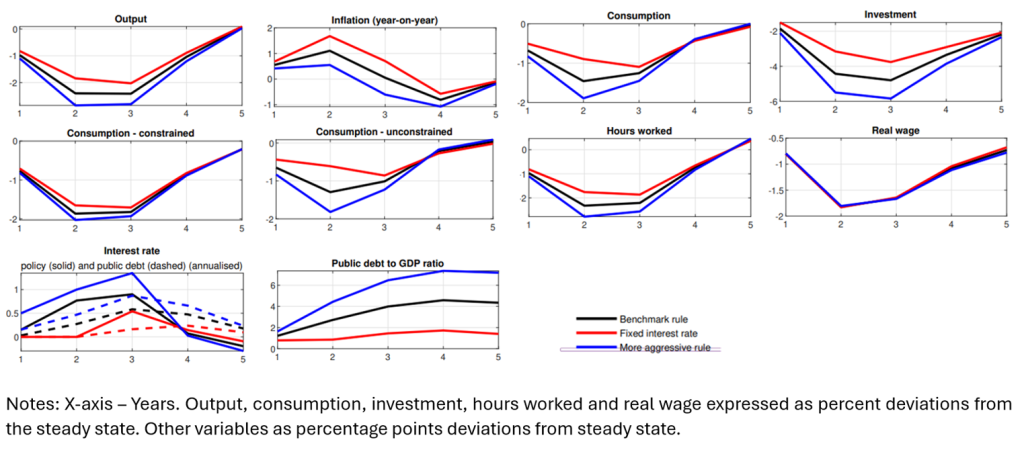
Figure 1 shows that a decisive rise in interest rates is most successful in taming inflation. However, output declines more sharply than in a scenario with delayed and lighter tightening. Higher interest rates increase debt-servicing costs while recessionary dynamics erode tax revenues, thereby raising the public debt-to-GDP ratio and reducing governments’ leeway to support vulnerable agents, exactly when such support is needed the most.
This interplay underscores the trade-offs emerging when monetary policy is required to tighten to tackle supply-driven inflation. The trade-off is starker in high-debt countries, as the snowball effect of aggressive monetary tightening implies a stronger increase in the debt-to-GDP ratio and hence further restricts the fiscal space. The trade-off is weaker when price changes are more frequent, which is typically the case after larger inflationary shocks, highlighting the presence of possible nonlinearities. This would likely call for a stronger monetary tightening to minimise risks of inflation becoming entrenched through higher inflation expectations.
Figure 1. Macroeconomic impact of a worldwide supply shock under alternative monetary policy responses
Fiscal authorities have several instruments that can be used to cushion the effects of inflation and recession on households and firms, each with different implications for the interplay between fiscal and monetary policies. We compare three possible fiscal measures:
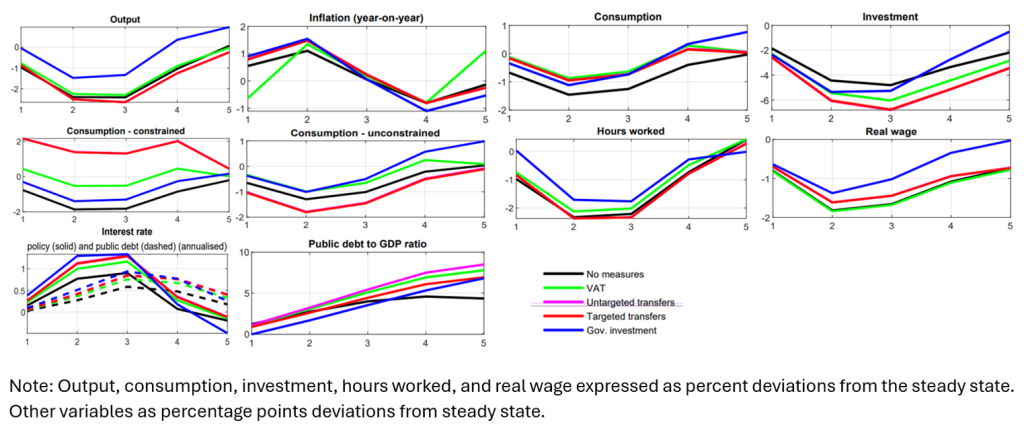
Figure 2 highlights that fiscal policy can cushion the economic fallout but has an overall limited direct contribution for the disinflationary process. However, it also shows that, because different fiscal measures yield different impacts on inflation, the design and composition of the fiscal support have important implications for the response required from the monetary authority, ultimately shaping how the inflationary episode unfolds.
Out of the fiscal measures we analyse, targeted transfers directed to low-income or liquidity-constrained agents offer the most balanced results. Moreover, because the implied fiscal costs are comparatively milder, targeted measures are also less detrimental for debt sustainability, which is particularly relevant when necessary monetary tightening puts upward pressure on interest payments.
Promoting productive government investment also stands out as a balanced alternative. It mitigates the short-term fallout in aggregate demand, inducing a stronger initial response by the monetary authority. However, inflation drops faster than in other scenarios allowing for a quicker unwinding of monetary tightening. Together with a favourable denominator effect, this results in a milder increase in the debt-to-GDP ratio.
Figure 2. Macroeconomic impact of a worldwide supply shock under different fiscal policy measures
Monetary and fiscal policies interact though different channels. Whereas in a low inflation and low interest rate environment they may naturally align, in a high inflation environment new challenges may arise, in particular when shocks generate a trade-off between stabilising inflation and economic activity. Our simulation exercises illustrate several policy-relevant results:
Not all inflation surges are alike, and policy responses must be tailored accordingly. When inflation is driven by supply-side disturbances, balancing price and output stabilisation with fiscal sustainability may be achieved through an appropriate mix of a monetary policy stance that credibly restores price stability and fiscal measures that directly support vulnerable agents and productive public investment.
Bonam, Dennis, Matteo Ciccarelli, and Sandra Gomes (2024). “Challenges for monetary and fiscal policy interactions in the post-pandemic era.” Occasional Paper 337, European Central Bank.
Campos, Maria Manuel, José Miguel Cardoso‐Costa, Sandra Gomes, and Pascal Jacquinot (2025). “Monetary and fiscal policy interactions in the aftermath of an inflationary shock. Working Paper 2025/3145, European Central Bank.
Dao, Mai, Allan Dizioli, Chris Jackson, Pierre-Olivier Gourinchas, and Daniel Leigh (2023). “Unconventional fiscal policy in times of high inflation.” Working Paper 2023/178, International Monetary Fund.
Gomes, Sandra, Pascal Jacquinot, and Massimiliano Pisani (2012). “The EAGLE. A model for policy analysis of macroeconomic interdependence in the euro area”. Economic Modelling, 29(5), 1686–1714.
Motyovszki, Gergo (2023). “The fiscal effects of terms-of-trade-driven inflation.” Discussion Paper 2023/190, European Commission.