

This policy brief is based on Deutsche Bundesbank Discussion Paper 30/2026. The views expressed are those of the authors and not necessarily those of the institutions the authors are affiliated with.
Abstract
What are the macro-financial implications of a potential shift in safe haven status from the United States to the euro area (EA)? Utilizing a two-block DSGE model, we find that a safe haven status of the EA mitigates the impact of flight-to-safety shocks on domestic aggregate demand and financial conditions but exacerbates them for production. Following the US tariff announcements on April 2, 2025, the EA’s safe haven status likely had a sizeable effect on the transmission of the shock. However, in a crisis with a relatively smaller international flight to safety, such as during the 2008‑09 financial crisis, the impact of a European safe haven status would be limited.
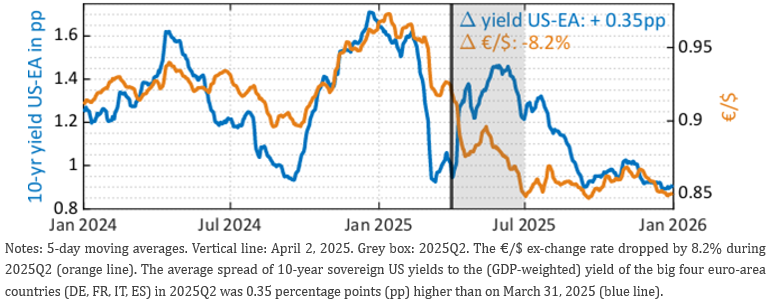
Periods of heightened global uncertainty often trigger a flight to safety, where investors reallocate capital towards assets and currencies perceived as safe havens. Historically, the US dollar and US treasuries have often taken on this role, appreciating in value and experiencing a drop in yields during financial stress. However, recent events, particularly following the US tariff announcements on April 2, 2025, have revealed atypical market reactions. During this period, the euro appreciated against the US dollar, while US treasury yields rose and yields on government bonds declined (see Figure 1). This suggests at least a temporary shift of the safe haven status towards the euro area.
Figure 1. EUR-USD exchange rate and US-euro area sovereign yield spread after April 2
In a recent working paper, we analyze the macro-financial impact of being a safe haven for the transmission of international shocks. In a medium-sized open-economy DSGE model calibrated to the two blocks US and the euro area, we look at two historical episodes: The aftermath of the tariff announcements on April 2, 2025, and the global financial crisis 2008 09, in which flight to safety played an important role (Kekre and Lenel, 2024). For both episodes, we simulate a global flight-to-safety shock (Bodenstein et al., 2023), which combines a symmetric demand contraction in both blocks with an international flight into assets from the safe haven. The shock matches the observed exchange rate movements of the euro against the US dollar and the changes in sovereign yields in both regions during the two episodes.
For both the shock on April 2, 2025, and the financial crisis, we consider two scenarios: one in which the euro area, rather than the US, takes the role of a safe haven, and one in which US assets retain their traditional role of a safe haven. We then consider the role of a safe haven status on the shock transmission on European macro-financial variables.
Figure 2. Global Flight to Safety as after April 2, 2025: Effects on euro area variables
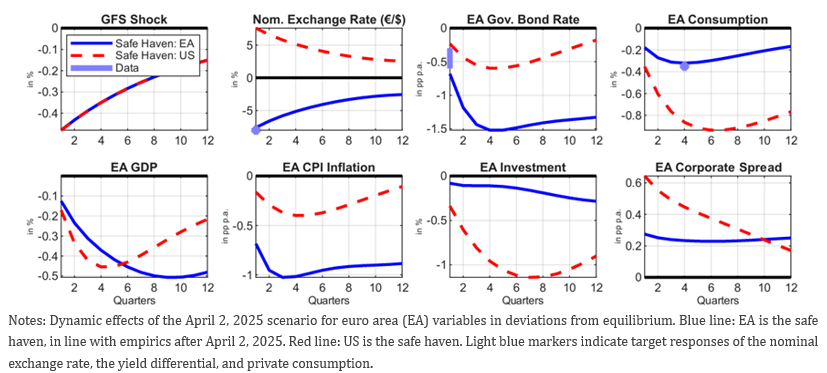
Our simulations yield two central insights. First, a safe haven status mitigates the effects of global flight-to-safety shocks on aggregate demand and financial conditions. Our simulations suggest that during the turmoil after the US trade announcements from April 2, 2025, the temporary safe haven status of the euro area dampened the drop in European consumption and investment by a factor of three (see Figure 2). The reason is that capital inflows into the safe haven lead to a terms of trade appreciation and lower interest rates. This stabilizes financial conditions and shields aggregate demand in the safe haven (consumption and investment). However, the safe haven status amplifies the negative repercussions on production (in line with empirical evidence for example in Georgiadis et al. 2024). This is due to the appreciation of the safe-haven currency, which makes exports more expensive and thereby reduces pro-duction and employment.
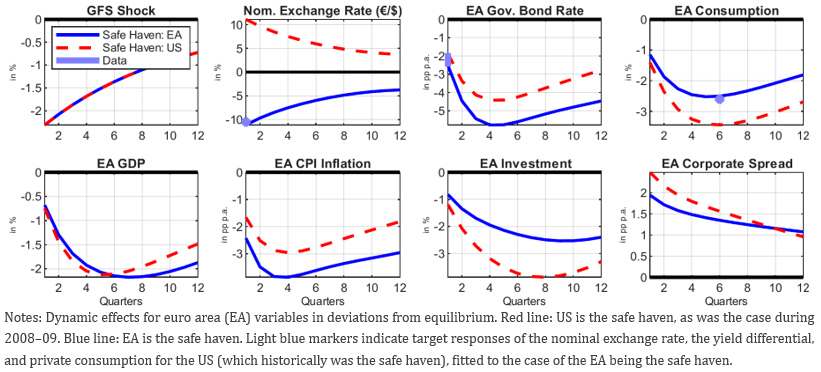
Second, the impact of a safe haven status is considerable when the international flight to safety is relatively large (as was the case after April 2, 2025). If, in contrast, the symmetric demand contraction dominates – as during the deep recession hitting the global economy in the financial crisis of 2008 09 –, a safe haven status does not have a big effect. This episode is depicted in Figure 3. In 2008-09, a safe haven status of the euro area would have mitigated the deterioration in consumption, investment, and financial conditions to a much smaller degree than it did after April 2, 2025. The additional strain on production is also limited.
Figure 3. Global Flight to Safety as during 2008–09: Effects on euro area variables
A safe haven status affects the fallout from international shocks. This suggests that maintaining and enhancing the euro area’s perception as a safe haven could be beneficial for aggregate demand and financial stability but might cause additional strain on production. Our simulations propose that a temporary safe haven status of the euro area cushioned the effects of the turmoil after the US trade announcements after April 2, 2025, on European consumption, investment and financing conditions.
However, there are two caveats: First, our analysis does not consider heterogeneity within the euro area: Some countries like Germany have already benefited from a certain safe haven characteristic in past crises. For these countries, a potential wider safe haven status of the euro area, implying a euro appreciation during future crises, would exacerbate the strain on production and employment. This would be particularly true for export-oriented economies, whose net exports would suffer most from exchange rate appreciations during crises.
Second, policy cannot rely on a potential future safe haven status to shield the euro area from crises. As our second scenario shows, the safe haven status only has a limited ability to cushion the blow of a large crisis like the global financial crisis. Therefore, sovereigns should retain their fiscal space to be able to step in future crises, while monetary and macroprudential policy should stand ready to guarantee price and financial stability, respectively. There is no haven that is safe in every storm.
Bodenstein, M, P A Cuba-Borda, N M Gornemann, I Presno, A Prestipino, A Queraltó, and A Raffo (2023), “Global Flight to Safety, Business Cycles, and the Dollar,” Board of Governors of the Federal Reserve System (U.S.) International Finance Discussion Papers 1381.
Georgiadis, G, G J Müller, and B Schumann (2024), “Global risk and the dollar,” Journal of Monetary Economics, Elsevier, vol. 144(C).
Hasenclever, S., B. Kolb (2026), “Safe haven status and international shock transmission,” Bundesbank Discussion Paper, No 30/2026.
Kekre, R and M Lenel (2024), “The Flight to Safety and International Risk Sharing,” American Economic Review 114(6), 1650–91.