

This policy brief is based on Deutsche Bundesbank Discussion Paper 24/2026. The views expressed are those of the authors and not necessarily those of the institutions the authors are affiliated with.
Abstract
Climate policies affect inflation and economic activity through their impact on energy prices. In a model calibrated to the euro area, we show that carbon pricing raises inflation and depresses output, while green subsidies have the opposite effects, confronting central banks with a trade-off between stabilising inflation and real activity. Because energy is difficult to replace in production and consumption, this trade-off is pronounced, and monetary policy focused solely on inflation stabilisation can impose large welfare costs. Central banks can achieve higher welfare by assigning greater weight to real activity and accommodating temporary inflation movements. In line with this, policy rules that respond to both inflation and output outperform those focused only on inflation. Fiscal design matters too: using carbon revenues to finance green subsidies eases the monetary policy trade-off.
Climate policies work by changing relative energy prices. A higher carbon price makes fossil energy more expensive. Headline inflation rises because household energy bills go up and because firms pass on higher production costs, which pushes up core inflation by less than headline but more persistently. At the same time, output falls. Green subsidies lower energy prices and have the opposite effects. Climate policies can therefore move inflation and output in opposite directions, and a central bank that leans against the inflation effects of these policies amplifies their impact on real activity.
This trade-off is particularly pronounced because energy is hard to replace, both in production and in consumption. For firms, higher energy prices raise marginal costs, so keeping inflation stable would require larger cuts in real wages and employment. For households, a rise in carbon prices acts like a tax on real income and weakens demand. As a result, curbing inflation no longer stabilises the welfare-relevant output gap (the gap between actual output and its efficient level): the so-called “divine coincidence” breaks down.
Should a central bank offset the inflation effect or stabilise real activity?
In Carli, Diluiso and Hoffmann (2026), we study this trade-off in a multi-sector New Keynesian model calibrated to euro area data, with sticky prices and wages, a non-energy sector, and separate fossil and green energy sectors. We compare welfare-maximising monetary policy (“optimal policy”) with simple interest-rate rules and assess how the design of climate policy affects the central bank’s stabilisation task.
When the central bank is fully credible and can commit to its future policy, it is better to accommodate some short-run inflation movements than to force inflation immediately back to target. After a carbon price increase, the optimal monetary response in our baseline simulation is a small, temporary cut in the policy rate, which cushions the fall in consumption, employment and real wages, even though inflation rises. After a green subsidy, optimal policy raises the rate to restrain an otherwise excessive expansion, even though the subsidy reduces inflation.
Optimal monetary policy thus resolves the trade-off in favour of stabilising the welfare-relevant output gap, because the welfare gain from avoiding inefficient swings in output and employment outweighs the cost of temporary inflation deviations. This does not mean abandoning price stability: inflation returns to target over the medium term, and a credible commitment to this keeps inflation expectations anchored.
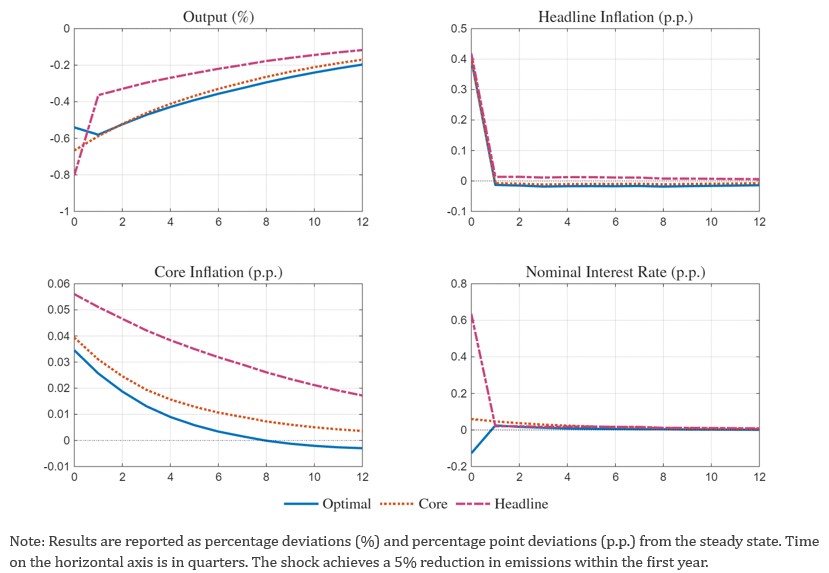
Figure 1 compares the response to a carbon price increase under optimal policy and under two simple rules that respond only to headline or only to core inflation (i.e. the inflation measure that excludes energy price movements). Unlike optimal policy, both rules raise the policy rate, but in different ways. Headline inflation targeting implies a sharper but shorter-lived tightening: output falls more on impact and recovers faster, at the cost of more persistent core and wage inflation. Under core inflation targeting, the policy rate rises less but stays restrictive for longer, so the initial fall in output is smaller but the recovery slower. Overall, core inflation targeting brings the economy closer to the optimal path and yields lower welfare losses than headline targeting. This is in line with, for example, Aoki (2001) and Olovsson and Vestin (2025), who find that monetary policy should focus on core inflation and look through relative energy-price movements.
Figure 1. Dynamic response to a temporary increase in the carbon price
(optimal monetary policy vs headline inflation targeting vs core inflation targeting)
Rules that respond to both inflation and the output gap come closer to the welfare-maximising response. In our simulations, they generate smaller welfare losses than inflation-only rules after both carbon pricing and green subsidy shocks, and they close the welfare gap between headline and core inflation targeting. What matters most is therefore not the choice of inflation measure, but whether the rule also responds to real activity.
The size of the trade-off faced by monetary policy also depends on fiscal design, starting with how carbon revenues are employed. When carbon-tax revenues are returned to households as lump-sum transfers, households do not internalise the fact that part of the higher price they pay for fossil energy is effectively returned to them through those transfers. They therefore cut fossil-energy use and activity by more than is desirable, and optimal monetary policy partly offsets this by supporting demand. The opposite holds when green subsidies are financed through lump-sum taxes. The way revenues are used therefore matters for the central bank’s task.
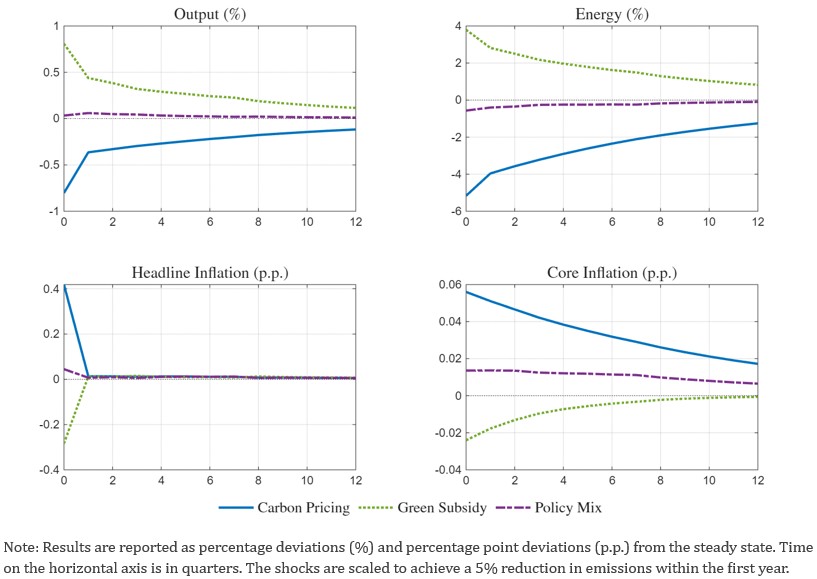
Financing green subsidies with carbon-pricing revenues offers a valid alternative. Figure 2 compares three revenue recycling scenarios under the headline-inflation targeting rule, with each shock scaled to deliver the same emissions reduction: carbon pricing with revenues returned to households as lump-sum transfers (solid blue line), a green subsidy financed through lump-sum taxes (dotted green line), and a policy mix in which carbon revenues finance the green subsidy (dashed purple line). The policy mix achieves the same emissions reduction with much smaller swings in energy use, less inflationary pressure and a slight increase in output. Because the green subsidy offsets the effect of carbon pricing on energy prices, swings in relative energy prices are largely neutralised and the policy mix resembles a mild positive demand shock: output and inflation move in the same direction, and the trade-off faced by monetary policy disappears.
Figure 2. Dynamic response to climate policy shocks under headline inflation targeting
Our results show that strict inflation stabilisation is not optimal in response to either carbon pricing or green subsidies. Mechanically offsetting the inflation effect of a climate policy shock can add unnecessary volatility to employment and output. Instead, central banks can look through the temporary price effects of climate policy and focus on its impact on real activity, as long as their commitment to medium-term price stability remains credible.
For simple policy rules, targeting core rather than headline inflation helps, particularly after carbon pricing shocks, but responding to the output gap as well as to inflation matters more. The appropriate interest-rate response still depends on the type of shock and on the economy’s structure, but in all cases inflation and real activity need to be assessed together.
Fiscal authorities can help by considering how carbon revenues and green subsidies are combined. A stand-alone green subsidy lowers inflation but stimulates activity, and the optimal monetary response is then to tighten, partly offsetting the fiscal stimulus. Financing green subsidies with carbon revenues delivers the same emissions reduction with less macroeconomic volatility and removes the trade-off the central bank faces.
Aoki, K. (2001), “Optimal Monetary Policy Responses to Relative-Price Changes,” Journal of Monetary Economics, 48(1), 55–80.
Carli, M., F. Diluiso and M. Hoffmann (2026), “Navigating Climate Policy Shocks: Optimal Monetary Policy Responses,” Bundesbank Discussion Paper No. 24/2026, Deutsche Bundesbank.
Olovsson, C. and D. Vestin (2025), “Greenflation?” European Economic Review, 105237.