

This policy brief is based on ECB Working Paper Series, No 3150. The views expressed are those of the authors and not necessarily those of the institutions the authors are affiliated with.
Abstract
Monetary policy transmission to investment depends on economic fundamentals and financial conditions. We study this mechanism using survey-based measures of funding needs and availability as proxies for fundamentals and financial conditions. We show that monetary policy is most effective for firms with strong fundamentals, while investment of firms with favourable financial conditions reacts less to monetary policy. Crucially, firms with high funding needs and limited access to finance—financially constrained firms—exhibit the strongest investment response to monetary policy. These findings offer new light on the transmission of monetary policy to corporate investment, emphasising not only the role of financial conditions but also the importance of economic fundamentals, which are beyond the direct influence of central banks.
Business investment is a central driver of economic growth, yet recent episodes have raised concerns among policymakers about the effectiveness of monetary policy in stimulating investment. In the euro area, investment has at times remained subdued even during periods of accommodative monetary policy. This raises a key policy question: under what conditions does monetary policy succeed—or fail—in stimulating corporate investment?
Economic theory highlights two distinct prerequisites for investment. Firms must want to invest, meaning they have profitable investment opportunities driven by sound economic fundamentals. They must also be able to invest, meaning they can access the financing necessary to fund those opportunities. These two factors have been seen as the drivers of investment by the economics literature but disentangling them has proven to be difficult (Fazzari, Hubbard, Petersen, 1988; Gilchrist and Himmelberg, 1998). In a recent paper (Ferrando, Lamboglia, Offner, 2025), we propose the use of two variables derived from survey data as proxies for these two factors. The first one is firms’ funding needs and the second one is firms’ perceived funding availability. We show that once controlling for key firm-level characteristics, both variables significantly drive investment through distinct channels: needs are mainly driven by investment opportunities, while availability is largely shaped by financial conditions.
We use these two variables to show that monetary policy transmission depends on both investment opportunities and financial conditions, operating through distinct mechanisms. When a central bank eases monetary policy, the investment response is strongest among firms with higher investment opportunities. In contrast, firms with more favourable financial conditions tend to react less. Importantly, the interaction between these two dimensions helps explain the behaviour of firms that are constrained in their ability to invest due to limited access to external finance. Our empirical results show that monetary policy has the most significant impact on these constrained firms. This is likely because monetary easing primarily improves firms’ access to external funding through the credit channel (Bernanke and Gertler, 1989; Bernanke, Gertler and Gilchrist,1999). By easing policy, central banks help relax these financial constraints, enabling firms to pursue investment opportunities they would otherwise be unable to finance. Our findings also have practical relevance for monetary policymakers: improving financial conditions through easing unlocks investment potential among firms that are otherwise held back.
This analysis draws on firm-level evidence from the ECB’s Survey on the Access to Finance of Enterprises (SAFE). Our analysis focuses on survey replies from 2010 to 2022 to questions related to firms’ external financing needs and their perceived availability of various financing sources: bank loans, credit lines, trade credit, equity and debt security issuance. Specifically, each firm is asked the following question: “For each of the following types of external financing—bank loans, credit lines, trade credit, equity and debt security issuance—please indicate whether your needs (availability) increased, remained unchanged, or decreased during the previous and current quarter”. The responses to these questions are used to create a discrete variable for each type of financing, assigned a value of 1 if the firm reports an increase, −1 for a decrease, and 0 if unchanged. The firm-level average of these values generates the Needs and Availability variables used in this study, which ranges between -1 and 1.
We merge the survey data with accounting data from ORBIS database, supplied by BvD, a Moody’s Analytics subsidiary. We use this dataset to construct our dependent variable, the investment rate, measured as the annual growth rate of fixed capital. Additionally, we include key financial indicators such as financial leverage, debt burden ratio, liquidity ratio, return on equity, internal funding, sales growth, and a SME dummy for small and medium enterprises (up to 250 employees).
Our analysis of the monetary policy transmission builds on the literature on monetary economics that identifies the causal effects of monetary policy using high-frequency movements in interest rates around central bank announcements. We use forward guidance surprises from the Euro Area Monetary Policy Event-Study Database (EA-MPD), compiled by Altavilla et al. (2019), which are more relevant for firms’ long-term borrowing.
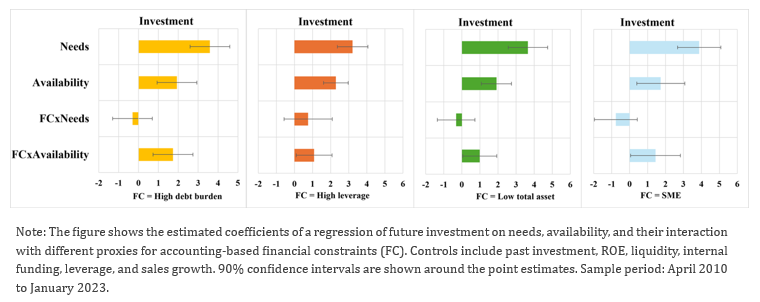
Our analysis is based on the key insight that funding needs reflect firms’ perceived investment opportunities and funding availability captures firms’ perceptions of their access to external finance. Our first contribution is to show that, once controlling for internal funding and other key firm characteristics, this insight holds empirically. Figure 1 shows the coefficients of a regression of future firm-level investment on needs and availability, their interaction with accounting-based proxies for financial constraints, which we denote by FC, and firm-level controls which we omit for improved visibility. The figure shows that both needs and availability exhibit a positive and statistically significant impact on investment, capturing valuable information beyond traditional accounting variables. The interaction coefficients provide an answer to the question whether needs and availability affect investment of firms that differ by their debt burden, leverage or size differently. These types of firms are known to be more financially constrained, mainly because of tighter financial conditions (Ottonello and Winberry, 2020). The interaction coefficient of needs and FC, which is mostly non-significant, implies that external funding needs drive investment similarly for small and large firms, as well as for firms with high and low debt. In contrast, funding availability exhibits a stronger effect on investment for financially constrained firms, as shown by the significant and positive interaction coefficients. Small firms and those with high leverage or debt burdens are more sensitive to changes in funding availability when making investment decisions, indicating that availability primarily serves as a proxy for financial conditions. Our results also suggest that large firms and firms with low debt, which typically have strong economic fundamentals, can fund their investment opportunities regardless of credit market conditions.
Figure 1. Link of financial constraints and the effects of needs and availability on investment
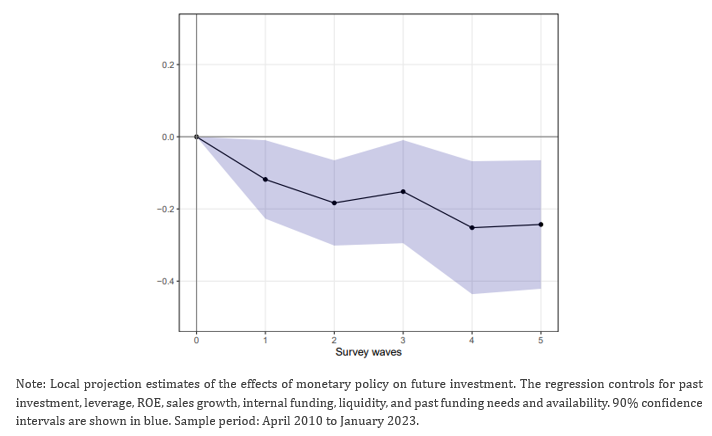
We start our analysis on monetary policy transmission by showing how future firm-level investment responds to monetary policy surprises using a local projection (Figure 2). We find that a 1 basis point tightening of monetary policy leads to a persistent and statistically significant decline in investment of 0.2 percentage points after one year (equivalently, a 25 basis points tightening leads to a 5-percentage point decline). This result aligns with previously documented effects in the literature (Durante, Ferrando, and Vermeulen, 2022).
Figure 2. Impact of monetary policy on firm-level investment
To understand how fundamentals and financial conditions influence the transmission of monetary policy to investment, we extend the local projection by incorporating interaction terms of monetary policy surprises with needs and availability. Figure 3 Panel A shows how the investment sensitivity to monetary policy depends on funding needs. Because a tightening surprise has a negative effect on investment, our findings indicate that firms with higher funding needs respond significantly more to monetary policy surprises. Specifically, a 1 basis point increase in monetary policy surprises leads to an additional 0.15 percentage point decline in investment after six months, if funding needs have increased during the last six months (equivalently, a 25 basis points tightening leads to an additional 3.75 percentage points decline in investment). Similarly, because the result is symmetric, it suggests that monetary easing is most effective for firms with strong fundamentals.
Figure 3. Effects of monetary policy on investment conditioned on needs and availability
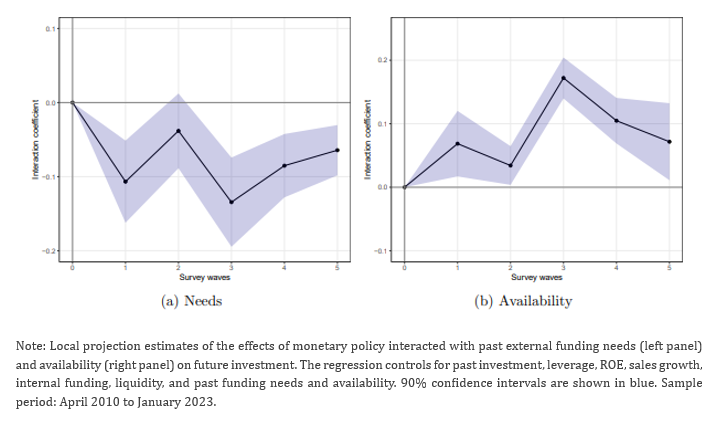
To assess whether financial conditions also influence the investment response to monetary policy, we repeat our local projection analysis, this time interacting monetary policy surprises with external funding availability. Figure 3 Panel B shows that the interaction coefficient between monetary policy surprises and external funding availability is positive, suggesting that firms with greater access to external funding are less affected by monetary policy. Specifically, an increase in monetary policy surprises leads to a smaller decline in investment for firms that perceived an increase in funding availability. Since availability is mainly driven by financial conditions, these results suggest that investment of firms with tighter financial conditions is more responsive to monetary policy.
Building on the previous results from local projections conditioned separately on funding needs and availability, an important question is how these effects interact when both dimensions are considered jointly at the firm level. Specifically, if firms with either high financing needs or low funding availability are more sensitive to monetary policy, are firms experiencing both high needs and low availability significantly more responsive than others? Addressing this question not only enhances our understanding of the heterogeneous responses of individual firms to monetary policy but also contributes to the broader debate in the literature on whether financially constrained firms are more or less sensitive to monetary policy (Ottonello and Winberry, 2020; Durante, Ferrando, Vermeulen, 2022)
To analyze the investment response conditional on both financing needs and availability, while avoiding too many interaction terms, we classify firms into distinct groups based on two dimensions. Specifically, we construct two dummy variables: the first equals one for firms with needs above 0 and availability below 0, and the second equals one for firms with needs below 0 and availability above 0. The first group likely comprises firms with strong investment opportunities that would invest but are constrained by limited access to external finance. We refer to these as “financially constrained firms”. The second group includes firms with limited investment opportunities, but that perceive an increased availability of external funding. We refer to these as “unconstrained firms”. Firms not falling into either category are classified as “others”. In our sample, around 6% of firms are financially constrained, while 4% are unconstrained firms.
Figure 4. Response of investment to monetary policy based on needs and availability jointly
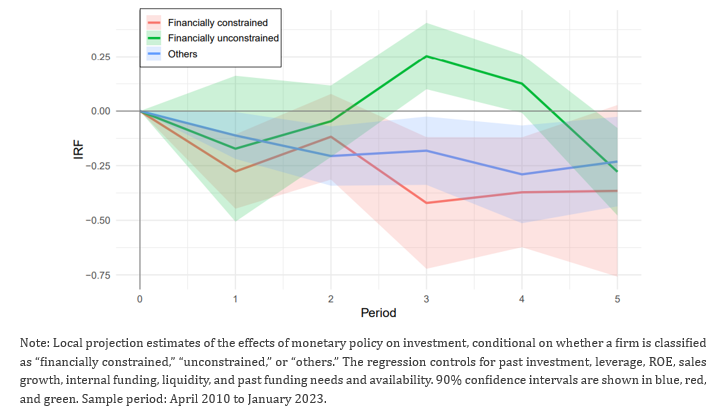
Figure 4 presents the local projection of firm-level investment in response to monetary policy surprises interacted with financial constraint dummies. Financially constrained firms exhibit a significantly larger decline in investment following a positive monetary policy surprise. This effect becomes particularly pronounced after three survey rounds (approximately 1.5 years), with investment falling by approximately 0.42 percentage points. In contrast, unconstrained firms show a muted response to monetary policy surprises, consistent with prior findings. These results suggest that financially constrained firms are notably more sensitive to monetary policy, supporting the view that monetary policy can alleviate borrowing constraints. Specifically, firms with rising investment needs but limited access to external finance are likely to be constrained in their ability to invest. Expansionary monetary policy can relax these constraints, allowing greater investment. This may occur via the balance sheet channel, where improved collateral valuations enhance firms’ borrowing capacity, or through the bank lending channel, where loan availability increases. Among financially constrained firms, those with stronger investment opportunities stand to benefit most from easier access to credit.
Leveraging data from the ECB SAFE survey, we created two proxies, firms’ funding needs and availability, for fundamentals and financial conditions across the euro area. Our analysis shows that monetary policy is most effective on investment when fundamentals are strong, underscoring the critical role of fundamentals, such as economic growth prospects and investment opportunities. In contrast, we observe that firms with favourable financial conditions, characterized by high funding availability, exhibit a muted response to monetary policy changes. This attenuated reaction points to the fact that for firms already experiencing ease in obtaining external finance, additional monetary accommodation may not significantly influence their investment behaviour. By jointly examining funding needs and availability, we find that firms experiencing both rising financing needs and declining funding availability—those that we characterize as financially constrained—are the most responsive to monetary policy. Our findings underscore the role of monetary policy in affecting investment through financial conditions, but its effectiveness ultimately hinges on the broader economic environment shaping firms’ investment opportunities.
Altavilla, C., Brugnolini, L., Gürkaynak, R. S., Motto, R., & Ragusa, G. (2019). Measuring euro area monetary policy. Journal of Monetary Economics, 108, 162-179.
Bernanke, B. S., & Gertler, M. (1995). Inside the black box: the credit channel of monetary policy transmission. Journal of Economic perspectives, 9(4), 27-48.
Bernanke, B. S., Gertler, M., & Gilchrist, S. (1999). The financial accelerator in a quantitative business cycle framework. Handbook of macroeconomics, 1, 1341-1393.
Durante, E., Ferrando, A., & Vermeulen, P. (2022). Monetary policy, investment and firm heterogeneity. European Economic Review, 148, 104251
Fazzari, S., Hubbard, R. G., & Petersen, B. C. (1987). Financing constraints and corporate investment, NBER Working Paper Series No. 2387.
Ferrando, A., Lamboglia, S., & Offner, E. (2025). Monetary Policy Transmission to Investment: Evidence from a Survey on Enterprise Finance. Working Paper Series No 3150, European Central Bank.
Gilchrist, S., & Himmelberg, C. (1998). Investment: fundamentals and finance. NBER macroeconomics annual, 13, 223-262.
Ottonello, P., & Winberry, T. (2020). Financial heterogeneity and the investment channel of monetary policy. Econometrica, 88(6), 2473-2502.