
The views expressed are those of the authors and not necessarily those of the institutions the authors are affiliated with. An earlier version of this article appeared in Italian in the February 2026 issue of Eco, the monthly economic journal directed by Tito Boeri.
Abstract
The European Commission’s most recent financial reform agenda brings together two previously separate objectives — the completion of the banking union and the strengthening of capital markets — under a single framework: the Savings and Investments Union (SIU). This integrated approach has strong potential, as meaningful progress in market development must take into account the bank-centered structure of Europe’s financial system. However, for the strategy to succeed, two key conditions must be met. First, European banks need to expand in scale, scope, and cross-border presence so they can play a more active role in financial integration and economic development. In this context, “completing the banking union” should go beyond reinforcing deposit protection and resolution mechanisms to support the growth and consolidation of banking institutions. Second, capital markets should be developed from the ground up, focusing initially on segments that are crucial both for banks’ operations and for improving Europe’s economic performance. After outlining the limitations of current policy agendas, the paper proposes four priority actions to strengthen the SIU, with the goal of encouraging cross-border banking activity, introducing new savings instruments, and revitalizing securitization.
The proposals currently being put forward by the European Commission under the label of Saving and Investments Union (SIU)1 are part of a decade-long debate on strengthening the European financial architecture. The idea of unifying saving and investment within a single strategic framework is intuitive: the European Union is rich of private saving, but struggles to channel it towards productive investment, especially high-risk and high-return long-term projects.
Yet this apparent clarity of purpose raises a crucial question: what does the SIU actually mean in concrete terms? Does it represent a genuine paradigm shift in European financial policies, or merely another rhetorical reformulation of familiar objectives, such as the Capital Markets Union or the completion of the Banking Union (BU)? In the absence of a clear operational definition, there is a risk that the SIU will remain a politically appealing slogan with little transformative content.
The real challenge, therefore, is not the announcement of new goals but the ability to identify realistic, politically feasible instruments that can align the European financial system with the needs of growth, technological transition, and strategic autonomy. All this must take place in an increasingly competitive international environment, in which the US banking industry is boosted by deregulation under the Trump administration, and other financial centers follow the same footsteps, competing more aggressively with Europe.
Reconciling three objectives – developing capital markets, making banks globally competitive, and preserving prudential soundness – requires a radically new European strategy. So far, the SIU appears only partially consistent with this demanding agenda.
To understand the potential and limits of the SIU, one must start from a basic fact: Europe is, and will remain for the foreseeable future, a bank-centered financial system. Banks play a dominant role in financial intermediation, especially in corporate finance, and this is particularly true for services to small and medium-sized enterprises, which form the backbone of the European productive structure.
Attempting to replicate the US model, based on deep capital markets and a more limited role for banks, is unrealistic given the institutional, legal, and cultural differences between Europe and the United States. Instead, the SIU should be conceived as a project of functional integration between banks and capital markets. European banks should be seen not as an obstacle, but as an essential vehicle for market development.
The key point is that European capital markets will grow only to the extent that banks are incentivized and enabled to participate actively in them. Any strategy that ignores this structural reality risks being ineffective, or even counterproductive.
In light of the above, it is easy to see why the traditional debate over completing the BU has produced limited results, particularly in developing capital markets. That debate has focused on three main objectives: a European deposit insurance scheme, a stronger backstop for the Single Resolution Fund, and the management of sovereign exposures in bank balance sheets.
These objectives are important for the stability of an integrated European credit market, but they have proven politically controversial. Conflicts of interest among member states, differences in perceived risk, and resistance to loss sharing have effectively blocked any meaningful progress.
More importantly, these objectives are only marginally related to the development and integration of capital markets. Even if fully achieved, they would not automatically lead to more market-based financing for firms, nor to the channeling of European saving into an integrated continental capital market.
If the SIU is to acquire real economic substance, the debate must be refocused. Rather than insisting on institutional reforms that have been stalled for years, it is necessary to identify an alternative strategy – less politically divisive and, above all, capable of giving major European banks both the ability and the incentives to become the driving force of capital market integration.
Ability is the first issue. A simple look at global bank rankings shows that European institutions are far from occupying positions consistent with the continent’s economic and strategic weight. At the top are Chinese banks, partly state-owned but operating under market-oriented business models. Next come large and highly diversified US banks. Only around the tenth position do European banks begin to appear, led by French institutions. Further down the ranking, banks tend to specialize in either traditional or niche activities.
European banks’ weakness is compounded by their fragmentation along national lines. This explains why banks have so far impeded capital market integration: credit is largely provided by institutions that are too small to compete globally in underwriting and investment banking.
Moreover, European banks lack sufficient incentives to engage in market development. Saving is still mainly collected through unsophisticated instruments such as bank deposits. Professional asset management, though growing, remains underdeveloped. National regulators discourage cross-border expansion and capital market activity, often to retain domestic savings and support government bond placement. Cross-border mergers are discouraged by national politics and occasionally blocked altogether. Even securitization is penalized by regulation, despite its proven role in market development elsewhere.
These shortcomings can be addressed by acting within the SIU strategy along two dimensions: on the banking side, by promoting size and international reach and creating a small core of genuinely European banks; on the market side, by fostering private initiatives to build the missing components of a mature financial system.
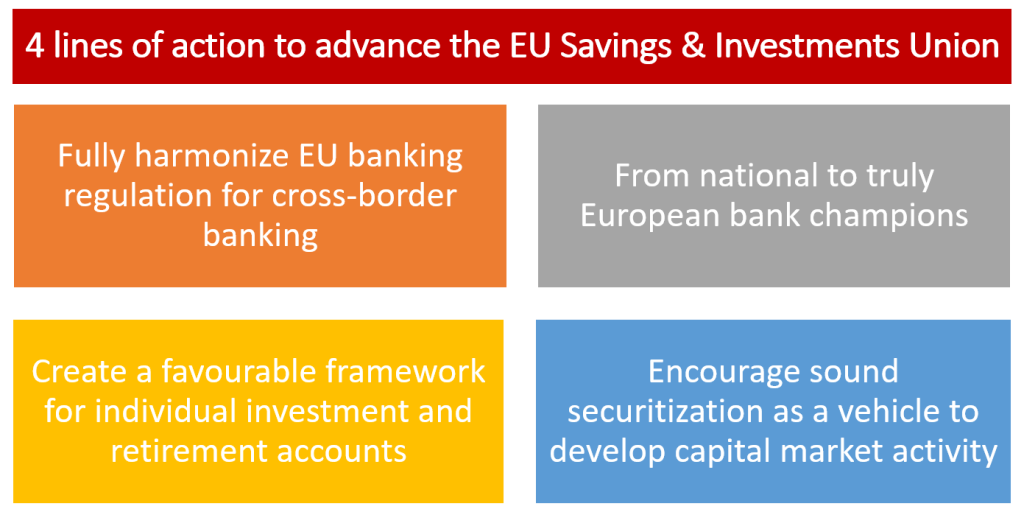
The first line of action concerns scale and cross-border activity. Despite its achievements, the BU has failed to create an integrated banking system.2 This is not due to a lack of initiative on the part of banks, which have expanded abroad mainly through subsidiaries and acquisitions. The problem lies in national and European regulation, and in state interference aimed at preserving domestic control. The result is a “prisoner’s dilemma”: individual strategies lead to collective weakness.
To remove this obstacle, the first proposal – put forward in the Draghi report3 – is to make euro-area banking fully equivalent to domestic banking. This would involve creating a single jurisdiction for cross-border banks, “country-blind” in supervision and crisis management. While consistent with existing EU law, this would require regulatory adjustments to eliminate remaining barriers to cross-border activity.
The second line of action is political. A coherent European regulatory framework cannot work if member states continue to promote national champions. A convergence of political intentions is needed to view cross-border mergers as a tool to strengthen European banking rather than as a threat to national interests. Competition policy should also be reframed with global, not merely internal, benchmarks.
The third line of action concerns markets. The goal is to encourage life-long and retirement savings to support capital market development. A recent Bocconi University report4 proposes new individual savings instruments, inspired by the Swedish ISK model, that include fiscal incentives for equity investment. These accounts would be flexible, portable, and transparent, and would feed into a single pool of European savings accessible to both public and private investors.
The fourth line of action concerns securitization. Stigmatized after the global financial crisis and penalized by regulation, securitization can, in fact, foster market development if properly regulated. A more favorable prudential treatment and the introduction of market makers, with initial public support, could improve liquidity.
The last two initiatives aim at market development but also directly involve banks, strengthening their role in saving collection and asset transformation.
For thirty years, Europe has sought to build a banking union; for fifteen years, it has also pursued a capital markets union. Progress has been made, but it remains incomplete. New global challenges and the need for strategic autonomy require new efforts on both fronts.
This paper proposes four lines of action to strengthen the Commission’s SIU agenda: two focused on banking and two on markets. These proposals require limited political support but rely mainly on private initiative. They can be launched by “coalitions of willing” countries and need not be confined to the EU. The current geopolitical environment, characterized by the erosion of the “old world order”, is bringing European countries closer together, reducing the relevance of formal borders and fostering shared interests and risks – including with so-called “middle powers” beyond Europe.
In this context, building a genuinely integrated European financial system becomes not only an economic objective but also a key element of the continent’s long-term strategic positioning.
This refers in particular to the set of legislative proposals presented in December 2025 (The Market Integration Package), and to earlier initiatives on securitization (Revitalising EU Securitization, June) and pension saving (Commission proposes to boost supplementary pensions to help ensure adequate retirement income, November).
Angeloni, I. (2024), The Next Goal: Euro Area Banking Integration; report prepared at the request of the European Parliament’s Committee on Economic and Monetary Affairs.
Draghi, M. (2024), The future of European competitiveness; report prepared at the request of the President of the European Commission.
Angeloni, I., and Cavallini, A. (2025), Feasible Steps to Finance Innovation in Europe: Six Proposals to Strengthen EU Capital Markets, Bocconi University, Institute for European Policy.