

The views expressed are those of the authors and do not necessarily reflect those of the Bank of Finland or the Eurosystem.
Abstract
This paper examines price level differences across the European Union to find out how far we are from the Single Market that is cornerstone of European integration. The central question is how large these differences are and how they have evolved during the EMU period. This second question gives rise to several related issues: How much does the degree of convergence vary across countries? Has the speed of convergence changed over time? And what factors drive differences in convergence speeds? We find that the average speed of convergence is around 6 per cent. Although this speed has fluctuated over time, it shows no clear long-term trend after the early years. The convergence parameter appears to be systematically related to certain background variables — most importantly, the overall level of living standards and the size of the initial price level gap.
How far are we from a single European market for consumption goods? The European Single Market is typically assessed using indirect indicators such as trade volumes, openness measures, regulatory indices, or the degree of legal harmonisation. While valuable, these indicators do not directly address a straightforward, consumer-oriented question: Do Europeans pay broadly similar prices for comparable baskets of goods and services? Price levels offer a direct, outcome-based perspective. In a well-integrated market, large and persistent cross-country price differences should be difficult to sustain, as competition, trade, and free entry exert pressure on firms to align prices with broader European conditions.
This perspective is particularly relevant in a currency union. With nominal exchange rates fixed, persistent cross-country differences in price levels translate into persistent real exchange rate differences and thus into differences in relative competitiveness. Price levels therefore provide a bridge between the microeconomics of market integration and important macro outcomes such as inflation dispersion, competitiveness, and perceived cross-country differences in cost of living. When discussing price level convergence, it is often assumed to concern mainly the newer EU member states (“latecomers”). However, this is not the case when all price categories are considered. Convergence is far from monotonic. For example, if we examine changes in the price gap — defined as pij − peuj, where i denotes the country, EU the European average, and j the commodity group — the share of positive changes is less than 40% for countries such as France and Italy, but exceeds 60% for the Baltic states and Romania. This suggests that convergence problems may not disappear even as newer EU countries approach the EU average in productivity and living standards. New price discrepancies can easily emerge as a result of failed economic policies or institutional weaknesses.
In this study, we analyse convergence patterns over the period 2000–2024, paying attention not only to latecomer countries but also to all countries whose national price levels have deviated — in either direction — from the European benchmark, and whether they subsequently return toward it. We also investigate whether adjustment is systematically faster for goods than for services. This distinction matters because goods are generally more tradable and exposed to cross-border competition, whereas many services are non-tradable, locally provided, and shaped by domestic regulation and market structure. A third question concerns the reasons for differences in convergence speeds: Is it mainly the size of the initial price gap, the level of living standards, or simply the passage of time (i.e., differences across sub-periods)?
In what follows, we estimate — for each item category and country — how fast the national price level for that item changes over one year depending on how far it was from the EU mean in the previous year. If a country’s price for an item is above the EU mean, we test whether its subsequent price inflation tends to be lower; if below, whether it tends to be higher. We allow the speed of adjustment to vary by country while controlling for item-specific patterns. The result is a set of country-specific convergence speeds that can be interpreted as an indicator of internal market integration.
We use Eurostat’s basic data for comparative price levels, which are based on extensive surveys covering more than 2,000 individual items across food, household appliances, and services. The main analysis relies on EU=100 Price Level Indices (PLIs) for the period 2003–2024, structured as an item-by-country-by-year panel. The data are intuitive: they indicate how expensive a consumption basket in a given category is relative to the EU benchmark. The dataset comprises 276 item categories with broad coverage across European countries, yielding a total of 121,440 item–country–year observations. To distinguish the effects of tradability from local market segmentation, we classify items into goods-like and services-like categories using a transparent, label-based mapping. This classification is not intended as definitive; rather, it provides a pragmatic partition that aligns with the prevailing policy debate — namely, that goods markets are generally more integrated than services markets. Finally, we complement the regression-based convergence speeds with system-level dispersion measures (i.e., how spread-out price levels are across countries). If integration strengthens over time, dispersion should decline; persistent dispersion would indicate that fragmentation remains economically relevant.
The goods–services distinction has solid economic foundations. Goods are typically tradable: imports, cross-border retail, and online commerce exert strong competitive pressure. When price levels for goods differ across countries, arbitrage and market entry can narrow these gaps. Services, by contrast, are often produced and consumed locally. They depend heavily on domestic inputs such as wages and rents, and are frequently influenced by national regulations (e.g., licensing, professional qualifications, local permits) and local market concentration. This leads to a clear, testable prediction: price-level gaps should close faster for goods than for services. Importantly, this prediction goes beyond trade alone — it also concerns contestability, i.e., whether firms from other member states can credibly enter, scale, and compete in the market. The macroeconomic relevance is immediate. Services account for a large share of consumption and value added in Europe. If services price levels converge slowly, cross-country differences in cost of living can persist, and inflation differentials may be more structural than cyclical.
Figure 1. Cross country dispersion of price levels
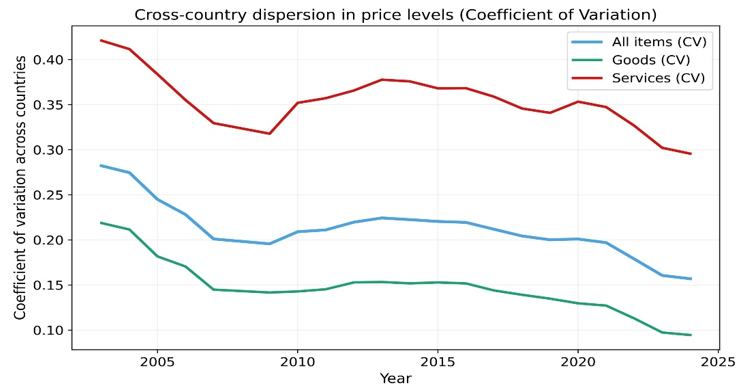
Across the full basket, we find clear evidence of mean reversion in price levels. The average convergence coefficient is -0.066, implying that roughly 6.6% of a lagged gap closes within one year. In other words, European price levels do not drift freely; market forces pull them back toward a common benchmark. The central result is the pronounced goods–services wedge. For goods, the average coefficient is -0.082 (≈8.2% gap closure per year); for services, it is -0.058 (≈5.8% per year). This supports the view that the Single Market is substantially more complete for goods than for services. These estimates are also broadly consistent with earlier studies (Égert, 2010; Garcia-Hiernaux et al., 2023). Country-specific results reveal substantial heterogeneity. Some countries converge quickly, while others adjust much more slowly — yet convergence characterizes practically all countries and items. This heterogeneity is informative: it suggests that productivity gaps remain large, and that the degree of integration and/or domestic frictions varies considerably across member states and sectors. Convergence coefficients capture adjustment speeds, while dispersion measures track system-level outcomes: are cross-country price levels becoming less dispersed over time? To address this, we compute the coefficient of variation of price levels (see Figure 1). The patterns for goods and services reinforce the main message. Where dispersion declines, integration is operating at the system level; where it persists, gaps are not being arbitraged away quickly. Overall, the trends are typically more favorable for goods than for services, consistent with stronger integration in tradable commodities. An intuitive way to illustrate convergence is through long-run catch-up patterns. We relate countries’ initial price-level gaps in 2003 to their subsequent cumulative price-level changes over 2003–2024. A negative relationship indicates catch-up: countries starting below the EU mean tend to rise toward it relative to the benchmark. This is exactly what one would expect if integration and income convergence gradually compress large initial gaps. To examine this, we estimate convergence regressions using different panel datasets and both linear and nonlinear models. Nonlinearity proves important in assessing the nature of the convergence coefficients: whether they are invariant across variables and/or countries, or whether they depend on the initial situation, living standards, time period, or other obvious candidates.
Figure 2. Catch-up values for 2003-2024
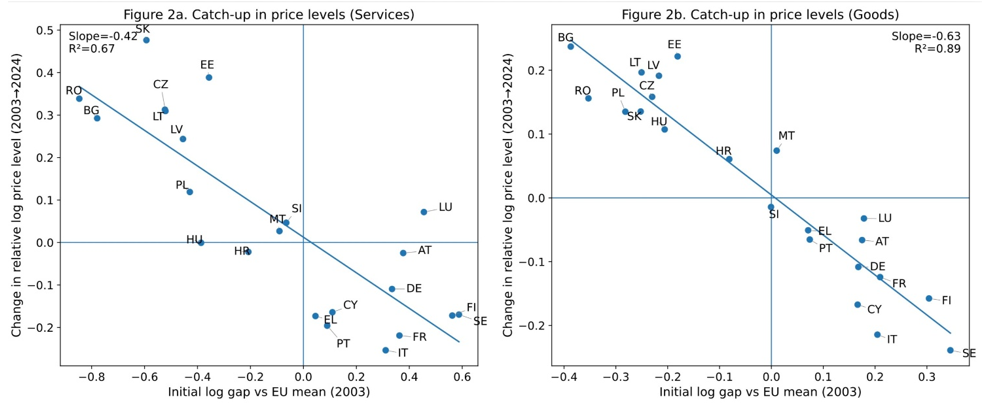
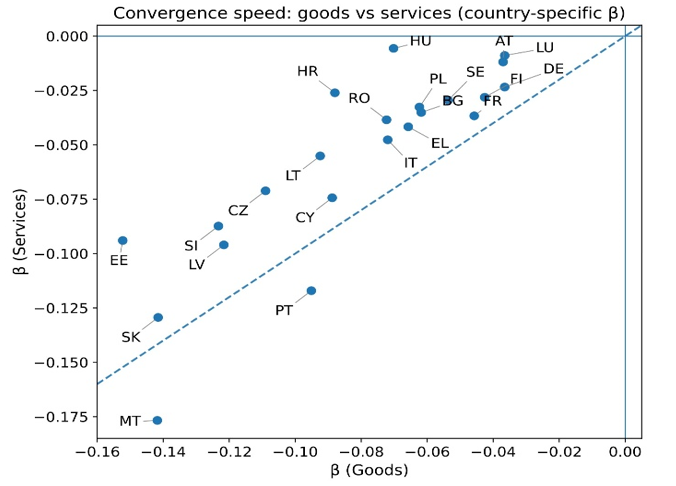
Before that, we examine the relationship between the initial price gap and the observed convergence of price levels for goods and services (Figure 2). Clearly, there is a strong relationship consistent with Balassa–Samuelson theory (Balassa, 1964): countries that began with relatively low price levels tend to experience larger subsequent increases. This catch-up pattern is stronger and clearer for goods than for services. In other words, stronger integration in tradable goods appears to drive more predictable convergence. From a policy perspective, this matters because it suggests that goods-market integration delivers a relatively predictable convergence process, whereas services remain more sensitive to country-specific institutions and market structures. The same pattern emerges when we estimate convergence coefficients for individual countries (Figure 3). Surprisingly few outliers appear — Estonia and Luxembourg are the most striking (likely reflecting post-COVID-19 developments).
Figure 3. Converge parameters for different countries
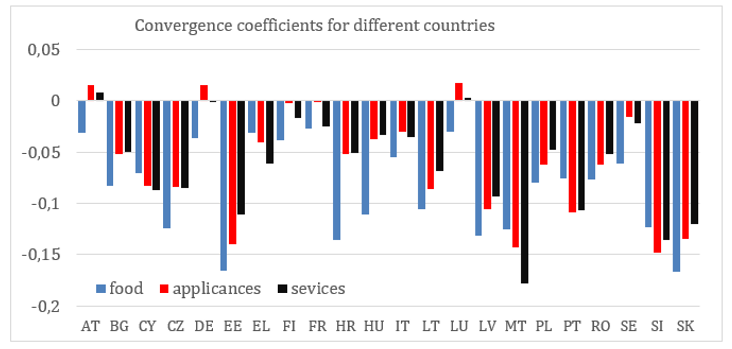
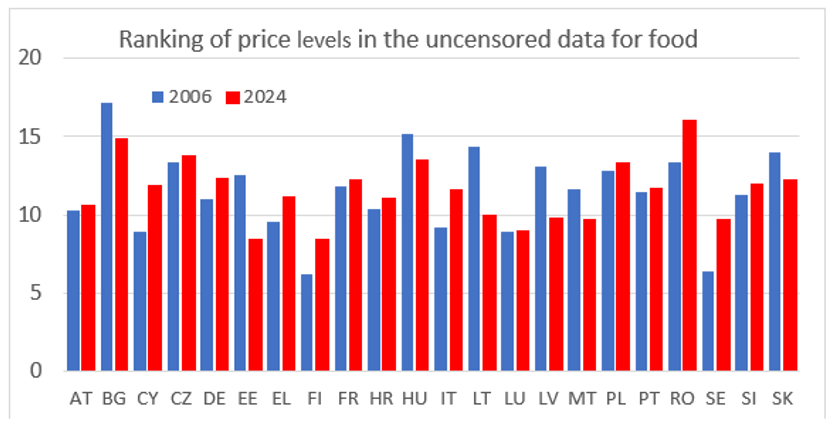
Before concluding, a few comments on robustness are in order. Regarding the data, the results remain largely unchanged when we focus on the raw Eurostat data classified into three broad categories (food, household appliances, and services), as shown in Figure 4. The same conclusion holds when we examine country rankings of prices for each individual item. In Figure 5, we use data on the same set of items for all countries and years; in Figure 6, we include all possible items (here limited to food, yielding 2,281 items across countries and years). Even then, the country profiles in price levels and convergence remain detectable. This supports the practical conclusion that sampling bias has limited impact on the headline patterns. In practical terms, the results indicate that relatively large differences persist between the old EU countries and the newcomers. Does this imply that everything boils down to the distinction between old and new member states? Not necessarily. Country groups are not homogeneous, exhibiting considerable within-group differences. Moreover, the convergence coefficients prove to be strongly nonlinear — above all, nonlinear with respect to the sign of the lagged/initial price gap. The absolute value of the coefficient is much larger for negative price gaps (defined as pij − peuj), reflecting a form of price rigidity: it is easier to raise prices than to lower them.1 Second, the convergence coefficients vary over time; they were considerably higher until the 2008/09 financial crisis, after which some levelling off occurred. Third, the coefficients depend strongly on income levels (GDP per capita in PPP terms), with smaller values for richer countries (which are, of course, correlated with higher relative price levels).
From a policy point of view, these differences are not trivial. If the patterns were driven solely by pre-accession conditions in new EU countries, the problems might fade away along with productivity catch-up (Lucas, 2009). But if they stem from institutions (e.g., market structures), new policy measures would be required.
Figure 4. Convergence coefficients with commodities in 3 categories
An outcome-based measure of Single Market integration can be constructed directly from price levels: how quickly do price-level gaps close? The data reveal systematic mean reversion in European price levels. The central policy message is the sectoral wedge: goods converge faster than services. This aligns with economic intuition and with the long-standing view that services markets remain more fragmented in Europe. The robustness checks suggest that this conclusion is not an artefact of item selection. Heterogeneity across countries underscores that the remaining integration gaps are uneven and likely shaped by domestic frictions and sector-specific barriers. For policy, the implication is clear: completing the Single Market in services offers the most direct route to narrower cross-country cost-of-living gaps and reduced inflation dispersion across member states.
Figure 5. Change of price rankings with raw data and identical classification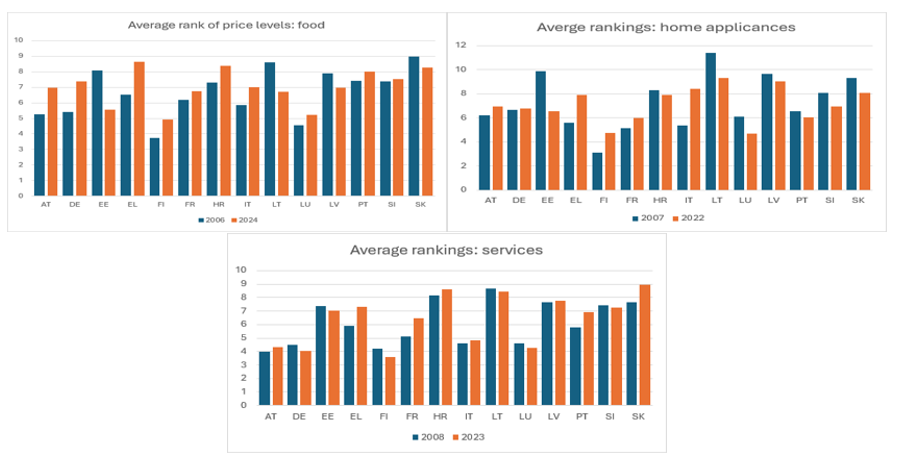
Figure 6. Change of price level rankings with the raw all-items’ data for food
Balassa, B. (1964) The Purchasing-Power Parity Doctrine: A Reappraisal, Journal of Political Economy, 72(6), 584-596.
Crt, L. and I. Masten (2020) Is there a Harrod-Balassa-Samuelson effect? New panel data evidence from 28 European countries. https://mpra.ub.uni-muenchen.de/100647/ MPRA Paper No. 100647.
Egert, B. (2010) Catching-up and inflation in Europe: Balassa-Samuelson, Engel’s law and other culprits. OECD Economics department Working papers no. 792 https://www.oecd.org/content/dam/oecd/en/publications/reports/2010/07/catching-up-and-inflation-in-europe_g17a1e8c/5kmblscvdk7d-en.pdf
Garcia-Hiernaux, M. Gonzales-Perez and D. Guerrero (2023) Eurozone prices: A tale of converge and divergence. Economic Modelling 126, 1-20. https://www.sciencedirect.com/science/article/pii/S0264999323002304
Lucas, R.E. Jr (2009) “Trade and the Diffusion of the Industrial Revolution”, American Economic Journal. Macroeconomics 1(1): 1–25, https://www.aeaweb.org/articles?id=10.1257/mac.1.1.1. M.
When we estimated a nonlinear threshold model, we found that the convergence parameter varies systematically with the price gap, living standards, and time period. For instance, when the (lagged) price gap serves as the threshold variable, the convergence coefficient is –0.68 below the threshold (restricted to zero) but only –0.32 above it. When the threshold value is estimated freely and multiple thresholds are permitted, qualitatively similar results emerge, but the shape of the convergence parameter becomes more sophisticated — particularly in the tails of the price-gap distribution. Detailed results will be published in a forthcoming Discussion Paper.