

This Policy Brief is based on BIS Papers No 163 and Amaral et al. (2025). The views expressed in this article are those of the authors and not necessarily those of the Central Bank of Brazil or the Bank for International Settlements.
Abstract
Periods of heightened uncertainty have challenged central banks in unprecedented ways. The shocks of recent years – from the Covid-19 pandemic and persistent inflation to volatile financial conditions and geopolitical tensions – have tested the resilience of monetary policy frameworks and the agility of policy responses worldwide. Against this backdrop, central banks have reassessed their analytical tools, decision-making processes and communication strategies to ensure the continued effectiveness and credibility of monetary policy. A recent BIS volume provides a comprehensive view of how central banks in the Americas and beyond have navigated uncertainty in recent times. Drawing on both survey-based evidence and in-depth case studies from 10 individual central banks, its chapters explore the evolving role of scenario analysis, the integration of high-frequency data and expert judgement, and the increasing importance of transparent and adaptive communication.
Many indicators of economic uncertainty have reached levels last seen during the Great Financial Crisis in 2008–09 or the Covid-19 pandemic. This poses challenges for monetary policy decision-making and communication by central banks. In particular, high levels of uncertainty give rise to a wider range of economic outcomes and a higher likelihood of rapid and profound changes in financial markets and the macroeconomy. Central banks have also increased their focus on communication, expanded their range of tools and further developed their analytical capabilities.
The Consultative Group on Monetary Policy, consisting of Bank for International Settlements (BIS) member central banks in the Americas and working under the auspices of the Consultative Council for the Americas (CCA), has recently brought together CCA central banks and several other central banks to discuss how they have dealt with periods of heightened uncertainty. The result is a volume with individual chapters from 10 central banks, from which emerges a rich and diverse panorama on the topic. The volume also contains a paper based on a survey that explores how 12 central banks have navigated times of heightened uncertainty regarding economic analysis, monetary policy decision-making and external communication. This policy brief summarises the central banks’ responses to the survey as well as the key contributions from the central banks’ individual chapters. It highlights key trends, challenges and practices among the participating central banks.
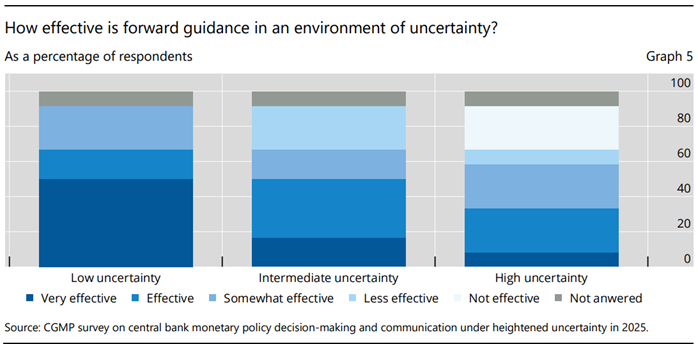
The survey’s responses show that heightened uncertainty plays an important role in shaping central banks’ monetary policy decisions and communication. Even though uncertainty is not explicitly embedded in monetary policy reaction functions, it affects several important aspects of the decision-making process such as macroeconomic modelling and the choice of relevant scenarios. Central banks have also adjusted their communication strategies, including a more restricted use of forward guidance. The key findings from the survey responses can be summarised as follows:
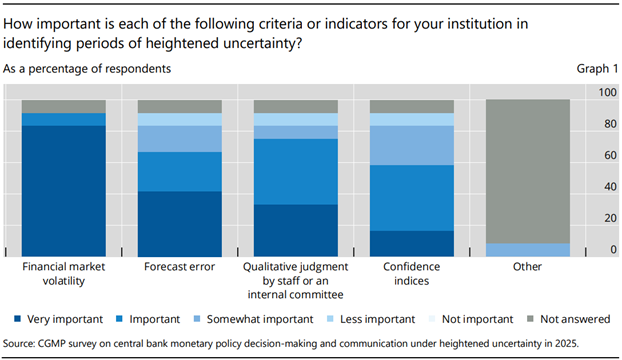
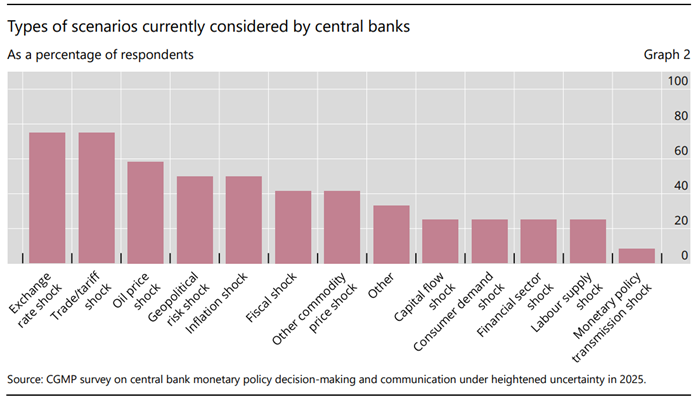
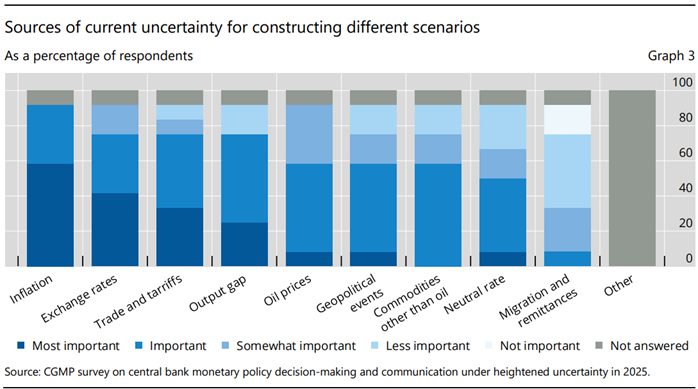
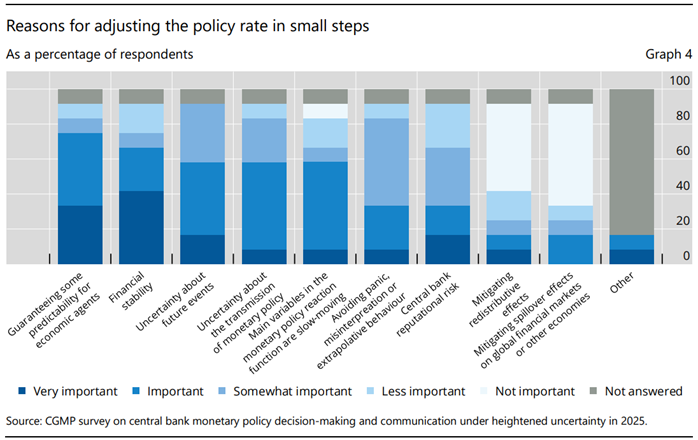
Country experiences differ, reflecting institutional settings, economic structures and inflation histories. There is no single blueprint, but a shared emphasis on flexibility, adaptability and credibility. The volume includes 10 case studies.
The Central Bank of Argentina’s chapter examines how extreme uncertainty and regime change reshape monetary frameworks, highlighting the role of expectations, credibility and transmission challenges in high-inflation environments as well as the central role of the foreign exchange (FX) channel in a bi-monetary economy like that of Argentina.
The Central Bank of Brazil’s experience shows how a monetary policy committee adapts analysis and communication under heightened uncertainty, balancing forward-looking assessments with robustness amid volatile inflation dynamics. Its experience emphasises that policymakers need to act with both caution and flexibility, to be transparent without overcommitting, and to provide guidance without creating confusion.
The Bank of Canada‘s chapter illustrates how risk management has been strengthened by integrating scenarios, alternative models and communication tools when standard forecasting relationships weaken. In times of extreme uncertainty, the central bank often considers a range of possible scenarios to help illustrate the high degree of unpredictability rather than relying on a single base case and its associated risks.
The Central Bank of Colombia‘s case highlights how uncertainty affects inflation dynamics and policy calibration, with a strong emphasis on probabilistic analysis and the careful interpretation of model-based signals. Uncertainty has been incorporated into the central bank’s monetary policy analysis and communication through risk scenarios and predictive densities of the main macro variables.
The Central Bank of Costa Rica’s chapter underscores the importance of clear, adaptive communication strategies to maintain credibility and anchor expectations in small open economies facing external shocks.
The Bank of Mexico‘s chapter draws lessons from two distinct episodes of high uncertainty (Covid-19 pandemic and shift in US trade policy). It shows how gradualism, risk assessment and communication interact in decision-making and how the central bank addressed uncertainty by technical rigour, institutional credibility and transparent communication.
The Central Reserve Bank of Peru’s experience emphasises monetary policy as risk management, combining scenario analysis and cautious calibration to preserve stability under persistent uncertainty. It also points out that the value of scenario analysis lies not in the permanence of the plan but in the discipline of planning.
The Central Bank of the Republic of Türkiye’s researchers provide evidence – from a study based on a randomised controlled trial – that communication itself can shape economic behaviour, showing how clarity and framing affect firm-level responses under uncertainty.
The chapter written by the Federal Reserve Board‘s researchers examines how uncertainty propagates through the economy and financial markets, highlighting implications for risk assessment and the transmission channels of uncertainty, such as financial, trade and supply chain channels in a post-pandemic world.
Finally, the South African Reserve Bank‘s chapter shows how resilient policy frameworks and transparent communication help economies exposed to domestic and global shocks to navigate uncertainty and how they can balance credibility with flexibility by combining formal modelling, scenario analysis, judgmental overlays and qualitative forward guidance.
The volume provides new insights into how central banks navigate the complexities of monetary policy decision-making and communication under heightened uncertainty. These findings underscore the significant impact of uncertainty on shaping central banks’ strategies, particularly in their efforts to maintain financial stability and guide economic agents through unpredictable environments.
High levels of uncertainty naturally present challenges for monetary policy decision-making, as financial market dynamics, including FX market developments, and the macroeconomic backdrop can change fundamentally in a short period of time. To address these challenges, central banks are increasingly leveraging advanced tools such as scenario analysis, high-frequency data and AI/ML techniques to enhance their understanding of rapidly evolving economic dynamics and improve the timeliness of their assessments. Despite these advancements, expert judgement remains critical, as it allows policymakers to interpret model outputs, account for limitations and incorporate qualitative insights when making decisions in uncertain environments.
Moreover, the survey results imply that central banks cope with this complex situation by taking a cautious approach of adjusting policy rates in small, incremental steps. This gradualism reflects the need to maintain financial stability and to provide a degree of predictability for economic agents in uncertain times. Predictability has its limits in times of uncertainty, however, as the more restricted use of forward guidance shows. Central banks are also divided on the importance of the central scenario during periods of extreme uncertainty. While some institutions prioritise alternative scenarios to address large, realised shocks such as the Covid-19 pandemic, others view the central scenario as a crucial anchor for providing stability and predictability to economic agents.
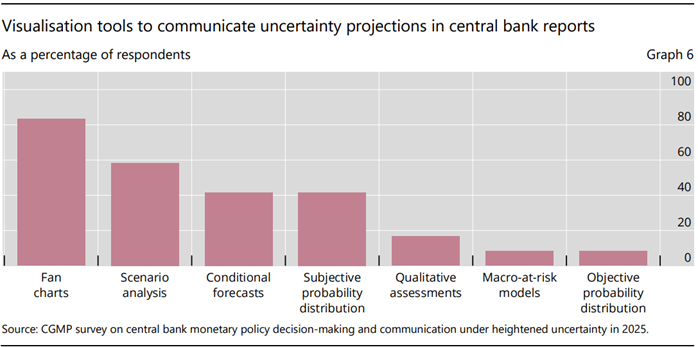
While central banks have made progress in communicating uncertainty, the survey results underscore that challenges remain in ensuring that market participants and the public fully understand its implications for monetary policy, related decisions and projections. Sophisticated visualisation tools, including fan charts and probability distributions, are being integrated into regular monetary policy and inflation reports to better communicate uncertainty. This points to the need for continued improvement in communication strategies, with an emphasis on tailoring messages to diverse audiences and raising awareness of the broad role that uncertainty plays in shaping the economy.
This volume stands as a testament to the power of collaboration and knowledge sharing within the central banking community. Across countries, experiences may differ, but a central lesson of the volume is that uncertainty is not the exception but the norm. Policymakers, researchers and practitioners working to strengthen monetary policy frameworks may find it useful.
Amaral, E., Avalos, F. and Shim, I. (eds) (2025). Monetary policy decision-making and communication under high uncertainty. BIS Papers No 163. Bank for International Settlements, Basel. Available at: https://www.bis.org/publ/bppdf/bispap163.pdf.
Amaral, E., Ehlers, T., Shim, I. and Tombini, A (2025). Monetary policy decision-making and communication under high uncertainty: insights from a survey of central banks in the Americas and beyond. Available at: https://www.bis.org/publ/bppdf/bispap163_b_rh.pdf.
Werning, V (2025). The economic impact of uncertainty: transmission channels and modelling issues underpinning Argentina’s new monetary framework. Available at: https://www.bis.org/publ/bppdf/bispap163_c.pdf.
Guillen, D. and Nogueira Ferreira, L (2025). Monetary policy decision-making and communication under heightened uncertainty in Brazil. Available at: https://www.bis.org/publ/bppdf/bispap163_d.pdf.
Cateau, G., Coletti, D. and Portelance, A (2025). From models to communications: strengthening risk management in monetary policy at the Bank of Canada. Available at: https://www.bis.org/publ/bppdf/bispap163_e.pdf.
Vargas, H (2025). Uncertainty and monetary policy: the case of the Central Bank of Colombia. Available at: https://www.bis.org/publ/bppdf/bispap163_f.pdf.
Central Bank of Costa Rica (2025). Communicating and managing uncertainty: the case of Costa Rica. Available at: https://www.bis.org/publ/bppdf/bispap163_g.pdf.
Bank of Mexico (2025). Monetary policy decision-making and communication under high uncertainty in Mexico: lessons from two episodes. Available at: https://www.bis.org/publ/bppdf/bispap163_h.pdf.
Armas, A., Rojas, Y., Herrada, R. and Butrón, N (2025). Monetary policy with risk and uncertainty management in Peru. Available at: https://www.bis.org/publ/bppdf/bispap163_i.pdf.
Akarsu, O., Karahan, F. and Torun, H (2025). Communication as policy and firm uncertainty: evidence from randomised control trial. Available at: https://www.bis.org/publ/bppdf/bispap163_j.pdf.
Londono, J., Ma, S. and Zer, I (2025). Risk and uncertainty in a post-pandemic world: implications for the economy, financial markets and monetary policy. Available at: https://www.bis.org/publ/bppdf/bispap163_k.pdf.
Loewald, C. and Morar, M (2025). South African Reserve Bank: resilient policy in an uncertain world. Available at: https://www.bis.org/publ/bppdf/bispap163_l.pdf.