

This policy brief is based on “Fiscal drag in theory and in practice: A European perspective”. The views expressed are those of the authors and not necessarily those of the institutions the authors are affiliated with.
Abstract
The 2022 inflationary spike in Europe has brought renewed interest in fiscal drag—the increase in tax revenue that occurs when nominal incomes grow but the parameters of the tax system, such as bracket thresholds or deductions, are not updated at the same rate. Using harmonized microdata for 21 European countries, we first document that the progressivity of personal income tax (PIT) systems gives rise to large tax‑to‑base elasticities, implying substantial potential for fiscal drag if parameters are not adjusted. We show that these effects are more prevalent for labor income and for taxpayers at the bottom and middle of the income distribution. We further document very heterogeneous policy responses across countries over 2019–2023, ranging from incomplete offsetting to over‑compensation of potential fiscal drag.
The post‑pandemic inflation surge and energy price shock that followed Russia’s aggression against Ukraine led to a rapid increase in nominal incomes across Europe. In progressive personal income tax (PIT) systems defined in nominal terms, this can raise effective tax rates even when real earnings are unchanged. Fiscal drag therefore matters for household purchasing power, tax equity, and public revenues. This has triggered renewed interest in the policy debate, see, e.g., OECD (2023), the IMF (Balasundharam et al., 2023), the European Commission (Leventi et al.,2024), the Institute for Fiscal Studies (Waters and Wernham, 2022) or the Bank of Spain (Balladares and García-Miralles, 2024).
Our recent work (García-Miralles et al., 2025) aims to provide a comprehensive overview of fiscal drag in Europe. We first provide a detailed characterization of PIT systems and the progressivity embedded in their design (Immerwoll, 2005), which we view as the potential for fiscal drag effects. We then analyze the recent dynamics between 2019 and 2023, incorporating observed income growth and government responses (Paulus et al. 2020), which give rise to actual fiscal drag effects.
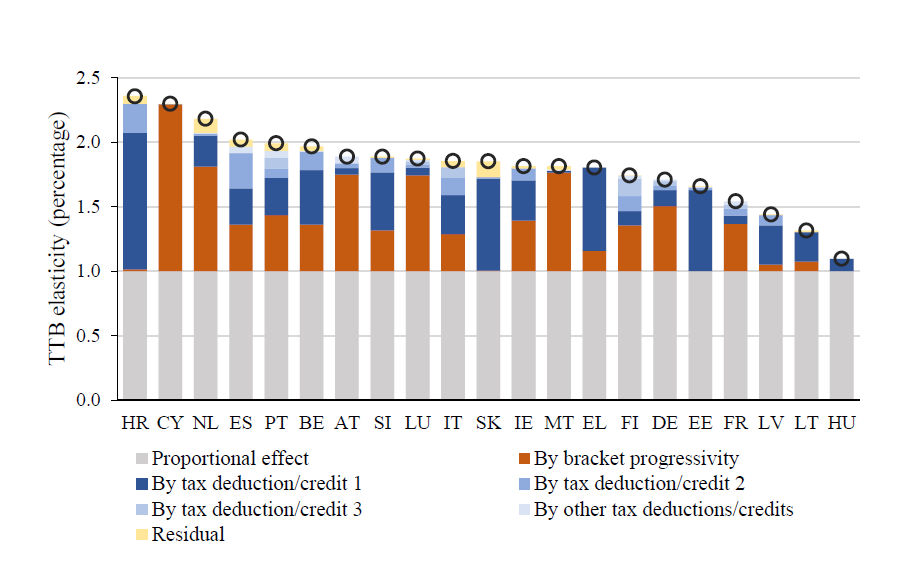
We compute tax‑to‑base (TTB) elasticities, the sensitivity of tax revenues to uniform income growth under unchanged tax rules. Across 21 European countries, elasticities mostly cluster around 1.7–2, indicating that a 1% income rise would lift PIT revenues by roughly 1.7–2% in the absence of changes in tax legislation. We show that bracket progressivity (or bracket creeping) is a key driver, but that a few major deductions and credits, such as family allowances or deductions for low-income earners, are on average equally important across countries. Figure 1 documents the estimated TTB elasticities and their determinants.
Figure 1. The progressivity of personal income tax systems in Europe measured as tax‑to‑base elasticities
Recalculating TTB elasticities by income source shows that labor income elasticities are generally the largest. Capital income often displays smaller elasticities, especially when it is taxed at flat or less progressive rates. Pensions and social benefits generally exhibit lower elasticities, close to or below one in several countries, owing to exemptions and targeted allowances. We see these estimates as potentially valuable for modeling and forecasting PIT revenue. We then explore differences across the individual distribution of TTB elasticities, documenting large spikes for low and middle incomes, often due to tax deductions phasing out or losing relative value. Figure 2 shows the results for the four largest countries in our analysis, while results for all 21 countries are reported in the paper.
Figure 2. Tax-to-base elasticities across the individual income distribution for the four largest countries
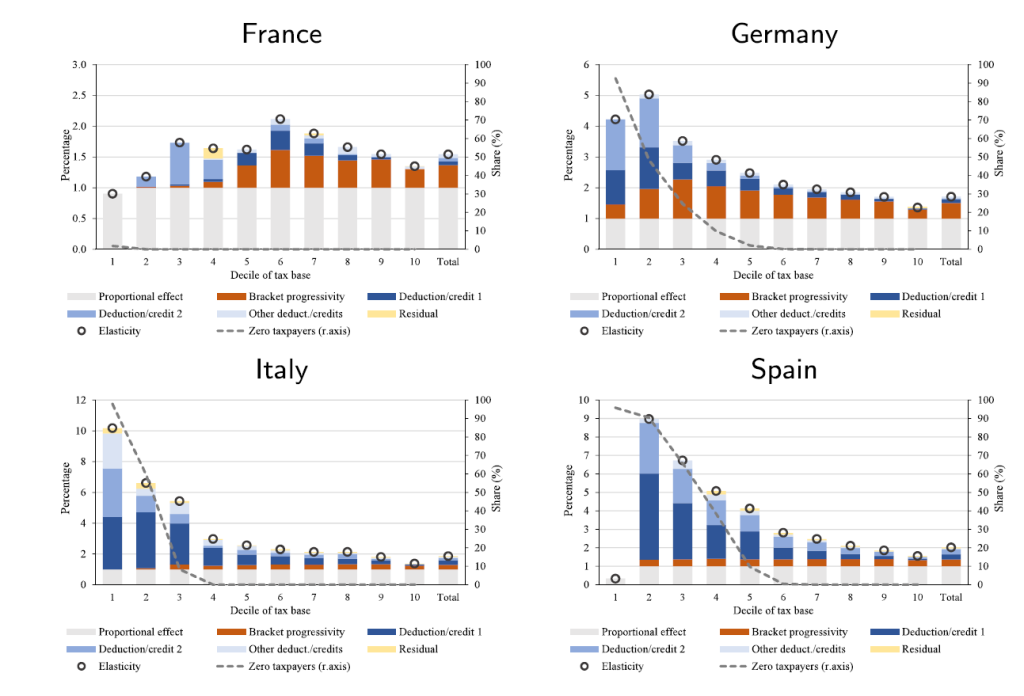
We study how these patterns affect the progressivity of each country’s PIT system and overall income inequality. We observe that, across all countries considered, their PIT systems become less progressive if nominal incomes grow uniformly while tax parameters are held fixed, consistent with TTB elasticities being lower for top income earners. However, we also find a reduction in income inequality in the majority of countries. This result can be reconciled with the decline in progressivity because a large share of individuals are zero-taxpayers (as shown in Figure 2) and remain so after the simulated income increase.
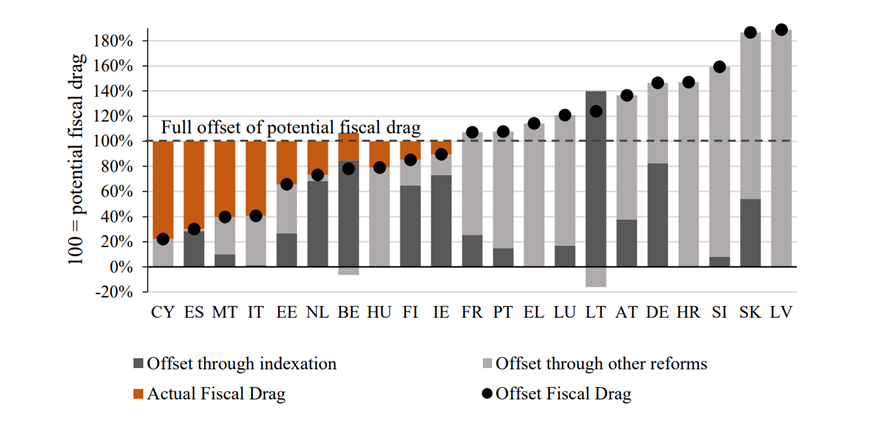
Comparing actual 2023 revenues against counterfactual scenarios in which the 2019 system had been kept unchanged or fully indexed shows that governments limited fiscal drag to varying degrees, as we illustrate in Figure 3. We evaluate three different counterfactuals based on alternative indexation benchmarks: past inflation, concurrent inflation, or nominal growth of the tax base. Although results are sensitive to this choice in some countries, the general patterns we document are invariant to the index used. Roughly one‑third of countries only partially offset fiscal drag, increasing effective tax rates by about one percentage point and revenues by around 0.5% of GDP. Another third of countries broadly neutralized fiscal drag via systematic indexation or other measures, while the remaining third overcompensated fiscal drag by implementing measures that further lowered revenues. Importantly, indexation policies were only a minor driving force of compensation, with other measures being the main driver of reduced revenue. These patterns show that indexation is far from widespread in Europe.
Figure 3. Actual fiscal drag in 2023 based on alternative indexation counterfactuals since 2019
Our findings highlight that fiscal drag is quantitatively significant in European PIT systems and can have notable consequences for both equity and public finances, particularly during periods of high inflation. The degree to which countries offset these effects has varied widely, affecting household purchasing power, public revenue, and the transmission of income shocks across Europe. These effects often remain largely unnoticed by the public, as their magnitude and distributional consequences are rarely communicated explicitly in budget documents. Policymakers could therefore give greater attention to this feature when analyzing the design and indexation of personal income taxes. The introduction of automatic adjustment mechanisms or timely and transparent discretionary updates could preserve tax progressivity and protect real incomes.
Furthermore, in the new EU economic governance framework, additional revenue stemming from fiscal drag is considered a discretionary revenue measure that creates fiscal space. Our paper offers a common framework to quantify these revenues, while illustrating that both bracket progressivity and tax deductions or credits have equally important effects, whose magnitude differs markedly across countries. More generally, enhanced monitoring and potential coordination at the EU level could help mitigate divergent national responses, supporting both fairness and macroeconomic stability across Member States.
Balladares, S., & García‑Miralles, E. (2024). Fiscal drag: the heterogeneous impact of inflation on personal income tax revenue (Occasional Paper No. 2422). Banco de España.
Balasundharam, V., Kayastha, A., & Poplawski‑Ribeiro, M. (2023). Inflation Indexation in Public Finances: A Global Dataset on Current Practices (IMF Working Paper WP/23/264). International Monetary Fund.
García‑Miralles, E., Freier, M., Riscado, S., Leventi, C., Mazzon, A., Abela, G., Boyd, L., Brusbārde, B., Cochard, M., Cornille, D., Dicarlo, E., Debattista, I., Delgado‑Téllez, M., Dolls, M., Fadejeva, L., Flevotomou, M., Henne, F., Harrer‑Bachleitner, A., Jászberenyi‑Kiraly, V., Lay, M., Lehtonen, L., Mastrogiacomo, M., McIndoe‑Calder, T., Moser, M., Nevicky, M., Peichl, A., Pidkuyko, M., Roter, M., Savignac, F., Strojan Kastelec, A., Tuzikas, V., Ventouris, N., & Wemans, L. (2025). Fiscal drag in theory and in practice: A European perspective. European Economic Review. https://doi.org/10.1016/j.euroecorev.2026.105275
Immervoll, H. (2005). Falling up the stairs: the effects of “bracket creep” on household incomes. Review of Income and Wealth 51 (1), 37–62.
Leventi, C., Mazzon, A., & Orlandi, F. (2024). Indexing wages to inflation in the EU: fiscal drag and benefit erosion effects (JRC Working Papers on Taxation and Structural Reforms No. 8/2024). European Commission, Joint Research Centre.
OECD. (2023). Taxing Wages 2023: Indexation of Labour Taxation and Benefits in OECD Countries. OECD Publishing.
Paulus, A., Sutherland, H., & Tasseva, I. (2020). Indexing out of poverty? Fiscal drag and benefit erosion in cross-national perspective. Review of Income and Wealth 66(2), 311-333.
Waters, T., & Wernham, T. (2022). Reforms, roll‑outs and freezes in the tax and benefit system (IFS Report R218). Institute for Fiscal Studies.