

The views expressed are those of the authors and not necessarily those of the institutions the authors are affiliated with.
Abstract
AI will affect consumers simultaneously through several channels, with labor markets, asset markets, prices, and policy decisions all playing key roles. For college-educated, high-income, city-dwelling (“CHIC”) households, elevated equity wealth relative to labor income makes asset markets important drivers of spending, and increases in asset prices can help offset temporary declines in labor income. Established CHIC workers likely have greater exposure to augmentation and wealth offsets, while younger consumers may be more vulnerable to displacement. Given that this younger cohort accounts for less spending, the near-term drag on aggregate consumption is likely smaller. Still, diffusion speed will be key. If AI diffuses about twice as fast as the internet, we expect task creation and wealth effects to offset labor displacement, resulting in an increase in output and income. CHIC households could reap the largest gains, and income and wealth inequality could widen. In a bear scenario, rapid diffusion could lead to higher unemployment, especially if accompanied by asset market declines. CHIC households are likely first affected by displacement, but the resulting aggregate demand shock would spread the weakness across cohorts, as less exposed occupations also tend to be more cyclical.
Conventional discussions of the effects of AI on different cohorts of consumers have focused primarily on occupational exposure, often culminating in a fear of white-collar job loss. This is only one part of the story. We broaden the analysis to three channels through which AI can affect consumer spending: labor markets, financial wealth, and inflation.
Across demographic groups, consumer exposures to each of these channels will vary. AI exposure is also not inherently positive or negative. Greater occupational exposure, for example, could mean greater risk of displacement or larger income gains from productivity-driven wage growth.
In this paper, we build on the results of our prior work, in which we used a general equilibrium model to form base and bear case outlooks around AI. We believe the extent of AI-related disruption is largely dependent on three forces: 1) the speed of AI adoption, 2) the speed and quantity of new task creation, and 3) indirect feedback loops such as wealth effects.
In our base case, we assume a moderate speed of diffusion, which is still twice that of the Internet (e.g., AI diffuses in about a decade versus two previously). We link the pace of task creation to the speed of diffusion and assume wealth effects that are smaller than those observed historically, to be conservative. In this scenario, the outcome is relatively optimistic; AI boosts productivity without triggering a downturn. While there is some temporary labor displacement, with the unemployment rate rising by around 0.5pp at the peak, real wage growth accelerates, employment is rebalanced across occupations, productivity supports disinflation, and profits rise. The net outcome is faster output and income growth.
Our bear case is based on a scenario of rapid AI diffusion, in which full adoption takes only six years, much faster than any historical precedent. Here, recession-like outcomes are possible as fast adoption means job displacement far outweighs job creation in the short term. Depending on the size of wealth effects assumed, the unemployment rate rises by anywhere from 0.6pp-4.1pp at its peak. The increase in unemployment is due to two drivers: 1) a mismatch in skills between workers and available jobs, and 2) demand-side weakness after the initial employment shock.
We now extend the analysis to refine our base and bear case outcomes by including outlooks for consumers across four demographic factors: income, education, region, and age. While our prior work provides a baseline for the economy, it does not speak directly to differential effects across consumers. Using micro data on occupations, consumer balance sheets, and spending patterns, we examine exposures of each cohort across the three transmission channels, which in turn helps us develop expectations for each.
Exhibit 1. Overview of AI Transmission to Consumers Across 3 Key Channels
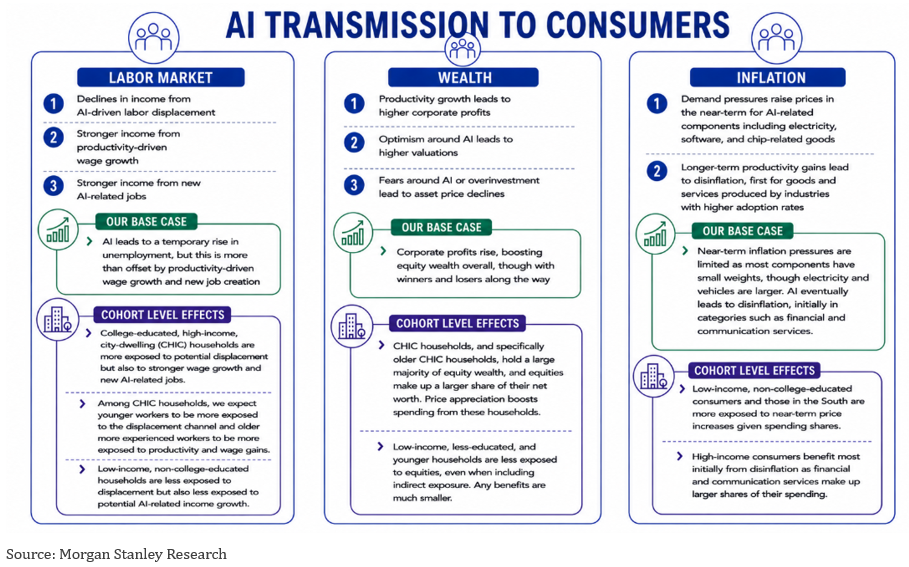
The first transmission channel we assess is labor markets. AI can affect labor markets in several ways. First, some tasks could be cheaper to perform with AI than with human labor, and if so, this could lead to labor displacement. Second, AI could enhance consumers’ productivity, allowing them to produce more output with the same number of hours worked. If so, this could lead to stronger wage growth. Third, new tasks and jobs could be created related to AI, increasing employment in certain industries or creating new industries entirely.
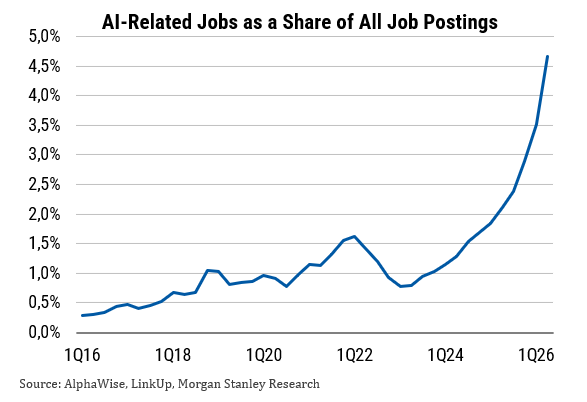
Using a framework that assesses how tasks within each occupation align with AI capabilities, we find that high AI exposure occupations tend to be concentrated among higher-income, highly educated, city-dwelling (or “CHIC”) households. Within this group, younger CHIC workers are so far more affected by displacement, while for more experienced workers, exposure could mean “augmentation” and thus faster productivity and wage growth. In terms of job creation, it is still early, but new AI-related occupations have so far been aimed at these same CHIC consumers; AI-related job postings have been targeted toward higher-income consumers with some experience in similar “highly-exposed” industries.
Exhibit 2. High exposure AI occupations tend to be higher-income, more educated, and concentrated in cities
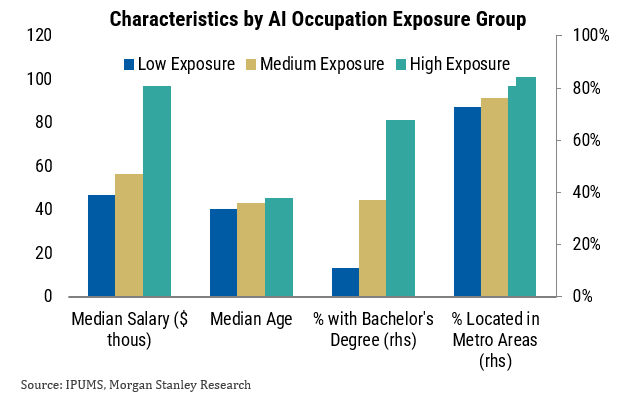
Exhibit 3. AI-related jobs have been increasing as a share of job postings
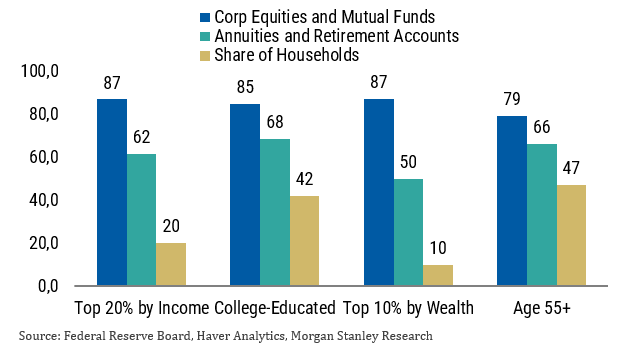
The second transmission channel is through financial wealth. If AI boosts productivity, firms may produce the same output at a lower cost, increasing profits. Even before profits rise, optimism around AI could lift valuations. In a bear scenario, fears around AI or overinvestment could result in asset price declines. CHIC households, and especially older CHIC households, have more equity exposure, both in absolute terms and as a share of their own net worth. The top 20% income cohort, the college-educated group, and the 55+ age group all account for around 80% or more of equity exposure among households. Among lower-income and less-educated households, a smaller share have any equity exposure at all. As a result, changes in equity valuations can more easily drive changes in net worth, and thus changes in spending, for CHIC households.
Exhibit 4. Both direct equity holdings and retirement accounts are more concentrated among high-income, college-educated, and older households
The final transmission channel we consider is through inflation. AI’s effect on inflation is likely twofold. In the near-term, increased demand for electricity, software, and chip-related goods (phones, televisions, household appliances, and cars) could result in larger price increases. In the medium- to longer-term, productivity gains could lower production costs, slowing inflation or even leading to reductions in prices.
We expect electricity, software, and chip-related goods to drive near-term AI-related price pressures, even if those pressures are somewhat limited. Given that these categories (especially electricity) make up larger shares of spending for low-income, less-educated, and younger households, these groups are likely more exposed. Meanwhile, if longer-term disinflation first stems from industries with higher adoption rates, and thus materializes in services categories such as financial and communication services, higher-income households will benefit first.
Combining these findings, CHIC households are more exposed to labor displacement, but also to AI’s potential upside: productivity-driven wage growth, new job creation, wealth effects, and disinflation. Lower-income, less-educated consumers are at less risk of displacement, but face more near-term price pressures and stand to benefit less from AI-related job and wealth creation.
The next question is how these exposures will balance out. As described above, our base case is that AI will raise productivity, and positive effects from wage growth, task creation, and wealth effects will offset the rise in unemployment. In this scenario, we expect CHIC households to benefit most. Some high-income, highly-educated workers may face temporary periods of softer consumption, especially younger workers who likely have greater risk of displacement and lower accumulated equity wealth. That said, for this group’s spending as a whole, substantial levels of equity wealth relative to labor income mean that relatively modest gains in asset prices can offset the spending effects of declines in labor income. In our base case, CHIC households are best off, reaping the largest gains from financial asset appreciation and also from eventual wage gains and disinflation.
Exhibit 5. For high-income consumers, equity wealth is very elevated relative to labor income
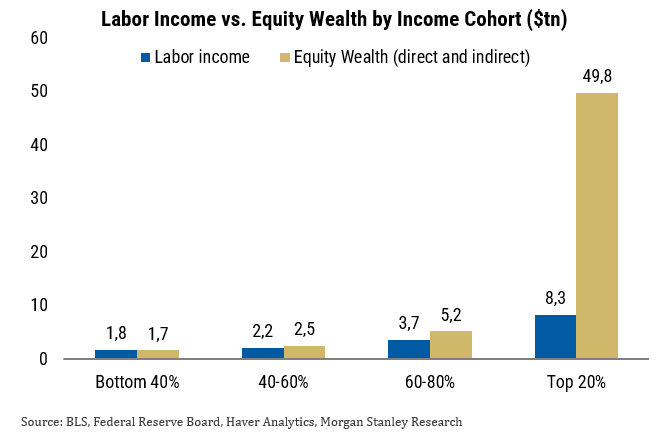
Income and wealth inequality widen in this scenario, though it does not mean low-income or less-educated consumers are worse off in absolute terms. These consumers could benefit from an eventual broadening of wage gains and disinflation, or from monetary easing that may accompany any initial displacement.
In our bear case, recession-like outcomes are possible as rapid AI diffusion means job creation cannot keep up with job displacement. In this scenario, we expect CHIC households to experience the initial adverse effects because of their greater occupational exposure. If displacement is accompanied by asset market declines, the downturn would be much more extreme. Given that these households control a large share of total spending, weaker demand would ultimately spread the shock across the broader economy. The initial intuition might be that white-collar workers would be most affected, but the net effect, in our view, would be worse outcomes for all cohorts. The ultimate distributional effects would depend not only on the pace of AI adoption and asset market outcomes, but also on monetary and fiscal policy responses.