

This policy brief is based on ECB Working Paper Series No 385. This publication should not be reported as representing the views of the European Central Bank (ECB). The views expressed are those of the authors and do not necessarily reflect those of the ECB.
Abstract
This article investigates whether earnings manipulation signals are reflected in banks’ internal credit risk estimates, measured through the probability of default (PD). Using AnaCredit credit exposures and Bureau van Dijk – Orbis financial statements for publicly traded corporations between 2019 and 2022, we compute Beneish M-Scores and match them with banks’ PD estimates for 1,349 firms. The full-sample evidence shows a weak negative correlation between M-Scores and PDs, suggesting that manipulation signals are not fully absorbed by internal models. However, firms exceeding the Beneish manipulation threshold, representing 8.9% of the sample, display higher PDs that increase as the M-Score worsens. The results indicate a context-dependent and non-linear relation between potential earnings manipulation and credit risk estimates. They also suggest the relevance of qualitative overrides, expert judgement and manipulation-adjusted credit risk indicators in banks’ internal risk assessment frameworks.
The assessment of corporate credit risk relies heavily on financial statement information. At the same time, a substantial body of literature shows that firms may engage in earnings manipulation, thereby distorting measures of financial performance and risk. Although tools, such as the Beneish (1999) M-Score can be used to detect such practices, little academic evidence exits on whether these signals are incorporated into banks’ internal credit risk models.
This raises an important policy question: do banks’ internal credit risk estimates, represented by their PD, respond to potential signals of earnings manipulation? The underlying hypothesis is that firms engaging in manipulation may experience increased credit risk over time, which should be reflected in higher PD values. Earnings manipulation may mask financial weaknesses that are not immediately detectable but can later impair the firm’s ability to meet its obligations. Conversely, stable or decreasing PDs despite manipulation signals may indicate that internal risk estimates are determined on the basis of less reliable financial inputs.
To address this question, we combined accounting data with granular credit data across the European Union. First, we relied on firm-level financial statement data from Bureau van Dijk – Orbis to compute the Beneish M-Score for publicly listed European firms between 2019 and 2022. Second, we used AnaCredit, a harmonised dataset covering euro area credit exposures, to obtain banks’ internal one-year PDs. After applying data availability filters and matching the two datasets via LEI codes, this resulted in a final sample of 1,349 firms, consisting primarily of large European firms, with strong representation from Italy, Germany, Spain and France, spanning a diverse set of industries.
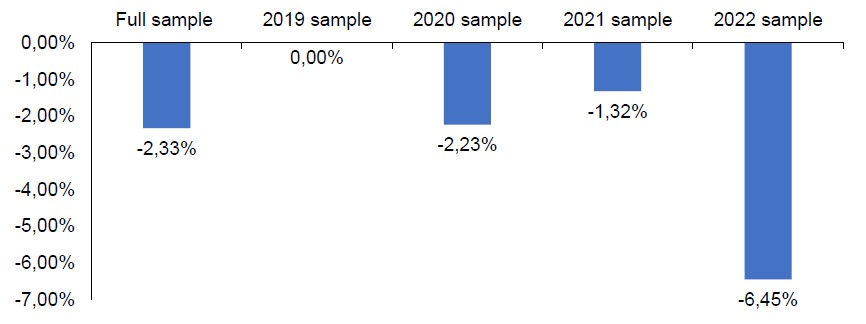
We investigated the contemporaneous relationship between a firm’s likelihood of engaging in earnings manipulation and banks’ PD estimates. These analyses showed that the pairwise correlation between the Beneish M-Score and PDs exhibit a low and negative correlation across the full sample of -2.33%. Conceptually, these results across the entire sample suggests that banks’ internal models may not fully capture the potential risk of earnings manipulation within financial statements. In some cases, internal models may even interpret manipulated financial statements as a signal of stronger credit quality.
Figure 1. Pairwise correlation between M-Score and PD by subsample
Nevertheless, our baseline results may be equally influenced by the prevalence of firms not being associated with potential earnings manipulation risk. Within our sample only 8.9% of observations depict a Beneish M-score in excess of the -1.78 threshold, which represents a cutoff value beyond which a company could be flagged as a potential earnings manipulator. In response, we further explored segmenting the sample by the distance to the M-score threshold. This revealed that firms whose financial statements indicate potential earnings manipulation are associated with statistically significant higher PDs. Furthermore, increases in PDs are observed when the M-Score worsens beyond the threshold. In economic terms our estimations indicate that, among likely manipulators, a one standard deviation change in the M-Score is associated with a 37 basis point increase in PD. This pattern indicates the relationship between potential earnings manipulation and banks’ PDs to be non-linear, and emerges only among firms displaying stronger manipulation signals. Banks’ internal credit risk estimates can therefore be considered responsive to potential manipulation risk for this subset of firms.
Figure 2. Pairwise correlation between M-Score and PD by distance to the earnings manipulation threshold
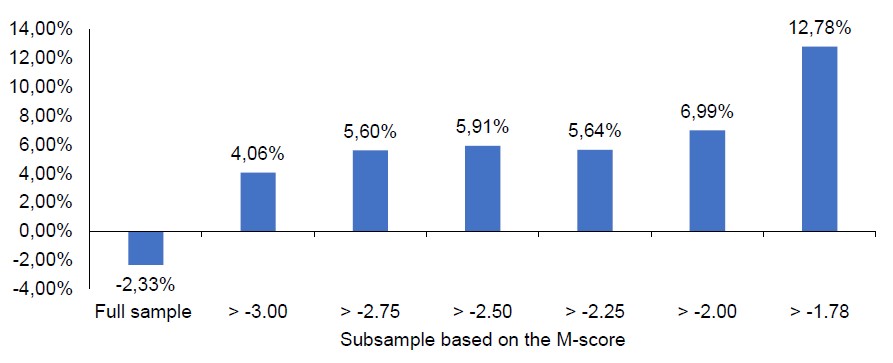
This study evaluates whether banks’ internal credit risk measures incorporate signals of earnings manipulation and whether such signals influence short-term credit risk. The findings point to a non-linear relationship between signals of potential earnings manipulation and PDs. While higher M-Scores are associated with lower PDs in the full sample, this result is driven by firms that do not exhibit manipulation risk.
Only a small subset of firms, equal to 8.9% of the sample, breaches the Beneish threshold. For these firms, banks’ internal credit risk estimates are effectively responsive: companies for which the M-Score indicates potential earnings manipulation display higher PDs, and PDs increase further when the M-Score worsens beyond the threshold.
Overall, the findings show that banks’ PD models, which often rely on financial ratios and quantitative indicators, are responsive to earnings manipulation signals mainly when those signals are sufficiently strong. The Beneish M-Score may therefore serve as a useful indicator for identifying possible manipulation in firms’ financial statements. The results also suggest the potential need for banks’ internal credit risk estimates to consider qualitative overrides and expert judgement where manipulation signals may not be adequately incorporated into model-based estimates.
To capture both default risk and the reliability of financial reporting, the article introduces a manipulation-adjusted credit risk perspective, denoted as PD+, which measures the extent to which manipulation risk, captured through a probability of fraud, may amplify default risk. This approach highlights the importance of combining quantitative PD models with indicators of financial reporting quality, particularly where internal models may not immediately incorporate the credit implications of unreliable accounting information.
Beneish, M. D. (1999), “The detection of earnings manipulation”, Financial Analysts Journal, 55(5), 24-36.