

This policy brief is based on CEPR Discussion Paper No. 21511 “Banking under Conflict: Managers and Organizational Design”. The views expressed are those of the authors and not necessarily those of the institutions the authors are affiliated with.
Abstract
Banks rely on soft information to allocate credit, making managerial assignment and the delegation of decision-making authority central organisational choices. In socially divided environments, these choices involve a trade-off between improving information acquisition through locally connected managers and limiting the risk of biased lending through favouritism. We study how banks adjust internally as conflict intensifies, using the outbreak of the 2020 Ethiopian civil war as a natural experiment. We show that conflict-exposed banks increasingly appoint managers who share the ethnicity of local customers while tightening headquarters’ oversight by reducing lending autonomy and relying on experienced insiders. Our results suggest that these organisational adjustments allow banks to sustain lending activity with little deterioration in loan performance.
Banks play a central role in allocating credit by screening and monitoring borrowers, activities that rely heavily on soft information about individuals and firms. As managers and loan officers are responsible for generating and transmitting this information, choosing who to hire is a crucial decision. Moreover, banks must decide not only who to appoint as managers, but also how much authority to delegate to them, shaping how information is translated into lending decisions. In socially divided environments, these decisions involve an additional trade-off: employees’ group membership may affect both the quality of the information they collect and how they use it in lending decisions.
A growing literature has examined the role of culture in the formation of credit relationships, showing that managers and loan officers who share customers’ social or cultural background are often better able to acquire and interpret soft information, improving borrower screening and expanding access to credit. Evidence from India shows that loan officers culturally connected with customers make more accurate lending decisions, leading to increased credit access (Fisman et al., 2017), while a study from Italy finds that banks with local social ties attract more borrowers (Accetturo et al., 2023). Similar evidence comes from the United States, where Frame et al. (2025) find that minority borrowers matched with minority loan officers are more likely to complete mortgage applications, obtain credit, and subsequently exhibit lower default rates.
However, social proximity may also distort lending decisions through favouritism, in-group bias or taste-based discrimination (Fisman et al., 2020; Rehbein and Rother, 2025). For example, Eichengreen and Saka (2026) show that cultural stereotypes affect multinational banks’ cross-border lending, with banks extending more credit to countries that are viewed more favourably. Similarly, D’Acunto, Ghosh, and Rossi (2026) find that cultural biases in FinTech lending lead investors to favour coethnic borrowers despite their poorer performance, resulting in higher default rates and lower returns. Consistent with this mechanism, Hjort, Song, and Yenkey (2025) show that investors allocate capital more favourably to firms led by coethnic managers, even after accounting for firms’ fundamentals.
For banks operating in socially divided environments, appointing managers who are socially close to customers may therefore improve information production while also increasing the scope for biased lending, creating a challenging trade-off. This organisational trade-off becomes more pronounced during periods of social conflict. As trust between groups declines and communication becomes more difficult, managers who do not share customers’ background may face greater challenges in collecting and interpreting soft information (Rohner et al., 2013). At the same time, managers who share customers’ background may bias lending towards their own group. Social conflict can therefore affect both sides of the trade-off by reducing the ability of socially distant managers to gather soft information while increasing the risk of biased lending by socially close managers. Understanding how banks respond to these competing forces is therefore important for financial stability and the design of resilient banking systems.
To make progress on this issue, we address two research questions. First, how do ethnic divisions shape the internal allocation of managers within banks? Second, how do banks reorganise their managerial structure when conflict between social groups intensifies? We examine two organisational choices: who banks appoint as branch managers and how much decision-making authority they delegate to them. We study this in the setting of the Ethiopian banking sector, looking at how they reorganised in response to the outbreak of the 2020 civil war.
Ethiopia provides an ideal setting to study how conflict affects bank organisation. The country combines high ethnic diversity at the national level with substantial ethnic homogeneity at the local level. Indeed, around 80% of the population lives in areas where more than 80% of residents belong to a single ethnic group. Many Ethiopian banks are historically associated with particular ethnic groups but operate nationwide. Consequently, they manage branches in cities where the predominant local ethnicity differs from that associated with the bank.
Our main analysis focuses on the effect of the Ethiopian civil war on banks’ internal organisation through its polarising effect on differences between groups (Rohner et al., 2013). The conflict was triggered by political reforms introduced in 2018, which excluded Tigrayans from the central government and ultimately culminated in the outbreak of the Tigray War in 2020. It subsequently spread to the Oromia and Amhara regions, although its intensity varied substantially across both time and space, with the highest levels of violence concentrated in specific areas (Figure 1).
Figure 1. Ethnic conflict over time and space
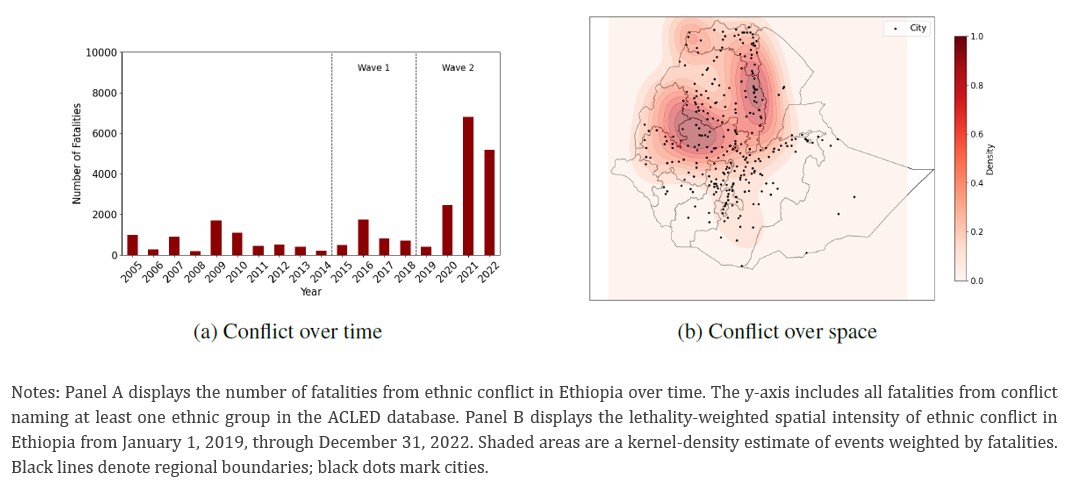
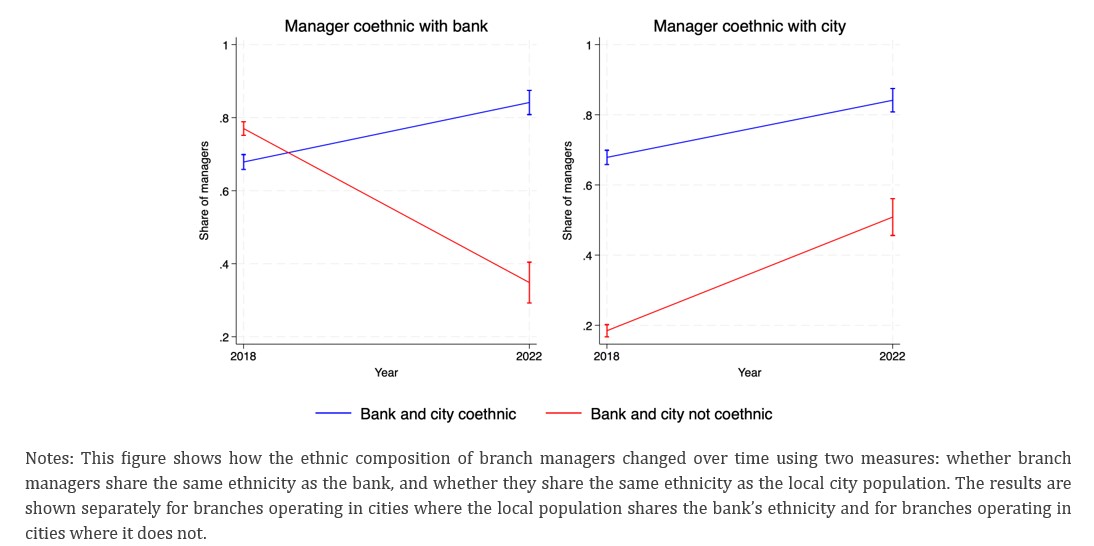
Figure 2 highlights the stark shift in the ethnic composition of banks’ managerial staff from 2018 to 2022 that motivates this study. In 2018, in cities with a different predominant ethnicity than the bank’s around 80% of managers shared the bank’s dominant ethnicity, and less than 20% the city’s. In 2022, this pattern reversed to 35 and 50% of managers being coethnic with respectively the bank and city. In cities sharing the banks’ dominant ethnicity, banks instead relied even more strongly on managers sharing the bank’s ethnicity in 2022 than in 2018. Our empirical analysis aims to highlight the specific mechanisms underlying this stark change following increased ethnic conflict.
Figure 2. Changes in manager ethnicity over time
To perform the empirical analysis, we conducted a unique survey on Ethiopian bank branches, which we combine with georeferenced conflict data and information on cities’ ethnic composition. The survey was conducted on Ethiopian bank branches in 2018 and 2022, covering almost 1,000 branches before and after the outbreak of civil war in 2020. The survey contains detailed information on branch managers’ ethnicity, as well as branches’ internal organisation, lending practices and the delegation of lending authority.
Our empirical strategy exploits differences in banks’ exposure to ethnic conflict through the geographic distribution of their branch networks. As the effect of conflict on ethnic divisions within a bank is likely greater the more exposed a bank is to ethnic conflict, this allows us to study how banks adjust their internal organisation and control systems in response to an external shock that affects the production and transmission of borrower information.
To organise our analysis, we develop a theoretical model of managerial assignment and delegation in which a bank’s headquarters jointly chooses whom to appoint as branch manager and how much authority to grant. The model captures the trade-off between appointing managers who are socially close to local borrowers, and therefore better able to acquire soft information, and managers whose interests are better aligned with headquarters but have less access to local information. Social conflict amplifies both forces by increasing the risk of bias among socially close managers while reducing the ability of socially distant managers to collect soft information.
The model predicts that conflict has an ambiguous effect on the optimal choice of manager ethnicity: whether banks rely more on locally connected managers depends on whether conflict affects information acquisition more than managerial bias. By contrast, it unambiguously predicts tighter headquarters’ control over managers who share customers’ ethnicity.
Our empirical evidence strongly supports these predictions: in branches located in cities with a different predominant ethnic group than the banks’, a one standard deviation increase in network-exposure to ethnic conflict increases the likelihood that banks appoint managers who share the ethnicity of local customers by 9.2 percentage points. This suggests that banks replace worse-informed but unbiased managers from the headquarters’ group with better-informed, locally connected managers who may be more biased.
The model highlights a trade-off between improved information acquisition and the potential for biased lending when managers are socially close to local borrowers. In line with the model, our empirical evidence shows that banks implement complementary organisational changes to limit the effect of such biases.
We find that, in response to ethnic conflict, banks tighten credit approval limits by reducing the maximum loan size that branch managers can approve without authorisation from headquarters. Additionally, banks increasingly rely on trusted insiders: rather than hiring externally, they reallocate experienced managers across branches and assign older managers with longer tenure within the organisation to branches in cities that do not share the banks’ ethnicity.
We also document important changes in lending behaviour that suggest these adjustments allow banks to successfully navigate the adverse effects of conflict. Evidence shows that branches operating in cities where the local population belongs to a different social group than the bank attract customers from a larger geographic area after the outbreak of conflict and issue fewer but larger loans. This suggests that banks concentrate lending on a smaller pool of safer or better-known borrowers when information becomes harder to obtain, and rely more on hard information. Despite these changes, we find no meaningful effects on lending rates or default rates, and only a modest reduction in collateral requirements. In contrast, branches operating in cities where the bank and the local population share the same social background expand their geographic reach and do not reduce the number of borrowers. Instead, they increase average loan size while also experiencing lower default rates. We note that our analysis does not allow us to fully separate the direct effects of conflict on lending from how successful banks were in reducing the negative effect of conflict through these organisational adjustments.
Several mechanisms could explain the changes in how banks operate during social conflict. Managers may prefer to work in areas where they share the local ethnic background because of security concerns. Alternatively, customers may be more willing to borrow from managers who share their ethnic background, as shared language and culture can facilitate information exchange and foster trust. In addition, banks may implement these shifts to benefit from appointing managers who can communicate and coordinate more effectively with local staff. Our evidence suggests that these channels alone do not fully explain the organisational changes we observe. In particular, the pattern we document is difficult to reconcile with an interpretation of managers themselves demanding transfers to cities affiliated with their ethnic group. Such a mechanism could account for changes in managerial assignment, but it does not explain why banks adjust the delegation of lending authority. Instead, our results are consistent with banks actively managing the trade-off our model highlights between exploiting local information and limiting managerial biases.
This Policy Brief presents evidence that social conflict affects banks not only through its impact on economic activity and borrower risk, but also through its impact on the information environment in which lending decisions are made. Using evidence from Ethiopia, we find that banks respond to social tensions by reconfiguring the way they produce information and manage credit risk. In response to ethnic conflict, banks shift to hiring local managers while reducing the authority they give those managers to make lending decisions. These organisational adjustments appear to help preserve credit provision without a significant deterioration in loan performance.
These findings carry three broader implications.
First, the paper highlights that, because a central function of banks is to collect and process soft information, they face a fundamental trade-off when assigning employees to local markets. Matching managers to customers with whom they share a social background can improve information acquisition, but it also raises concerns about biased decision-making, meritocracy, and regulatory and ethical constraints. Our findings suggest policymakers should consider this mechanism in designing effective regulation in socially divided environments.
Second, these trade-offs imply that organisational flexibility is an important source of banking resilience. Banks that can adapt managerial assignments, delegation structures, and oversight to changing local conditions are better equipped to cope with adverse shocks. Conversely, ignoring these organisational considerations or imposing rigid rules on employee assignment may limit banks’ ability to adapt and sustain efficient financial intermediation during periods of instability.
Finally, our results suggest that strengthening information infrastructure may reduce the need for costly organisational adjustments. By increasing the availability of hard information through credit registries, shared borrower databases, and digital financial records, banks can rely less on managers’ soft information and local social connections, thereby limiting the influence of social divisions on lending decisions.
As geopolitical fragmentation and social polarisation become increasingly relevant in many parts of the world, posing growing challenges to bank stability (Phan et al., 2022), understanding these organisational dimensions of financial resilience is likely to become an important area for both policymakers and financial institutions.
Accetturo, Antonio, Giorgia Barboni, Michele Cascarano, and Emilia Garcia-Appendini. 2023. “The Role of Culture in Firm-Bank Matching.” Journal of Financial Intermediation 53: 101018.
D’Acunto, Francesco, Pulak Ghosh, and Alberto G. Rossi. 2026. “How Costly Are Cultural Biases? Evidence from FinTech.” Journal of Financial Economics 175: 104202.
Eichengreen, Barry, and Orkun Saka. 2026. “Cultural Stereotypes of Multinational Banks.” Journal of the European Economic Association 24 (2): 567–609.
Fisman, Raymond, Arkodipta Sarkar, Janis Skrastins, and Vikrant Vig. 2020. “Experience of Communal Conflicts and Intergroup Lending.” Journal of Political Economy 128 (9): 3346–3375.
Fisman, Raymond, Daniel Paravisini, and Vikrant Vig. 2017. “Cultural Proximity and Loan Outcomes.” American Economic Review 107 (2): 457–492.
Frame, W. Scott, Ruidi Huang, Erica Xuewei Jiang, Yeonjoon Lee, Will Shuo Liu, Erik J. Mayer, and Adi Sunderam. 2025. “The Impact of Minority Representation at Mortgage Lenders.” Journal of Finance 80 (2): 1209–1260.
Hjort, Jonas, Changcheng Song, and Chris Yenkey. 2025. “Ethnic Investing and the Value of Firms.” Management Science. Published online November 10.
Phan, Dinh Hoang Bach, Vuong Thao Tran, and Bernard Njindan Iyke. 2022. “Geopolitical Risk and Bank Stability.” Finance Research Letters 46: 102453.
Rehbein, Oliver, and Simon Rother. 2025. “Social Connectedness in Bank Lending.” Review of Financial Studies 38 (9): 2759–2809.
Rohner, Dominic, Mathias Thoenig, and Fabrizio Zilibotti. 2013. “Seeds of Distrust: Conflict in Uganda.” Journal of Economic Growth 18: 217–252.