

The views expressed are those of the authors and do not necessarily reflect those of the Bank of Finland or the Eurosystem.
Abstract
Euro-area inflation analysis is usually framed in terms of flows: current and lagged inflation, slack, wages, unit labor costs, external shocks, and expectations. This note argues that the framework is incomplete if past shocks, convergence forces, and structural differences leave firms, sectors, and countries at different relative price-level positions. The object of the empirical analysis is not the shock itself, but the inherited relative price-level position, which ultimately shapes future price developments and inflation episodes across countries. Using an annual EA20 country panel, we show that lower inherited relative price levels predict higher subsequent relative inflation across all-items, goods and services, after controlling for lagged relative inflation, country fixed effects and year fixed effects. A 10 log-point lower inherited all-items price level predicts about 0.6 percentage points higher one-year relative inflation and about 2.1 percentage points higher three-year cumulative relative inflation. The policy implication is that euro-area inflation diagnostics should track both flows and levels.
Inflation analysis in a monetary union is usually written in the language of flows: current inflation, lagged inflation, slack, external shocks, and expectations. This language is indispensable. It is also incomplete. Countries do not enter an inflation episode from a blank slate. They enter it from inherited relative price levels. In a monetary union, where nominal exchange-rate adjustment is absent, those inherited positions may contain valuable information about subsequent inflation differentials. In that sense, bygones are not bygones.
Borio et al. (2023) have recently reminded us that inflation is not a one-regime process. In a low-inflation regime, relative price changes can remain largely idiosyncratic, weakly correlated, and macroeconomically muted. In a high-inflation regime, by contrast, price changes become more synchronized, inflation becomes more salient for firms and households, and wage-price interactions may acquire a self-reinforcing character. This view should not be read as a rejection of Phillips-curve reasoning, but as a warning against treating inflation as a stable, low-dimensional relationship between a small set of aggregate flow variables.
Borio et al. (2023) also criticize the standard treatment of inflation expectations. As they note: “Yet they are often taken off the shelf (e.g. based on surveys) and hence are determined exogenously to the Phillips curve relationship. Thus, there is no explicit feedback between slack, relative price changes and inflation expectations. One implication is that there is no role for attempts to recoup losses in purchasing power, or to compensate for squeezes in profit margins. In other words, unless inflation expectations adjust, bygones are bygones, so that wage-price spirals cannot occur”. This “timeless” perspective is indeed an important but frequently neglected point in most empirical inflation assessments.
Here we demonstrate the relevance of this point for euro-area inflation developments. Large shocks can disturb relative prices, but the analysis should focus not only on the immediate effects of these shocks but also on the subsequent adjustment process. Energy shocks, productivity shocks, supply-chain disruptions, sectoral demand shifts, or changes in pricing technology can all displace relative prices. Once those disturbances have occurred, they may leave countries and sectors at different relative price-level positions.
In a monetary union, these positions are not automatically erased. Instead, they become part of the initial conditions from which later inflation differentials emerge. This distinction is important. A shock is an event or impulse. Price-level drift is a state variable. It summarizes the inherited relative-price position left behind by earlier shocks, convergence forces, structural differences and past inflation histories. The empirical question is therefore not which shock created the position, nor whether the position is normatively excessive. The question is narrower: does the inherited relative price-level position contain predictive information about subsequent inflation differentials?
This matters for euro-area inflation analysis. The recent inflation surge revived interest in cross-country inflation differentials, their sectoral composition, and their implications for relative competitiveness. ECB analysis has documented how the pandemic and energy-price shocks generated unusually large inflation dispersion across euro-area countries, with some of this dispersion reflected in relative price-level adjustments—especially in the Baltic and other central and eastern European economies. The natural next question is whether inherited relative price-level positions help predict subsequent inflation differentials.
An older literature already pointed in this direction. Rogers (2001) showed that if price levels differ initially across European countries, convergence implies higher inflation in initially low-price countries and found a negative relationship between initial price levels and subsequent inflation. ECB work by Andersson et al. (2009) also treated price-level differentials and inflation differentials as related objects, emphasizing the role of business-cycle positions, persistence, product-market regulation, and long-run determinants such as relative income and productivity. These papers make clear that price levels have never been irrelevant to the analysis of inflation dispersion. What has been missing is a compact state-variable interpretation that can be inserted directly into the standard flow-based inflation analysis framework.
The point of this note is not that Phillips-curve variables are irrelevant. Expectations, slack, wages, unit labor costs, and external shocks remain central to any serious account of inflation dynamics. However, a flow-only inflation equation can miss a stock-like state variable—namely, the inherited relative price level from which the next inflation episode begins. Lagged inflation captures recent flow persistence. Lagged slack captures cyclical pressure. Lagged wage and unit-labor-cost growth capture cost dynamics. But none of these variables necessarily captures whether a country starts the episode from a relatively low or high price level.
We study this question in an annual panel of euro-area countries. The key variable is lagged price-level drift: a country’s inherited log price-level position relative to the euro-area benchmark. A negative coefficient indicates that countries starting from lower relative price levels subsequently experience higher relative inflation. This is the empirical content of price-level memory.
The main result is straightforward. In the full EA20 convergence-and-monetary-union panel, inherited relative price levels predict subsequent inflation differentials. A 10 log-point lower inherited all-items price level predicts about 0.6 percentage point higher one-year relative inflation and about 2.1 percentage points higher three-year cumulative relative inflation. The corresponding services effects are about 0.7 and 2.2 percentage points. The signal is not absorbed by richer flow controls, including unemployment changes, unit labor costs, wage growth, and real activity. Services provide the cleanest interpretation, consistent with the idea that less tradable, more domestic, and more labor-intensive prices carry stronger local price-level memory.
We do not claim that inherited price-level drift is an exogenous causal shock, nor that it replaces Phillips-curve mechanisms. Nor do we claim that the full-sample evidence is a pure post-euro-adoption effect (later euro adopters’ convergence histories are part of the signal). The claim is conditional and predictive: standard reduced-form inflation regressions in a monetary union are underspecified if they condition only on flow variables while ignoring the relative price-level state from which countries begin.
The natural benchmark for this note is the euro-area Phillips-curve tradition. The canonical New Keynesian Phillips Curve explains inflation with expected inflation, lagged inflation (or persistence), and a measure of slack or real marginal cost (Gali et al., 2001). In policy use, this framework is typically expanded to include wages, unit labor costs, external price pressures, commodity prices, trend inflation, and other flow variables. The ECB Phillips-curve toolkit is a clear example of this broader applied benchmark (Eser et al., 2020). This benchmark is useful and should not be rejected. It has also been improved by richer measurement, model averaging, time variation, and disaggregation. The question is whether this flow-based benchmark is complete for cross-country inflation analysis inside a monetary union. If countries begin from different inherited relative price levels, then a flow-only specification may miss a stock-like state variable: the relative price-level position from which adjustment begins.
In this sense, price-level drift is not a substitute for expectations, slack, wages, or marginal costs. It is an additional state variable. Earlier work on European price-level convergence already showed that initially low-price countries can experience higher subsequent inflation and that price-level differentials are closely related to inflation differentials. The state-augmented version of the benchmark asks whether lagged relative price-level positions contain information about subsequent relative inflation after the usual flow ingredients have been taken into account.
The answer in our EA20 panel is yes. Lagged price-level drift predicts later relative inflation across all-items, goods, and services, and the signal is not absorbed by richer flow controls. The key distinction is simple: price-level drift is not the shock itself. It is the inherited relative price-level position left behind after past shocks, convergence forces, and structural differences that have worked through the economy. Energy shocks, sectoral demand shifts, productivity differences, tax and administered-price changes, market-structure changes, housing and rent dynamics, and long-run convergence can all move relative prices.
The purpose of the empirical exercise is not to identify these forces one by one, but to ask whether the inherited position that remains contains information about later inflation differentials. This makes the exercise deliberately reduced form and predictive. Let dit-1 denote country i’s lagged relative price-level position in year t-1. The dependent variable is cumulative inflation (relative to the Euro area average) over time horizon h. The baseline regression asks whether di,t-1 predicts future inflation πith after controlling for recent inflation πit-1, country and time fixed effects. Country fixed effects absorb persistent national differences, while year fixed effects absorb common euro-area shocks. The coefficient of interest asks whether the inherited relative price-level position still matters after recent relative inflation and common shocks have been taken into account. In a national-currency system, some relative-price adjustments can occur through nominal exchange rates. Inside the euro area, that channel is absent. This does not imply that every relative price difference should close. Some price-level differences are structural and may be justified by productivity. income levels, taxes, regulation, or market structure.
The headline estimates are shown by the Baseline bars of Figure 1. The coefficient on lagged drift is negative in all sectors and becomes larger in absolute value over longer cumulative horizons. The economic magnitude is meaningful. For all-items, a 10 log-point lower inherited price level predicts about 0.62 percentage points higher one-year relative inflation, 1.44 percentage points higher two-year cumulative relative inflation, and 2.12 percentage points higher three-year cumulative relative inflation
Figure 1. Baseline and extended dynamic annual estimates: effect of lagged price-level drift
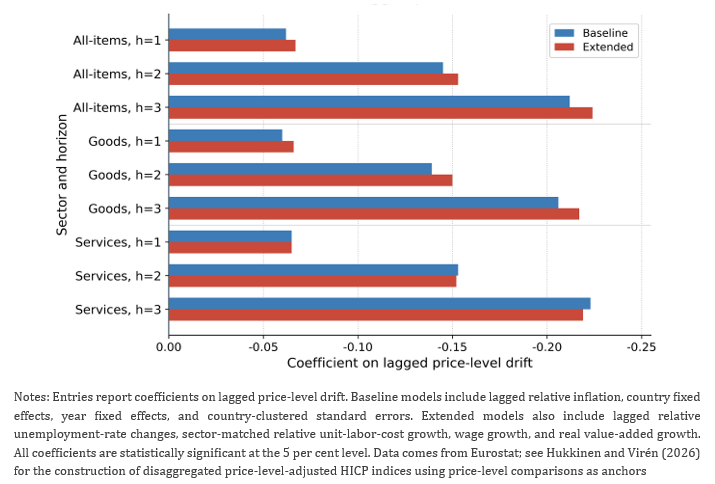
Figure 2. The relationship between inflation and lagged price level drift
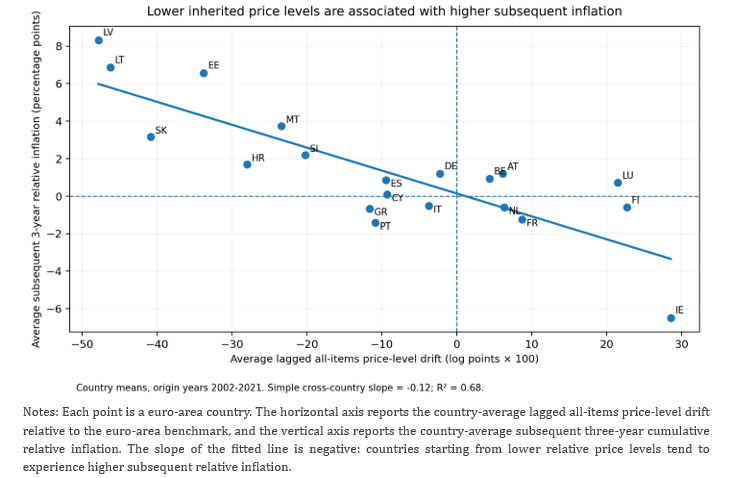
Figure 2 presents the same idea in a deliberately simple way. It averages each country’s lagged all-items price-level drift and subsequent relative inflation and plots the resulting country observations. The figure is not the identification strategy; it is just to show that low inherited relative price levels are associated with higher subsequent relative inflation.
Figure 3. Price-level memory effect for different time horizons
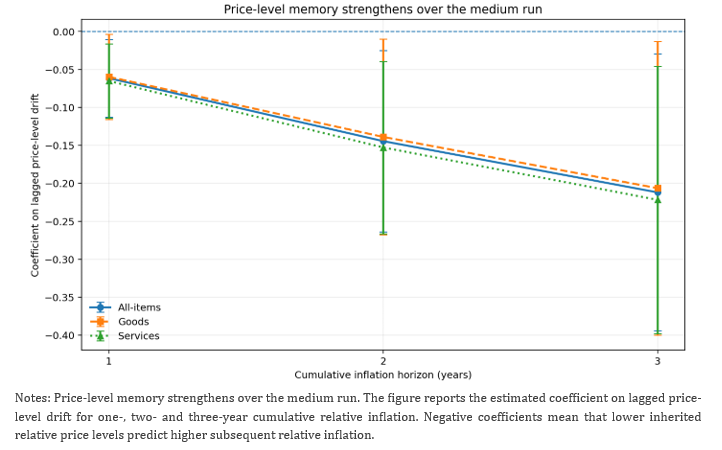
Figure 3 shows that price-level memory strengthens over the medium run. This pattern is visible across all-items, goods, and services, and is especially pronounced for services. The most direct Phillips-curve challenge is that lagged drift may simply proxy for ordinary flow pressures (e.g., faster wage growth, stronger unit-labor-cost growth, falling unemployment, or stronger real activity). To test this, we add lagged relative unemployment-rate changes, sector-matched relative unit-labor-cost growth, wage growth, and real value-added growth. The drift coefficient remains negative and statistically significant across all sectors and horizons (Figure 1, extended model bars) The inherited relative price-level position is therefore not merely a disguised Phillips-curve proxy.
Services are central to the interpretation. Services prices are less tradable, less exposed to direct cross-border arbitrage, and more closely tied to domestic labor markets, rents, regulation, taxes, market structure, and local demand. A country whose services price level remains low (or high) relative to the euro-area benchmark may continue to experience upward (or downward) relative-price pressure even after the immediate shock has faded.
If price-level memory operates through incomplete local relative-price adjustment, services should display a particularly clear signal. That is what the estimates suggest. The services coefficient is negative across horizons, strong in the baseline and robust to the richer flow controls. The practical implication is that services inflation should not be interpreted only through current wages and domestic slack. A country whose services price level remains low (high) relative to the euro-area benchmark may continue to experience upward (downward) relative-price pressure even after the immediate shock has faded.
Figure 4. Country- specific coefficients for different time horizons
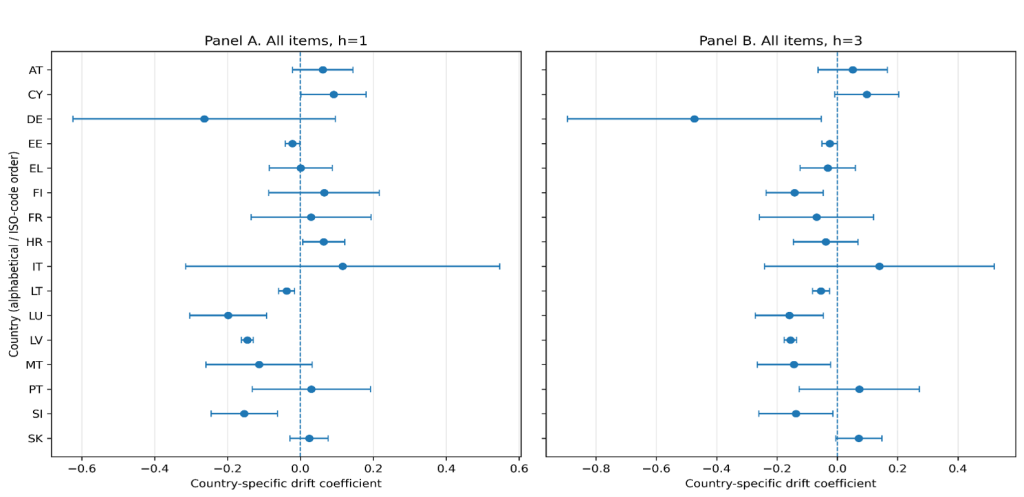
Figure 4 addresses a second concern: is the result driven by one country or by a single convergence episode? Clearly that is not the case. Figure 4also tells us that large differences still exist between countries and that relative-price adjustment is far from mechanically uniform across euro-area countries considered as the Single Market.
The euro-area inflation debate is rightly focused on expectations, wages, slack, unit labor costs, external shocks and the persistence of inflation. But a monetary union also needs to know where countries start from. Inflation is a flow; the relative price level is a state. When shocks, convergence forces and structural differences leave countries at different inherited relative price-level positions, those positions may help predict later inflation differentials. Finally, the relative price issue is not only related to enlargement of EU and to the initial productivity differentials, which may fade away over time. New shocks continuously emerge and the magnitude and frequence shocks may differ a lot from historical experience, cf. e.g. the current AI revolution in different countries. The evidence in this note is consistent with that view. In the full EA20 convergence-and-monetary-union panel, lagged price-level drift predicts subsequent inflation differentials across all-items, goods and services. The effect becomes larger over medium horizons and remains robust to richer flow controls.
The result does not claim that price-level drift is an exogenous structural shock. It does not reject the Phillips curve. It complements it. The missing object is a stock-like state variable: the inherited relative price-level position from which countries enter the next inflation episode. Euro-area inflation diagnostics should therefore track both flows and levels: not only how fast prices are moving now, but also where countries stand in the inherited relative price-level distribution.
Andersson, M., K. Masuch and M. Schiffbauer (2009), “Determinants of inflation and price level differentials across the euro area countries”, ECB Working Paper Series No 1129, European Central Bank.
Ball, L. and S. Mazumder (2020), “A Phillips Curve for the Euro Area”, ECB Working Paper Series No 2354, European Central Bank.
Borio, C., M. J. Lombardi, J. Yetman and E. Zakrajsek (2023), “The two-regime view of inflation”, BIS Papers No 133, Bank for International Settlements.
ECB (2024), “The dynamics of inflation differentials in the euro area”, Economic Bulletin, Issue 5/2024, European Central Bank.
Egert, B. (2007), “Real convergence, price level convergence and inflation in Europe”, Bruegel Working Paper 2007/02.
Eser, F., P. Karadi, P. R. Lane, L. Moretti and C. Osbat (2020), “The Phillips Curve at the ECB”, ECB Working Paper Series No 2400, European Central Bank; The Manchester School, 88(S1), 50-85.
Gali, J., M. Gertler and J. D. Lopez-Salido (2001), “European inflation dynamics”, European Economic Review, 45(7), 1237-1270.
Hukkinen, J. and M. Viren (2026) “How well do EU internal markets work? Evidence of price-level convergence”. https://www.suerf.org/wp-content/uploads/2026/04/SUERF-Policy-Brief-1408_Hukkinen-Viren.pdf
Nautz, D. and J. Scharff (2006), “Inflation and relative price variability in the euro area: evidence from a panel threshold model”, Deutsche Bundesbank Discussion Paper Series 1, No 14/2006.
Rogers, J. H. (2001), “Price level convergence, relative prices, and inflation in Europe”, International Finance Discussion Papers No 699, Board of Governors of the Federal Reserve System.