

This paper is based on “The Liquidity Promise of QE”. The views expressed are those of the authors and do not necessarily reflect those of the European Central Bank or the Eurosystem.
Abstract
We study the transmission of central bank purchases of corporate bonds – corporate QE – by jointly analysing bond yields and investors’ portfolio choices in the euro area. We find that corporate QE operates primarily by enhancing the liquidity of eligible bonds and thereby reducing their liquidity risk, rather than merely absorbing the supply of duration or credit risk. The central bank’s role as a standing buyer increases demand from investors who value liquidity, particularly mutual funds subject to redemption risk. The initial announcement of corporate QE thus significantly reduced spreads, with more than half of the decline driven by an increase in the CDS-bond basis rather than lower default premia. Mutual funds rebalanced toward eligible bonds, rather than selling them to the central bank, and bonds with higher mutual fund ownership experienced larger spread compressions. During the COVID-19 crisis, when liquidity demand surged, eligible bonds exhibited substantially greater price resilience, directly validating the liquidity enhancement mechanism. Importantly, the effects persisted even during quantitative tightening (QT), as investors continued to price in potential central bank intervention, making the effects of QT asymmetric compared to the QE phase. These findings highlight that the central bank’s role as a reliable standing buyer is key element of corporate QE transmission and that investor composition is crucial for the strength of its effect on asset prices.
Since the 2008 Global Financial Crisis, central banks have deployed large-scale asset purchase programs to stabilize financial markets and counter disinflationary pressures. More recently, central banks have begun unwinding their balance sheets, a process commonly referred to as Quantitative Tightening (QT). This Policy Brief summarizes findings from our paper “The Liquidity Promise of QE”, in which we study the ECB’s corporate bond purchase program, tracing its effects from the initial announcement through the Covid-19 crisis and into the current QT phase.
Our central finding is that corporate QE works primarily through a liquidity demand channel: by acting as a standing buyer, the central bank improves bond market liquidity and reduces liquidity risk (Pastor et al, 2003, Acharya et al, 2017). This raises demand from liquidity-sensitive investors and compresses credit spreads. Mutual funds are the key amplifier of this mechanism. Unlike banks and foreign investors, who sold eligible bonds to the ECB, mutual funds on net actually rebalanced toward eligible bonds — increasing their portfolio weight in those assets. Because mutual funds face redemption risk, the ECB’s liquidity backstop is especially valuable to them: knowing the central bank in principle stands ready to buy eligible bonds makes these safer to hold. This mechanism is especially powerful during periods of market stress, when the central bank’s liquidity promise is most valued. A further implication is that QT generates an asymmetric reversal – the spread compression achieved under QE does not unwind as the central bank withdraws, because the implicit expectation of future intervention persists.
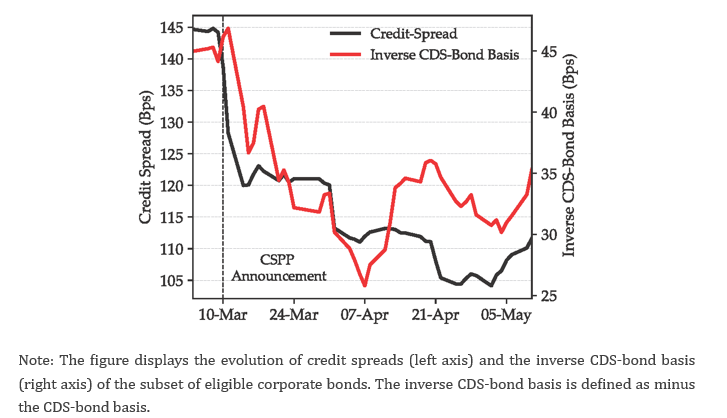
The ECB announced its Corporate Sector Purchase Program (CSPP) on 10 March 2016. This decision came as a surprise to financial markets and was followed by marked declines in corporate bond spreads (De Santis et al., 2018). Crucially, a large part of the decline stemmed from an increase in the CDS-bond basis (Figure 1), indicating that QE primarily compressed the liquidity premium rather than the default risk premium. The CDS-bond basis measures the non-default component of corporate bond yields and in a companion paper (Corell et al., 2026) we provide evidence on the key services that drive its variation over time.
In the paper, we quantify the precise causal effects of the announcement in a difference-in-differences analysis, comparing the change in spreads around the announcement for eligible versus ineligible bonds. The estimates put the spread reduction at around 20 basis points, with more than half of this decline explained by the increase in the CDS-bond basis rather than a reduction in CDS spreads.
Figure 1. Credit Spread and CDS-Bond Basis around the CSPP Announcements
To better understand the underlying drivers, we next looked at how different types of investors rebalanced their portfolios following the introduction of corporate QE. Our key finding here is that mutual funds substantially increased their portfolio weights in eligible bonds – by around 10% relative to pre-announcement levels. This behavior is striking because mutual funds are typically viewed as highly elastic investors who would sell securities in response to price increases – a pattern that was indeed observed for sovereign QE programs, when mutual funds acted as net sellers to the central bank (Koijen et al., 2021; Breckenfelder and De Falco, 2024). These findings show that the transmission of QE is asset-specific, as the liquidity properties of the securities purchased govern how intermediaries rebalance and, in turn, how prices adjust.
Further underpinning this point, we show in granular fund-level data that entities with more volatile capital flows – those facing greater redemption risk – rebalanced most strongly toward eligible bonds. This provides further evidence that funds valued the improved ability to liquidate positions during periods of market stress. By contrast, insurance companies and pension funds, which have more stable funding, decreased their holdings of eligible bonds.
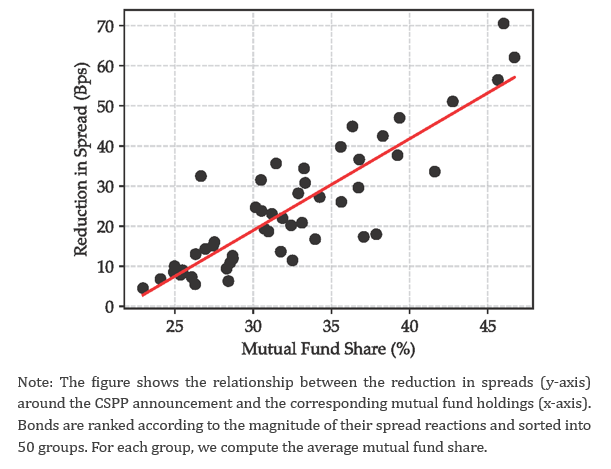
The heterogeneous response across investor types has important implications for QE transmission. Bonds with higher mutual fund ownership experienced larger declines in spreads following the CSPP announcement (Figure 2). Also controlling for a range of bond characteristics, we estimate that a 10 percentage point higher mutual fund ownership share corresponds to an approximately 3 basis point larger reduction in spreads. This represents roughly a quarter of the average announcement effect, demonstrating that the composition of the investor base significantly shaped policy effectiveness.
Figure 2. Mutual Funds Holdings and Spread Response
The COVID-19 crisis provides further compelling evidence for the liquidity enhancement mechanism. When markets became stressed in early 2020, eligible bonds exhibited substantially greater price resilience than ineligible bonds. Before the ECB announced the PEPP on March 18, 2020, spreads of ineligible bonds had increased by 191 basis points compared to 128 basis points for eligible bonds. Given a median duration of approximately five years, ineligible bonds experienced additional losses of roughly 3% relative to eligible bonds.
This differential performance occurred almost entirely through the CDS-bond basis. The basis of ineligible bonds decreased by 140 basis points compared to 81 basis points for eligible bonds. Investors apparently anticipated that eligible bonds would be less vulnerable to fire-sale dynamics given a higher likelihood for ECB intervention. This expectation proved correct when the ECB announced the Pandemic Emergency Purchase Program (PEPP) shortly thereafter, also providing for the purchase of corporate bonds in stressed conditions.
The crisis also revealed that once the ECB had adopted CSPP, subsequent announcements had more muted effects. In our interpretation, this pattern reflects that the initial CSPP announcement fundamentally reshaped investors’ perceptions of liquidity, and by the time PEPP was announced, markets had already priced in the possibility of further intervention. This state-contingent nature of QE – where markets factor in potential future support during liquidity stress periods – emerges as an important mechanism.
Starting in end-2021, the ECB gradually shifted its communication, suggesting its asset purchases would be gradually phased out. Following up on this communication, it no longer grew its asset portfolio from mid-2022 onwards, instead just reinvesting maturing amounts, and since the beginning of 2023 it has let its portfolio run down. This puts us in a position to study not only the buildup phase in the lifecycle of the program, but also the wind-down phase. In other words, we can study not only the impact of corporate QE but also of corporate QT.
This analysis reveals an important asymmetry. As the ECB reduced its corporate bond holdings starting in 2022, one might expect the effects of QE to reverse symmetrically, but this did not occur. Despite the ECB announcing its intention to discontinue purchases, the spread differential between eligible and ineligible bonds did not revert toward pre-QE levels.
In particular, during the tightening period, spreads widened across all corporate bonds. However, eligible bonds experienced smaller increases than ineligible bonds. At the peak in October 2022, ineligible bond spreads had risen by 146 basis points compared to 102 basis points for eligible bonds. The CDS-bond basis also declined less for eligible bonds, indicating that investors continued to value the liquidity properties of eligible bonds even as the ECB reduced its balance sheet.
Portfolio rebalancing data again confirms this interpretation. Mutual funds did not sell eligible bonds proportionally during QT. Over the two years following the start of tightening, mutual funds actually accumulated an additional €46 billion of eligible bonds while divesting from ineligible securities.
These findings contrast with evidence from sovereign bond QT in the United States, where on average larger effects have been estimated than for QE (D’Amico and Seida, 2024). The difference likely reflects the fact that corporate bonds are less liquid than sovereign bonds, making the liquidity backstop particularly valuable and persistent. Once the ECB designated bonds as eligible, this label fundamentally altered market perceptions in a way that survived balance sheet unwinding, given the lower hurdle for the ECB to step in when stress arises.
Our research shows that the ECB’s corporate bond purchase programs affected asset prices not only by reducing supply but also by fundamentally altering how investors perceive and value the liquidity of eligible securities. When the ECB commits to purchasing corporate bonds – both in normal times and especially during market stress – it improves investors’ prospective ability to liquidate positions when needed. As a consequence, investors who value liquidity more highly, particularly those prone to elevated redemption risk, increase their holdings of eligible bonds. This shift in demand raises bond prices even when the effect on default risk is limited.
Our findings highlight key policy implications for unconventional monetary policy. First, policy announcements and communication are central to transmission: by shaping expectations of future liquidity support, they influence prices even before purchases materially reduce supply. Second, the strength of the transmission depends on the composition of the investor base, as investors with greater sensitivity to liquidity risk – such as mutual funds facing redemption pressure – respond more strongly to eligibility. As such investors gain market share, liquidity-based transmission may become more powerful. Finally, quantitative tightening may not symmetrically unwind the effects of quantitative easing. As long as central banks preserve the option to intervene during future periods of stress, the expectation of renewed support can sustain altered pricing dynamics and portfolio allocations even after central bank holdings decline.
Acharya, V. V. and Pedersen, L. H., “Asset Pricing with Liquidity Risk,” Journal of Financial Economics, 2005, 77(2), 375–410.
Breckenfelder, J. and De Falco, V., “Investor heterogeneity and large-scale asset purchases” Working Paper Series 2938, European Central Bank May 2024
Corell, F., Holm-Hadulla, F., Leombroni, M., Mota, L. and Papoutsi, M., “Drivers of Convenience Yields”. Available at SSRN: https://papers.ssrn.com/sol3/papers.cfm?abstract_id=4656963
Corell, F., Holm-Hadulla, F., Leombroni, M., Mota, L. and Papoutsi, M., “The Liquidity Promise of QE” (December 19, 2025). Available at SSRN: https://papers.ssrn.com/sol3/papers.cfm?abstract_id=5943814
D’Amico, S. and Seida, T. (2024), “Unexpected supply effects of quantitative easing and tightening,” The Economic Journal, 134(658), 579-613.
De Santis, R., Geis, A., Juskaite, A. and Vaz Cruz, L. (2018), “The impact of the corporate sector purchase programme on corporate bond markets and the financing of euro area non-financial corporations”, European Central Bank, Economic Bulletin, Issue 3, pp.66-84.
Koijen, R. S. J. and Yogo, M., “A Demand System Approach to Asset Pricing,” Journal of Political Economy, 2019, 127 (4), 1475–1515.
Pástor, Ľ. and Stambaugh, R. F., “Liquidity Risk and Expected Stock Returns,” Journal of Political Economy, 2003, 111(3), 642–685.