

This policy brief is based on “When fiscal discipline meets macroeconomic stability: The Euro-stability bond”. The views expressed are those of the authors and not necessarily those of the institutions the authors are affiliated with.
Abstract
The euro area has faced a fundamental dilemma since its inception: how to reconcile fiscal discipline with macroeconomic stabilization. Market discipline, through sovereign spreads, is meant to discourage excessive borrowing. Yet, as the euro crisis revealed, these spreads can amplify shocks rather than contain them. The COVID-19 crisis marked a turning point. For the first time, the EU issued common debt to finance the Recovery and Resilience Facility (European Council, 2020). However, this step was explicitly temporary. As the debate on reforming the European fiscal framework continues, also to tackle new historical challenges (e.g., common defense, energy transition, economic security), a key question remains: can the euro area design a permanent common debt instrument that preserves fiscal discipline while reducing macroeconomic risk?
This column proposes a Euro-stability bond to address this trade-off (Greco, Pintus, and Raggi, 2025). The proposal combines two key elements. First, debt is issued jointly at a single euro area interest rate, eliminating rollover risk differentials and reducing the scope for self-fulfilling crises. Second, a country-specific fiscal discipline premium is applied, calibrated on observable fiscal fundamentals such as public debt and primary balances. The Euro-stability bond allows member states to benefit from common issuance while preserving incentives for prudent fiscal behavior. Crucially, it replicates the disciplining role of markets without their destabilizing features.
Sovereign spreads in the euro area play an important signaling role. In principle, they reflect differences in fiscal fundamentals and help discipline governments (Mody et al., 2012). In practice, however, they have often been misaligned with fundamentals.
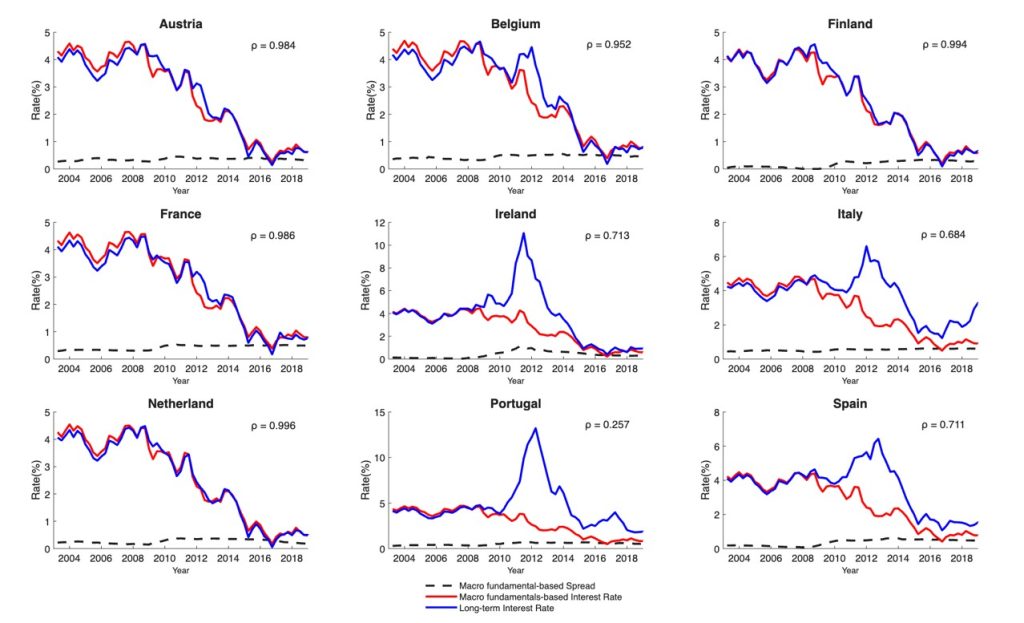
Before 2008, spreads were persistently compressed, underpricing risk. During the euro area crisis, they overshot dramatically, reflecting panic, liquidity shortages, and contagion effects (De Grauwe and Ji, 2012; Cole et al., 2025). Distress in one country spilled over to others, independently of their fiscal positions (De Santis, 2012), turning spreads into a source of systemic instability.
Figure 1 shows that market rates of sovereign bonds often deviated from levels justified by fundamentals, first in the direction of complacency (1999-2007) and later in the direction of excessive pessimism (2008-2019). The Euro-stability bond replaces these volatile market signals with a rules-based premium linked to observable fiscal indicators. By construction, this premium is:
At the same time, it removes the amplification mechanisms associated with contagion and market panic. In doing so, it preserves discipline while eliminating a key source of macroeconomic instability.
Figure 1. Market interest rates diverge from fundamentals in the euro area
To assess the macroeconomic effects of the Euro-stability bond, we use a Global VAR (GVAR) model covering ten euro area countries together with the US, Japan, and China (Pesaran et al., 2004; Di Mauro and Pesaran, 2013). This framework captures both domestic dynamics and cross-country spillovers, making it well suited to analyse a reform that operates through financial integration. We compare baseline projections with a counterfactual scenario in which sovereign borrowing is replaced by Euro-stability bond issuance.
Three main results emerge. First, public debt trajectories remain essentially unchanged under the fiscal discipline premium (relative to market discipline), implying that the new instrument does not weaken incentives for fiscal prudence. Second, macroeconomic uncertainty declines. As shown in Figure 2, debt forecasts become markedly tighter, indicating more stable fiscal dynamics. This reflects the elimination of abrupt spread movements driven by market sentiment rather than fundamentals. Third, the probability of recessions decreases in the medium term (Figure 3). By removing contagion effects and reducing financial fragmentation, the Euro-stability bond dampens the transmission of shocks across countries. This leads to a more resilient macroeconomic environment.
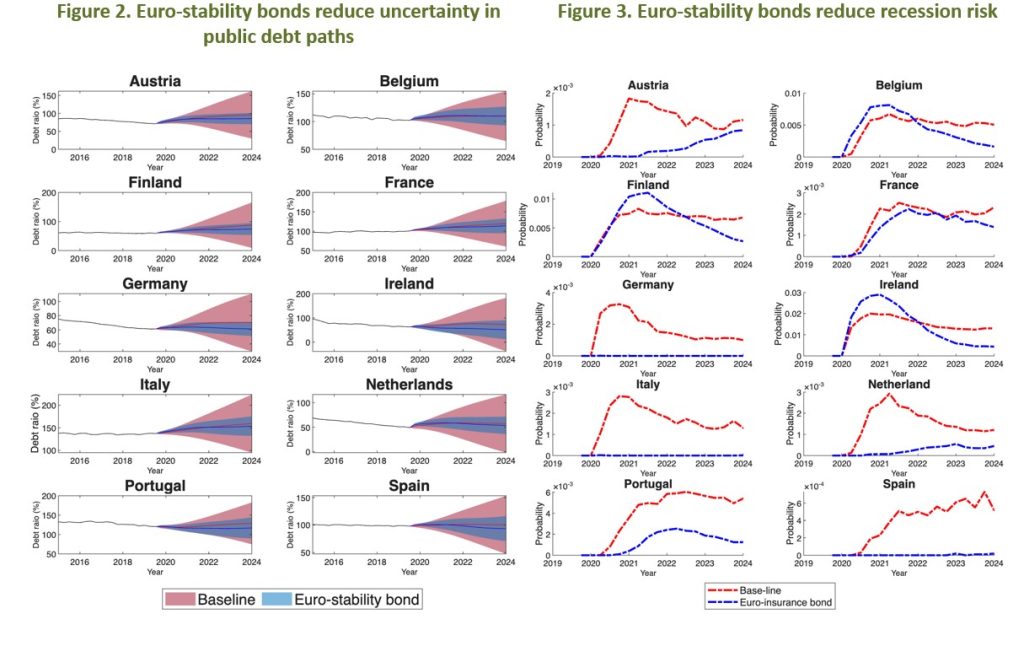
Importantly, interest expenditure follows a path similar to the baseline, implying no systematic cross-country redistribution. This is a key feature for political feasibility: the mechanism stabilizes the system without creating permanent transfers between member states.
These findings have direct implications for the ongoing debate on EU fiscal rules (Beetsma and Larch, 2018; Blanchard et al., 2021, Darvas et al., 2025). The current framework relies heavily on numerical targets and complex procedures, which have often proved difficult to enforce and adapt to changing economic conditions (European Commission 2024).
The Euro-stability bond offers a complementary and simpler approach. Rather than relying exclusively on ex ante rules, it embeds fiscal discipline in a price-based mechanism that is:
In this sense, it could act as a coordination device across member states, aligning incentives while allowing for greater flexibility in fiscal policy. Moreover, the revenues generated by the fiscal discipline premium could be used as EU own resources, strengthening the financial autonomy of the Union and reinforcing the link between national policies and collective outcomes.
From a political perspective, the design addresses one of the main objections to common debt: the risk of moral hazard. By ensuring that borrowing costs remain sensitive to national fiscal conditions, it avoids the perception of unconditional mutualization while still delivering the benefits of risk sharing.
A well-designed EU common debt instrument can reconcile fiscal discipline and macroeconomic stability.
The Euro-stability bond we propose provides a concrete way to achieve this balance. By combining joint issuance with a rules-based fiscal premium, it preserves incentives for sound policies while eliminating destabilizing market dynamics such as contagion and self-fulfilling crises.
As the EU moves from crisis response to institutional reform, the challenge is no longer whether common borrowing is possible, but how it should be effectively. The proposal outlined here suggests that it is possible to build a system that combines solidarity with responsibility, enhancing both the credibility and the resilience of the monetary union.
Beetsma, R. and Larch, M. (2018). ‘Rethinking EU fiscal rules.’ VoxEU.org.
Blanchard, O., Leandro, A. and Zettelmeyer, J. (2021). ‘Redesigning EU fiscal rules: From rules to standards.’ Peterson Institute.
Cole, H.L., Neuhann, D., and Ordoñez, G. (2025). ‘Information Spillovers and Sovereign Debt: Theory Meets the Eurozone Crisis’, The Review of Economic Studies.
Darvas, Z., Lennard W., and Zettelmeyer. J. (2025). ‘Sovereign Debt and Fiscal Integration in the European Union.’ Journal of Economic Perspectives.
De Grauwe, P. and Ji, Y. (2012). ‘Mispricing of sovereign risk and multiple equilibria in the eurozone.’ CEPS Working Document.
De Santis, R. (2012). ‘The euro area sovereign debt crisis: safe haven, credit rating agencies and the spread of the fever from Greece, Ireland and Portugal.’ ECB Working Paper.
European Commission (2024). European Commission (2024), ‘New economic governance framework’.
European Council (2020). ‘EU response to COVID-19: Recovery and Resilience Facility.’
Greco, L., Pintus, F.J., and Raggi, D. (2025). ‘When fiscal discipline meets macroeconomic stability: The Euro-stability bond.’ Journal of International Financial Markets, Institutions & Money.
Mody, A., et al. (2012). ‘Eurobonds: Concepts and implications.’ Bruegel.
Pesaran, M.H. et al. (2004). ‘Global VAR modelling.’ Journal of Economic Dynamics and Control.
Di Mauro, F. and Pesaran, M.H. (2013). ‘The GVAR Handbook: Structure and Applications of a Macro Model of the Global Economy.’